
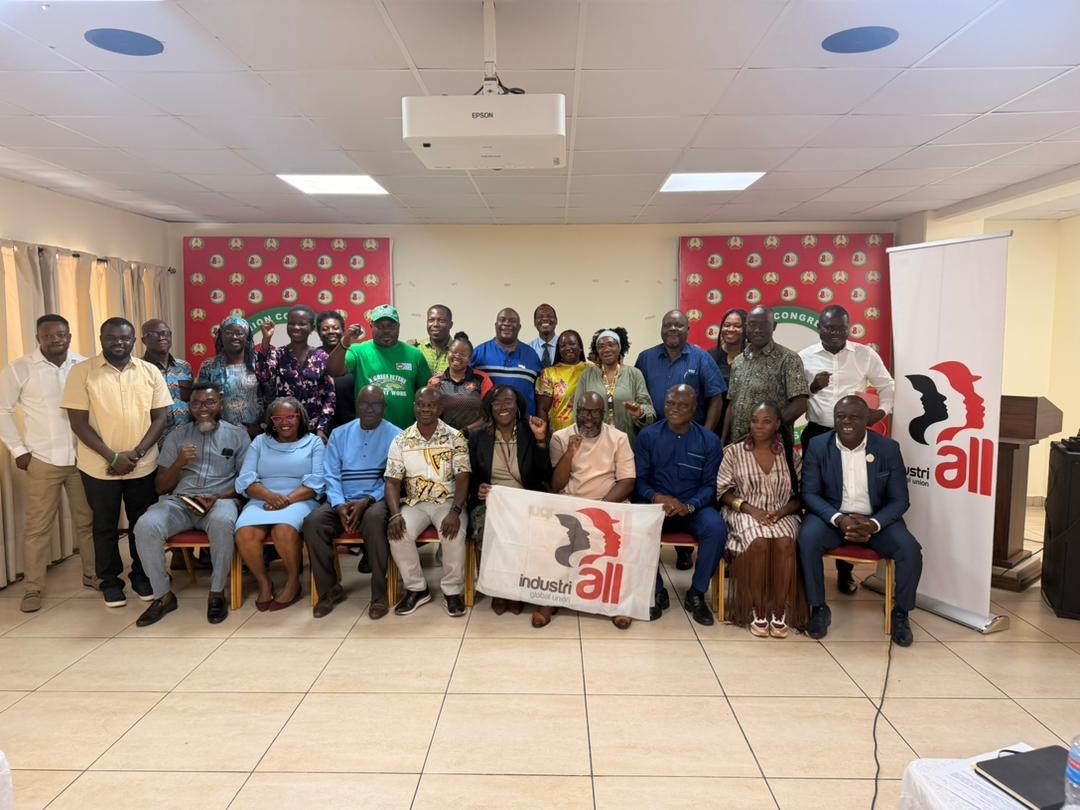



7 May, 2026At a meeting in Accra on 4 and 5 May, the African group of negotiators (AGN), the bloc that coordinates climate negotiating positions on behalf of 54 African countries under the United Nations Framework Convention on Climate Change (UNFCCC), agreed on a workplan to establish a labour liaison mechanism ahead of the 31st conference of the parties (COP 31).
The initiative was developed with IndustriALL Sub-Saharan Africa (SSA) regional office and the Sub-Saharan Africa energy network. It also involved IndustriALL affiliates in Ghana, ITUC-Africa, the Nigeria Labour Congress and the Ghana Trade Union Congress. The aim is to embed workers’ safeguards more firmly into Africa’s climate policies.
The workplan for the subsidiary body (SB64) sessions and COP 31 includes several steps. These include establishing an AGN-trade union Just Transition Work Programme (JTWP) liaison group with formal terms of reference. Moreover, they involve compiling sector-specific evidence briefs on employment, reskilling, critical minerals and informal workers. They also involve delivering joint pre-sessional briefings. Further, submitting joint evidence to the secretariat’s mapping process on sovereignty-designed pathways is scheduled. Developing a unified African labour position paper on the JTWP, border adjustment mechanisms and equitable value chains is also planned. Additional activities include convening a COP 31 side event on African workers and the just transition. Another step is reviewing and institutionalizing the AGN labour liaison mechanism.
The meeting heard that finance lies at the heart of the grievances. SSA receives less than 3 per cent of global climate finance annually. Much of it comes in the form of loans rather than grants. Trade unions rejected the use of loans as climate contributions. They argued that they risk deepening the continent’s debt crisis. Interest rates in the region are roughly seven times higher than those in Organization for economic co-operation and development (OECD) countries. To close this gap requires serious reform of multilateral development banks. This was argued by unions.
Drawing on the African mining vision, participants demanded that critical minerals such as lithium and cobalt be processed locally. This would generate decent, job-rich growth instead of raw exports.
Trade as a tool of exclusion
Unions raised concerns over the European Union’s Carbon Border Adjustment Mechanism, arguing that it risks shifting the costs of the energy transition onto African producers and workers. They also rejected product bans and green subsidies that function as trade barriers. Instead, they insisted on national rights to build regional value chains under the African Continental Free Trade Area.
Protecting workers and gender justice
Influenced by South Africa’s Just Energy Transition experience, unions called for negotiated transitions featuring five-year notice periods for fossil-fuel phase-outs and wage parity for affected workers. A recurring theme was the need to protect the continent’s large informal workforce. They pushed for International Labour Organization(ILO) standards to be explicitly linked to climate finance. In particular, unions want attention to opportunities and rights for women and youth in the green economy. Unions also called for the full funding of the Gender Action Plan to address the disproportionate impact of climate disasters on women.
The meeting, convened with support from IndustriALL, Danish trade union 3F and Friedrich Ebert Stiftung Senegal, brought together 20 participants from Ghana, Nigeria, Senegal, South Africa, Zambia and Zimbabwe. Civil-society delegates from Gambia and Senegal also attended.
“AGN commits to the systematic integration of labour, deepening of open conversations, engaging key stakeholders and providing a platform and guidance during negotiations,”
said Antwi-Boasiako Amoah, AGN chairperson.
Paule-France Ndessomin, SSA IndustriALL regional secretary emphasized:
“The conversation on climate change is shifting to the protection of workers and community interests. For African trade unions, the just energy transition is a fight against new green extractivism.”