
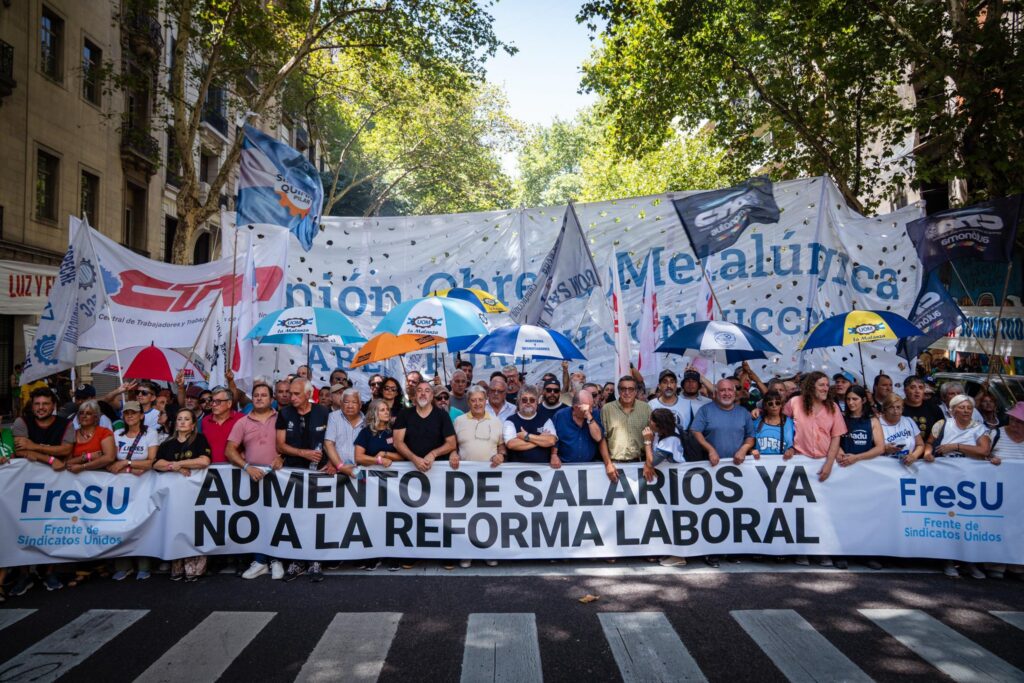
23 February, 2026IndustriALL Global Union affiliates in Argentina staged a national strike that brought the country to a standstill on 19 February, demonstrating workers' rejection of the labour reforms proposed by Javier Milei's government.
The aim was to reject the ‘labour modernization’ bill promoted by Argentine President Milei on the same day it was debated in the Chamber of Deputies. Workers claim that it could increase job insecurity by eliminating individual and collective rights enshrined in the National Constitution.
In the early hours of Friday morning, Argentina’s Chamber of Deputies approved the labour reform by 135 votes in favour and 115 against. However, as amendments were made, it must still return to the Senate to be ratified and become law. The most significant amendment was the removal of Article 44, which reduced sick leave pay from 100 per cent to 75 per cent or 50 per cent.
In its official call for a national strike, the General Confederation of Labour of the Argentine Republic (CGT) indicated that some 120,000 private sector jobs and 80,000 public sector jobs were lost, and the number of employees in private households fell by 25,000 during Milei’s two years in office. It also claimed that the crisis had worsened, the industrial fabric had been destroyed, unemployment had risen, consumption had fallen, and household and government debt had increased.
CGT pointed out that the serious problems of poverty, unemployment, precariousness and deterioration of the social situation are not the result of the laws governing the labour market, but are direct consequences of the lack of growth and productive investment in national economic policies. The CGT stressed that unionized workers are open to genuine labour modernization that respects acquired rights and works together towards a project for a country with better prospects for personal, family and community development, on a balanced path of progress and social growth.
The CTA Autónoma (CTA-A) and CTA de los Trabajadores (CTA-T) trade union confederations also joined the strike against the labour reform, saying it is regressive for the working class. The CTA-A stated that the labour reform bill is a direct attack on the rights of the entire population and a blow to democracy. It emphasised that it eliminates historic achievements such as paid holidays, weekly rest, severance pay, the eight hour working day and minimum protection guarantees. It warned that the consequences would be greater precariousness, growth in informality, increased unemployment and greater social exclusion.
The CTA-T described the reform as an attack by the government on workers, coming at an alarming time, as Argentina has one of the lowest average wages in Latin America, with a loss of around 30 per cent in purchasing power, amid announcements of thousands of new redundancies. It explained that the labour reform and austerity measures are not isolated measures, but part of a regressive project that seeks to offload the crisis onto those who live from their work.
IndustriALL strongly supports the unions in Argentina in their opposition to the labour reform. The proposed labour reform raises serious concerns from a union perspective as it proposes measures that could weaken collective bargaining, restrict trade union activity and affect fundamental rights recognized by ILO international labour standards, in particular freedom of association and the right to organize and bargain collectively.
IndustriALL general secretary Atle Høie said:
“I congratulate our Argentine affiliates for standing up to these attacks on workers’ rights. The revision of labour legislation is a clear signal from President Milei that he does not care about workers. The national strike has demonstrated strong opposition that Parliament should take into account.”