

Read this article in:
English
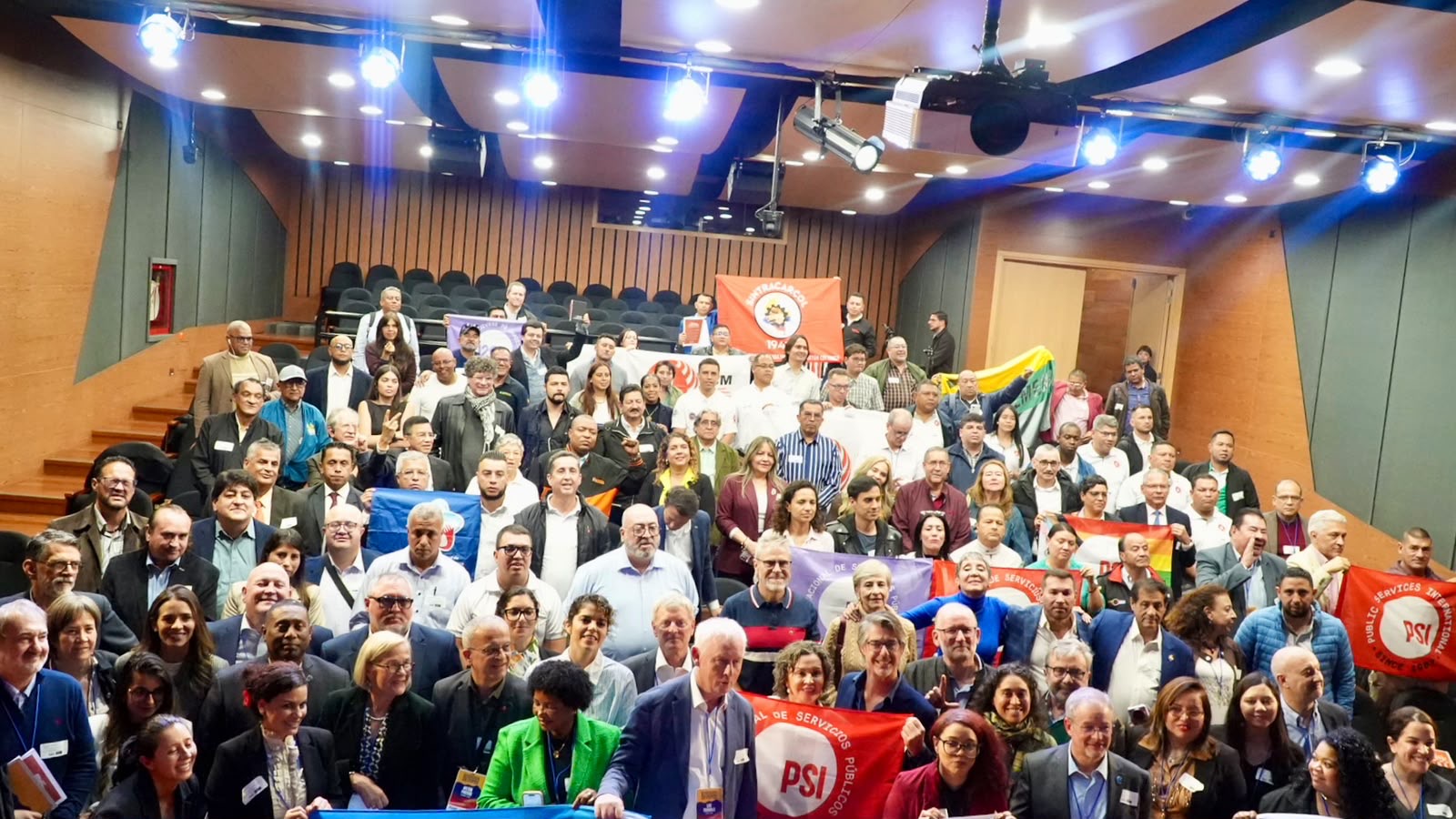
2 November, 2026The Council of Global Unions (CGU), representing more than 210 million workers worldwide has undertaken an international solidarity mission to Colombia(28-30 October 2026).
We came to Colombia because trade unions around the world are alarmed by reports of increasing threats against trade unionists and social movement leaders, attacks on democratic freedoms, efforts to weaken labour protections and the growing stigmatization of social protest and unions. Colombia has made important progress in recent years, but the organizations we met warned that these gains are under serious threat.
Today, we are deeply concerned by signals that Colombia could move backwards and dismantle hard won rights and protections.
During the mission, the Council of Global Unions met with:
- Colombia’s three national trade union confederations: CUT – Central Union of Workers of Colombia (Central Unitaria de Trabajadores de Colombia) CTC – Confederation of Workers of Colombia (Confederación de Trabajadores de Colombia) and CGT – General Confederation of Labour (Confederación General del Trabajo)
- Sectoral trade unions and workers’ organisations
- Representatives of the International Labour Organization (ILO-ACTRAV)
- Members of the Colombian Congress, including former presidential candidate and Senator Iván Cepeda.
- The Minister of Labour, Natalia López Fuentes.
- The Special Jurisdiction for Peace (JEP)
- Leading human rights organizations, including: The José Alvear Restrepo Lawyers’ Collective (CAJAR), the Permanent Committee for the Defence of Human Rights (CSPP), the Office of the Ombudsperson (Defensoría del Pueblo).
- Former ministers of key cabinets.
- Affiliates of the Global Union Federations in Colombia.
Across virtually every meeting, the delegation heard concerns about rising insecurity, threats against trade unionists and social leaders, attempts to roll back labour rights and government rhetoric that seeks to discredit unions, social movements and workers providing public services. We also heard deep concern about the weakening of democratic safeguards and growing risks to civic participation. These concerns were remarkably consistent across trade unions, human rights organisations, public institutions and civil society representatives.
Colombia’s trade union movement has paid an extraordinary price for their union work and as leaders in the struggle for labour rights, social justice, democracy and peace. Thousands of trade unionists have been murdered, disappeared, threatened, displaced, or persecuted because they organized workers exercising their fundamental rights, defended public services and the environment, demanded better working conditions and challenged inequality. Their struggle is part of the history of the global labour movement.
Trade unionists and social leaders are facing increased threats and violence. The new government of Abelardo de la Espriella is loudly pushing an agenda that seeks to silence social protest and stigmatize civil society leaders. Workers are being asked to accept the erosion of hard-won labour protections. At a moment when democracy around the world is under pressure from authoritarianism, inequality, corporate power and violence, Colombia cannot afford to return to policies and practices that undermine rights, social dialogue, a historic peace process and democratic participation.
The CGU delegation raised these concerns directly with minister of labour Natalia López Fuentes. While government representatives argued that labour rights and democratic protections are not being reversed, the delegation made clear that such assurances must be matched by concrete action. Rights are measured not by government declarations but by the lived reality of workers and trade unionists. We will continue to judge progress on the basis of results
The general secretaries of the Global Union Federations also stressed that Colombia must honour its commitments under ILO Conventions 87 and 98 and ensure that social dialogue remains the foundation of labour policy and practice. The delegation clearly expressed to the minister that they would be closely monitoring the government’s actions and would be vigilant to ensure Colombia keeps its international commitments in terms of human and labour rights.
The labour minister stated her respect for fundamental trade union rights, particularly the right to organize and the right to collective bargaining. The minister welcomed meaningful social dialogue and stressed that her door would always be open. While these are good assurances, we will remain vigilant and focused on the real outcomes.
Colombia’s history stands as a stark warning. The world remembers the decades during which trade unionists were threatened, persecuted, disappeared and killed for defending workers’ rights. No one should underestimate the damage that can be done when democratic institutions are weakened and anti-union narratives are pushed at the highest levels of government. Colombia must not return to those dark chapters of its past.
“Workers in Colombia are not alone. The global labour movement will closely follow developments in the months ahead. We will continue to speak out whenever trade union rights, democratic freedoms or human rights are threatened.”
The CGU calls for the following:
1. Full protection for trade unionists and civil society leaders
The Colombian authorities must take urgent and effective measures to prevent crimes, violence, threats, intimidation and harassment against trade union leaders, social leaders, human rights defenders and labour activists.
Impunity for crimes against trade unionists must end.
2. Strengthening freedom of association, collective bargaining and the right to strike
The CGU urges the government, employers and public authorities to take concrete steps to ensure full compliance with ILO Conventions 87 and 98 and also:
- Respect for freedom of association in law and practice.
- Expansion of collective bargaining coverage.
- Protection against anti-union discrimination.
- Meaningful social dialogue at national, sectoral and workplace levels.
- Upholding the right to strike as a fundamental element of labour policy and practice.
- Strengthening workplace inspections and other enforcement mechanisms to ensure compliance with collective bargaining agreements and national labour law.
- Addressing the key issues contained in the rescinded decrees, including protection contracts, precarious and platform-based work and outsourcing, all of which create significant barriers to union growth and decent work.
The CGU urges the Colombian government to adopt the conclusions of the ILO Committee on the Application of Standards from its June 2026 review: adequately funded protection for trade unionists at risk; punishment of both those who commit crimes and those who order them.
3. Protect the rights to peaceful protest, assembly and democratic participation
The CGU reaffirms that the rights to peaceful assembly, freedom of expression, freedom of association and democratic participation are fundamental human rights and essential pillars of any democratic society.
Workers, trade unionists, students, Indigenous Peoples, Afro-Colombian communities, women and social movements must be able to organize, mobilize and speak out without fear of violence, criminalisation, harassment, surveillance, arbitrary detention, or intimidation.
The CGU calls on the Colombian Government to:
- Guarantee the right to peaceful protest and social mobilization.
- Ensure that public security responses are consistent with human rights standards.
- Prevent the stigmatization and criminalization of trade unionists, social leaders and activists.
- Protect journalists and media workers, human rights defenders and observers covering demonstrations.
- Promote dialogue and democratic engagement as the primary means of addressing social conflict.
4. Support for truth, justice, reparation, and guarantees of non-repetition
The CGU reaffirms its support for the comprehensive implementation of the 2016 Peace Agreement, recognizing that sustainable peace requires social justice, fair work, rural development, strong public institutions and meaningful participation by workers and their organizations.
The delegation recognizes the important work carried out by the Special Jurisdiction for Peace (JEP) in establishing truth and accountability for crimes committed during decades of conflict. The historical memory of the armed conflict, social struggles and peace processes is fundamental to avoid history repeating itself and to preserve the rights of victims.
We call on the government and all stakeholders to cooperate fully with transitional justice mechanisms and to ensure that victims, including trade unionists, obtain truth, justice, reparations and guarantees that such violations never happen again. We also support the progress made around land reform during the peace process.
We want to be very clear that the impunity for crimes against trade unionists, human rights activists and civil society leaders must end.
5. Ensuring a just transition for workers and communities
As Colombia advances economic transformation and climate policies, workers and their unions must be fully involved in decision-making processes. The ecological areas known as páramos fulfil fundamental functions in water regulation and conservation of biodiversity. Their protection is inseparable from the guarantee of access to sustainable, high-quality public water and sanitation services.
Climate action and industrial transformation must create good jobs, strengthen communities and leave no worker behind. The defence of strategic ecosystems, páramos, water sources and the commons and public participation in environmental decision-making must be maintained and strengthened.
6. Investment in public services and infrastructure
We are concerned to hear of plans to dismantle critical state institutions, through closing, merging or privatising public entities and firing public servants. We do not accept that these functions are wasteful or inefficient. Such cuts will decrease public services to the people, undermine the capacity of democratic institutions to hold the government accountable and result in more expensive services as private entities are less efficient in providing essential services. The privatization of the national assets of the country is detrimental to the entire nation. Yet, the recently released budget of the nation includes spending cuts and reductions affecting public entities and agencies.
We call for the strengthening of public services, including public education, healthcare, social protection and comprehensive care systems, as foundations of equality, gender justice, social cohesion and a strong democracy. We demand the recognition of care as a fundamental right and a collective responsibility, alongside the recognition, reduction and redistribution of unpaid care work and decent working conditions for paid care workers. We denounce any attempts to privatise public services, undermine workers’ rights, cut essential public service jobs, or make them more precarious through austerity policies.
7. An unwavering commitment to solidarity, democracy and social justice
The Council of Global Unions reaffirms its unwavering solidarity with Colombia’s workers and their organisations. We will continue to monitor developments closely, engage with Colombian affiliates, raise concerns through international institutions and mobilize the strength of the global labour movement to respond whenever rights are threatened.
There can be no lasting peace where unionists are persecuted, democracy cannot survive without trade union rights and where peaceful social protest is criminalized and social justice cannot become a reality where dignified work and fair wages are not defended.
There can be no social progress while workers and social leaders face threats and intimidation. Colombia’s workers have fought too hard and sacrificed too much to see these gains reversed.