Read this article in:
English
- Español
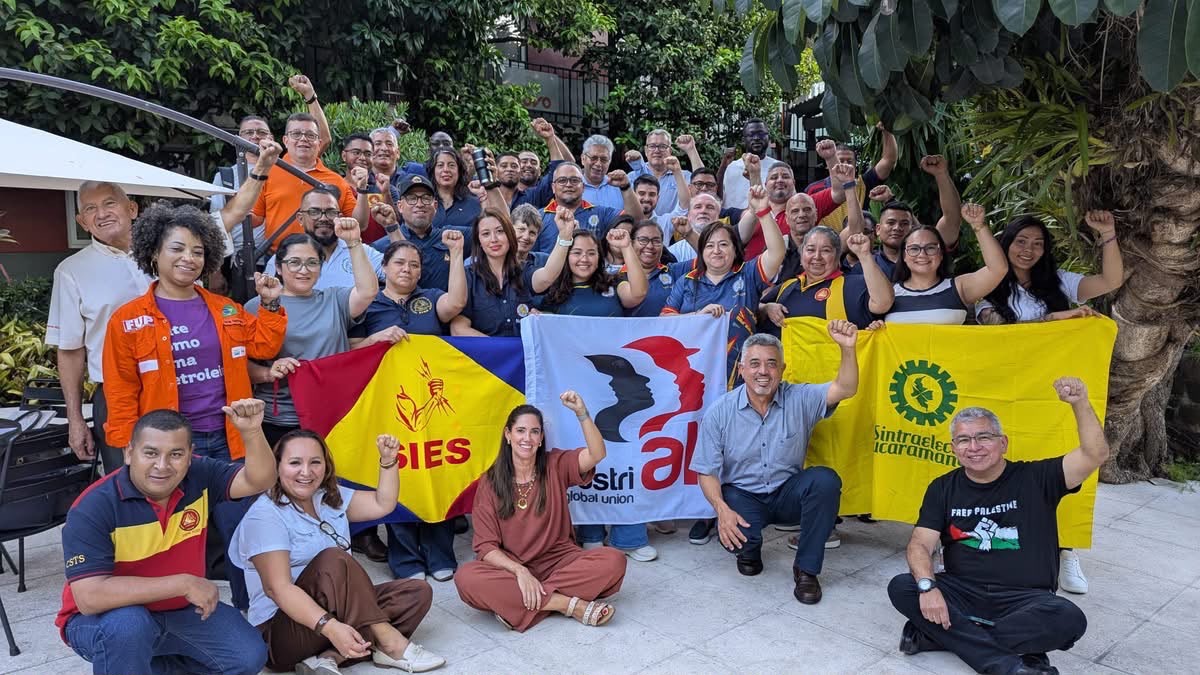
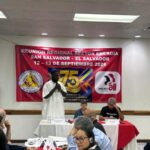
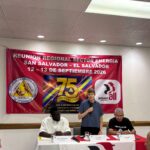
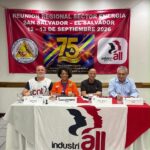
17 September, 2026Trade union delegates from the oil, gas, electricity and nuclear energy sectors gathered in San Salvador for a regional energy sector meeting, with a clear objective: to move beyond exchanging information towards a common trade union strategy. The meeting was hosted by the El Salvador Electrical Industry Union (SIES), marking its 75th anniversary and brought together ten organizations from seven countries: Argentina, Brazil, Chile, Colombia, El Salvador, Mexico and Suriname.
Global turmoil frames the debate
The opening day set the debate against a backdrop of global turmoil. Emmanuel Adjei-Danso, IndustriALL director for the mining and energy sector, outlined the partial closure of the Strait of Hormuz following the conflict between the United States, Israel and Iran. This sent the price of oil soaring to over US$120 a barrel. As a result, there were direct consequences for workers. Emmanuel Adjei-Danso reaffirmed the role of Global Framework Agreements and international frameworks on responsible business conduct as tools for holding multinationals accountable.
A region rich in renewables, short on access
José Medardo Cadena Mosquera of the Latin American and Caribbean coordinator of Energy Workers’ Organizations (OLACDE) offered a regional analysis. Latin America and the Caribbean already generate 67 per cent of their electricity from renewables, well above the global average. However, 17 million people in the region still lack access to electricity. The energy mix will need to triple its installed capacity within 24 years. Achieving this will require an estimated US$1.5 trillion in investment. José Medardo Cadena Mosquera said this transition will only be legitimate if it is fair to those who make it possible.
Energy as a public good, not a commodity
The afternoon’s panel on sovereignty and a just energy transition brought together representatives from Brazil’s oil sector, the Mexican electricians’ union and Argentina’s nuclear sector. They agreed that energy must be treated as a public good, not a speculative commodity. Furthermore, they argued that development should result in value chains and local employment rather than dependence on foreign technology.
Elizabete Sacramento of Brazil’s Federation of Oil Workers (FUP) called for a sovereign, state-led transition using Petrobras’s wealth to strengthen national industry. She said this would help tackle energy poverty and ensure workers and communities share in the benefits.
Argentina’s Rodolfo Kempf warned that the Milei government is dismantling decades of public investment. He argued the sector’s future depends on public ownership and skilled workers. Mexico’s Humberto Montes de Oca reviewed his country’s long struggle for public control of electricity. He noted that the United States and private investors are pressing to remove preferences for public companies. In addition, heavy dependence on US natural gas constrains energy sovereignty. As moderator Marcelo Vecellio summarized, “there is no trade union solution without a political solution.”
Mapping opportunities for coordination
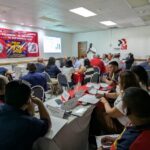
On the second day, Laura Carter, IndustriALL Latin America deputy regional secretary, facilitated a session mapping affiliates’ representation and the companies offering the strongest potential for regional coordination. Delegates developed a strategic plan built on seven thematic points. These points included industrial policy, just transition, health and safety, a regional communication and mobilization network, and mapping multinationals and ‘multi-Latinas.’ They also focused on building inclusive unions that prioritize women, young people and outsourced workers.
Building union influence internationally
A further session, moderated by IndustriALL executive member Edson Bicalho of Brazil’s Federation of Chemical Workers (Fequimfar), brought together Nolberto Díaz of Chile’s National Federation of Electricity Workers (Fenatrapech) and Diana Junquera, IndustriALL industrial policy director, to discuss union influence over the region’s energy future. Nolberto Díaz traced problems such as privatized water and energy. He endorsed the affiliates’ priorities of energy sovereignty, industrial policy and public ownership. Diana Junquera presented the international bodies where IndustriALL already has a foothold. She urged members to use them as practical tools: the ILO’s sectoral meetings, the IEA’s clean energy labour council, IRENA, UNECE, WEF and UNFCCC, among others.
Marking 75 years
On Monday 14 September 2026, the delegation joined celebrations marking the union’s 75th anniversary.
Joselito Acosta, SIES general secretary:
“Born from workers’ collective demands, SIES has demonstrated over 75 years the power of collective bargaining to secure lasting gains, while championing constructive proposals for an electricity sector that serves the people of El Salvador.”