20 August, 2026Unions in South Africa, Zambia and Zimbabwe are using human rights due diligence as a bargaining tool to defend workers' rights, challenge unsafe working conditions and hold mining companies accountable. Rather than treating HRDD as a compliance exercise for companies, they are turning it into leverage at the negotiating table.
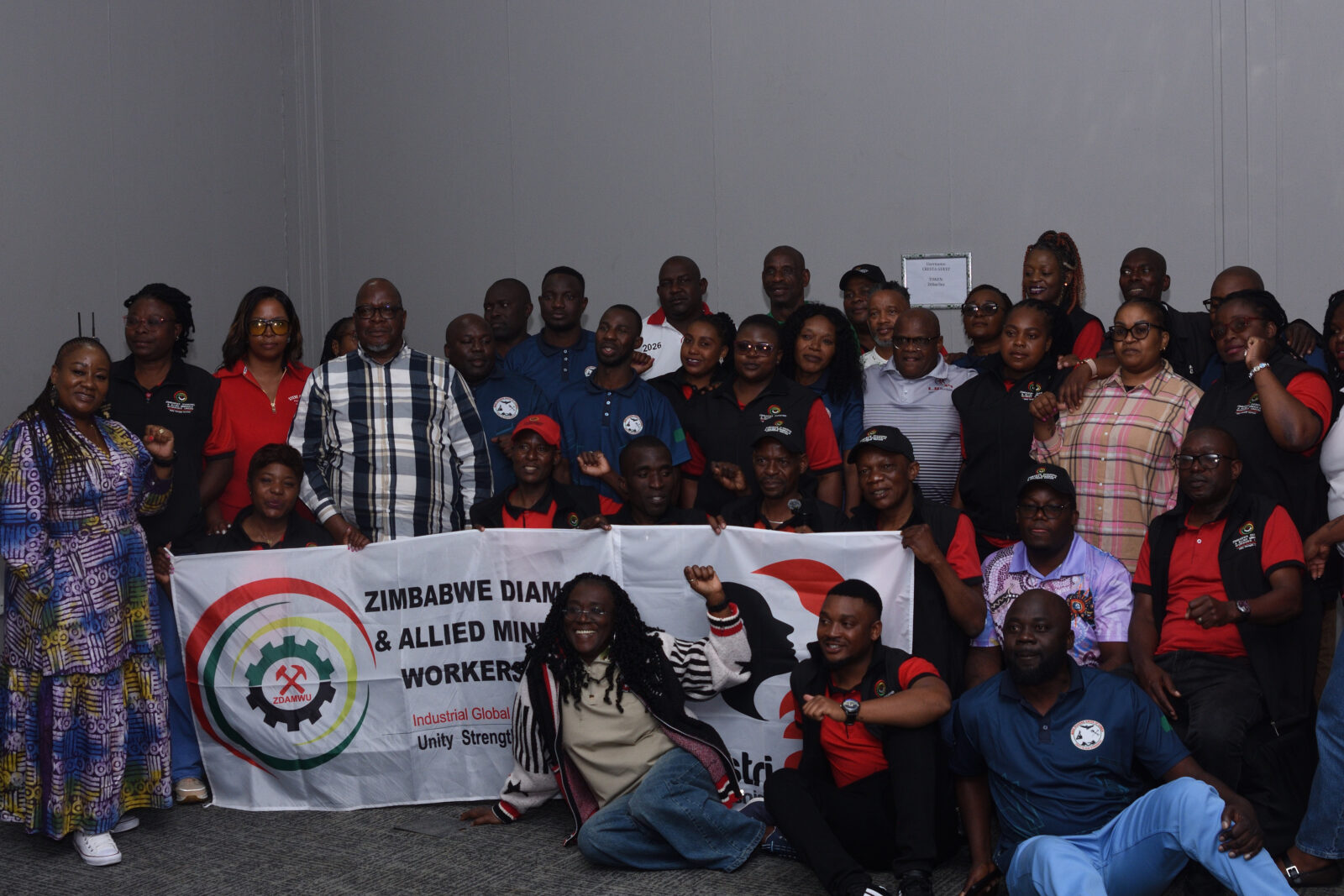
At a workshop in Harare, Zimbabwe, on 18 August, three IndustriALL Global Union affiliates presented pilot cases showing how HRDD can be turned into a practical union strategy in the mines. The National Union of Mineworkers (NUM) in South Africa, the Mineworkers Union of Zambia (MUZ) and the Zimbabwe Diamond and Allied Minerals Workers Union (ZDAMWU) shared examples from gold, copper, platinum and diamond mining.
The workshop brought together 41 delegates from the three countries, alongside UNI Global, Zimbabwe’s Ministry of Public Service, Labour and Social Welfare, the National Employment Council for the Mining Industries, Competence Centre for HRDD and IndustriALL.
HRDD comes from the UN Guiding Principles on Business and Human Rights. It is increasingly part of European supply-chain law, including the Corporate Sustainability Due Diligence Directive and the German Supply Chain Act. It requires companies to identify, prevent and account for human-rights violations tied to their operations.
For unions, the strategic value discussed at the workshop is clear. HRDD can move from a corporate compliance process to an organizing, bargaining and accountability tool. This helps workers challenge violations across mining operations and supply chains.
Combating gender-based violence in South Africa’s gold mines
NUM’s HRDD work is anchored on the pilot case at goldmine Sibanye Stillwater. It singles out gender-based violence and sexual harassment, particularly in isolated underground mines as rife. The union’s findings describe a workplace culture still shaped by male dominance, stereotyping and the exclusion of women. This holds even as female representation has grown.
Women made up about 18.8 per cent of the workforce and 29.4 per cent of management positions at the company, according to Sibanye’s 2025 report. But the mining industry has not caught up with that shift. Personal protective equipment and underground facilities were historically designed around the male body, leaving women workers inadequately protected and accommodated.
NUM’s analysis points to further problems: the physical demands of shift and night work, bias in recruitment and promotion, and unaddressed psychological-safety concerns.
The company has responded with several measures that include the Women of Sibanye-Stillwater network, Women’s Voice workshops, gender-based violence support centres, equal-pay audits, leadership-development programmes and upgraded PPE and facilities. NUM’s HRDD work will test how far these initiatives translate into a demonstrably safer and more equal workplace.
Fighting for workers’ rights in Zimbabwe’s platinum and diamond mines
ZDAMWU’s pilot cases at Bikita Minerals and Prospect Minerals Zimbabwe centre on defending workers’ rights, protecting freedom of association and ending gender-based violence and harassment. They also challenge short-term contracts, pushing for extensions from three to 12 months.
The cases raise concrete concerns: precarious employment, weak collective bargaining power and unsafe reporting conditions. Workplace practices also leave workers and communities with limited voice when violations occur. The union’s approach also extends beyond the mine gate, through collaboration with affected communities.
Demanding freedom of association on Zambia’s copperbelt
In Zambia, MUZ is pressing for HRDD-compliant grievance mechanisms at CNMC Luanshya Copper Mines and Sino Metals Leach Zambia. The union is calling for channels that are safe, accessible and properly structured. These would let mineworkers report labour-rights violations, occupational health and safety hazards, discrimination and harassment. They could do so without fear of retaliation. The union frames functioning grievance mechanisms as a precondition for freedom of association on the Copperbelt. There, reporting workplace concerns has often carried real risk for the worker who speaks up. MUZ also wants remedies for workers and communities that were affected by the tailings dam spill at Sino Metals.
Binta Mutale, programme manager for the Competence Centre for HRDD said:
“Participants learnt concrete tools to bring HRDD into their organizing strategies and were reminded that legal frameworks are only as strong as the organized workers supporting them.”
“HRDD is a broad framework that trade unions can leverage to defend rights and working conditions and to make local and global capital accountable. The emerging success stories from the unions show the tremendous potential for HRDD tools in union organizing and building trade union power,”
emphasized Paule-France Ndessomin, IndustriALL regional secretary for Sub-Saharan Africa.