

Read this article in:
English
25 August, 2026Trade unions in India’s base metal sector have agreed to strengthen organizing and occupational safety and health (OSH) as central priorities in a sector facing growing precarious employment and rapid industrial change.
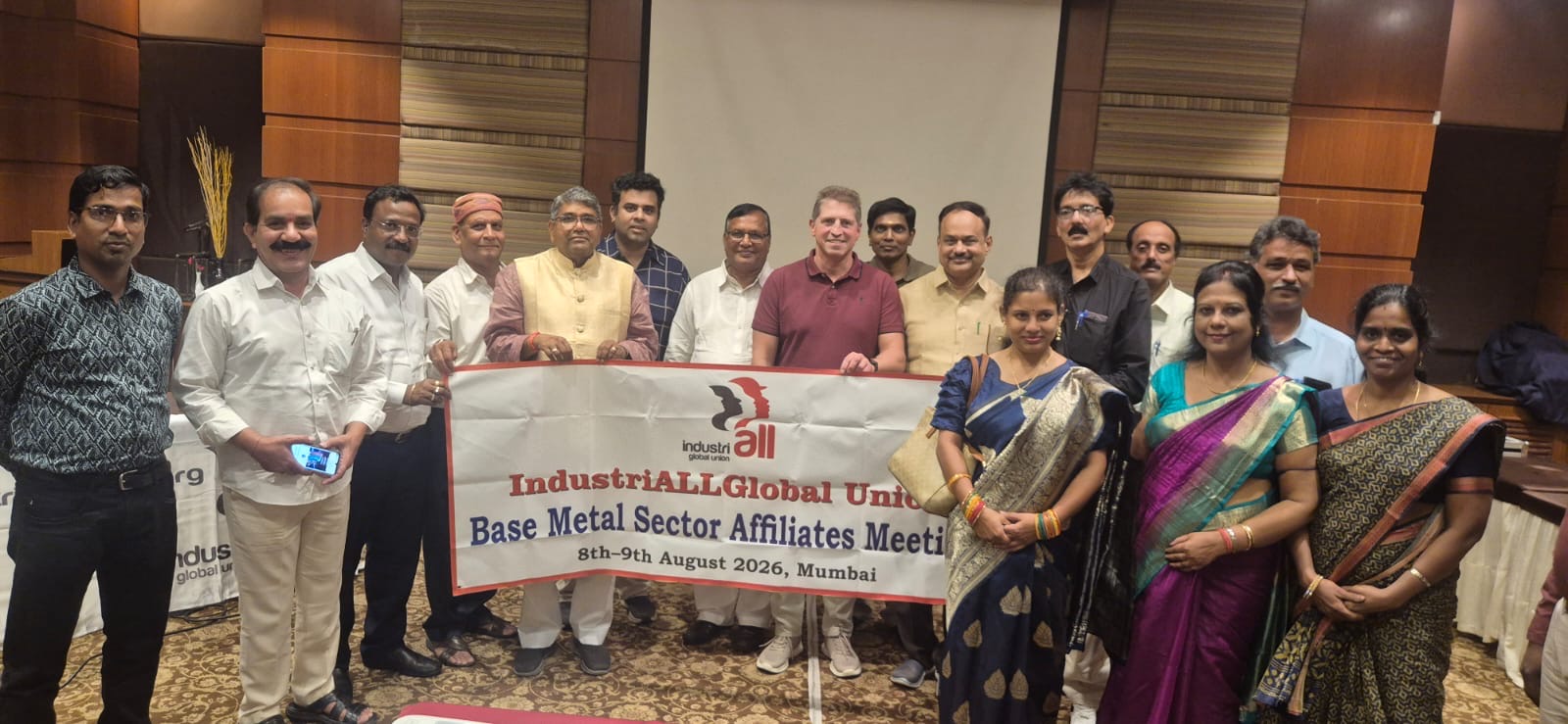
More than 30 trade union leaders from the steel, aluminium, copper and engineering industries participated in a two-day workshop organized by IndustriALL in Mumbai on 8-9 August. The meeting brought together unions to examine the growing use of contract labour, workplace safety and how unions can build stronger organization across increasingly fragmented workplaces.
Contract workers at the centre of OSH concerns
A prominent concern throughout the discussions was the link between precarious employment and workplace safety. Unions reported that serious accidents frequently involve contract workers, who often do not have the same access to PPE, medical facilities, insurance, transport and other provisions as permanent workers.
The growing reliance on contract labour is also changing the very nature of union organizing, as unions face the challenge of reaching workers who may be employed through multiple layers of contractors.
Yet affiliates also shared examples of successful union action that produced concrete improvements. Experiences from BALCO, Bhilai and Rourkela demonstrated the potential of collective action, joint safety mechanisms and campaigns around medical examinations, insurance and the right to refuse unsafe work.
Occupational health needs greater attention
The discussions also highlighted a broader problem in that workplace safety cannot be reduced to preventing accidents.
IndustriALL executive committee member and general secretary of SMEFI, Sanjay Vadhavkar, pointed to the large gap between the attention given to accidents and the less visible burden of occupational health problems:
“A safe workplace is not simply one where accidents do not happen. Workers can leave the workplace every day without an injury and still pay the price through illness, exposure and long-term occupational diseases. Prevention must therefore be at the core of workplace safety, with unions having a meaningful role in identifying and addressing risks.”
Organizing must keep pace with a changing industry
The meeting also considered the wider changes affecting the sector, including industrial restructuring, automation, artificial intelligence, heat stress and the transition towards green steel. Discussions included how these changes affect not only jobs but also the composition of the workforce and how diverse kinds of workers need to be brought more firmly into union structures if unions are to maintain their organizing strength.
Affiliates now plan to work towards stronger workplace organizing, with a common strategy that aims to turn workplace safety into a source of collective strength while building more inclusive and organised unions across India’s base metal sector.
Raghunath Pandey, general secretary of INSMM&EEF, said:
“Even as a seasoned trade union leader, I learned a lot. The most encouraging part was seeing participants openly share their experiences and learn from each other. That exchange brought a diversity of workplace realities into the room and made all of us stronger.”