
Read this article in:
English
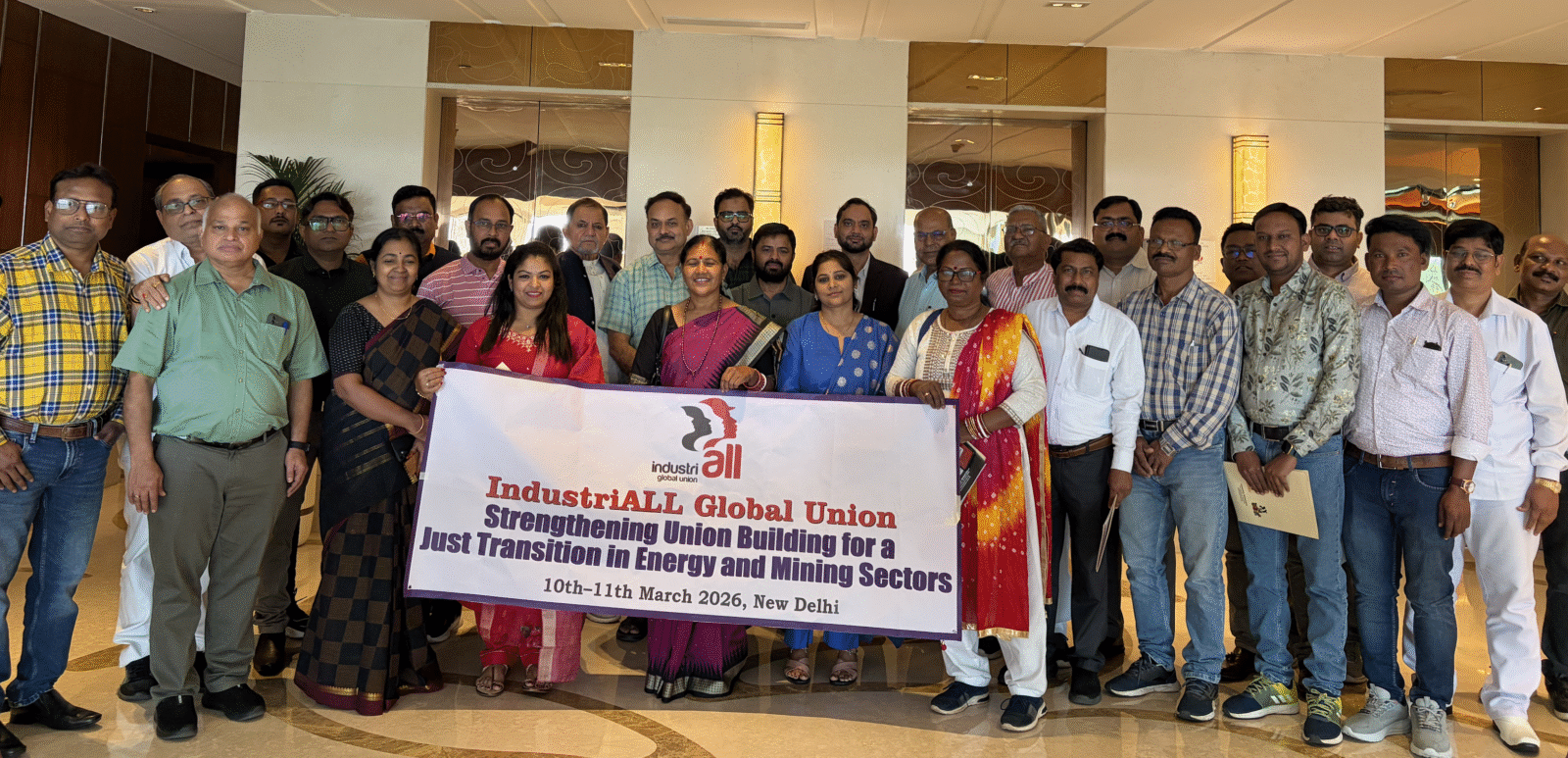
24 March, 2026India’s energy transition is no longer a distant policy ambition. Yet, as discussions at a two-day meeting held on 10–11 March in New Delhi made clear, the gap between the language of a “Just Transition” and the lived reality of workers remains stark. Organized by IndustriALL, the meeting brought together, for the first time in India, trade unions from both coal, mining and energy sectors to assess what this transition means and who it is leaving behind.
What emerged was not only concerns about exclusion, but a deeper critique of gaps between policy formation and governance design, where workers may be acknowledged as stakeholders in principle but remain excluded in practice.
Policy language vs ground reality
India’s transition is often framed in ambitious and progressive terms. Government narratives emphasize renewable expansion, climate targets, and green growth. Policy frameworks recognize that the transition will affect not just energy systems, but also employment, regional economies, and social stability.
However, participants repeatedly pointed to a disconnect between this political language and actual practice.
While frameworks are being designed, trade unions remain largely excluded from taskforces, committees, and ministerial processes shaping them. Even in states like Jharkhand, where the impacts of coal dependency are most acute, unions reported having no formal representation in planning bodies.
As a result, unions are not shaping policy but merely reacting to it, with interventions often occurring only after decisions have already begun to impact workers, limiting their ability to influence outcomes.
Transition without dialogue
The absence of structured social dialogue is not merely procedural but has material consequences. Participants highlighted that even large-scale protests and mobilizations have failed to compel governments to open lines of communication with unions.
In some cases, bipartite negotiations with management have yielded results, but these remain limited and inconsistent, often dependent on personal relationships rather than institutional frameworks. This raises concerns about sustainability and transparency.
At the same time, unions noted that international frameworks—such as those linked to decent work and development goals—can sometimes be leveraged to force inclusion.
Informalization as a core feature of the transition
A key finding from policy analysis and field discussions is that transition is not eliminating precarious work but reorganizing it.
In coal, production has not declined in proportion to transition narratives. Instead, there has been a freeze on permanent jobs, accompanied by increased use of contract labour. Examples such as NMDC Ltd. were cited, where pressure to maintain production has led to greater reliance on outsourced work.
This aligns with what has been described as a “wait-out strategy,” where difficult decisions around restructuring and closure are deferred through gradual informalization.
In renewable energy, employment is often precarious and short-term, disappearing once projects become operational.
The missing pillar: social protection
Discussions made clear that Just Transition must also address income security and social protection.
Policy assessments already recognize that the transition is not only about energy substitution but about restructuring entire regional economies.
However, while the scale of financial disruption is acknowledged, there is little clarity on how resources will be redistributed to protect workers and communities.
Contract workers often lack access to basic benefits, legal protections, and safety nets. Participants highlighted the absence of frameworks to support workers nearing retirement, displaced by closures or unable to transition into new sectors.
Mine closures and collapse of local economies
The consequences of unplanned mine closures extend far beyond the loss of jobs. Entire local economies built around mining face collapse.
Policy discussions recognize the need for planned mine closures, land rehabilitation, and economic diversification.
However, participants described how closures have led to the emergence of ghost towns, where the shutdown of mines triggers a chain reaction: workers migrate, services shut down, and local economies collapse. In some cases, communities are effectively displaced, becoming “refugees” within their own country.
Skills without security
Recent policy modelling underscores the scale and complexity of India’s transition, highlighting its far-reaching social and economic implications.
While skill development is often presented as a key solution, participants were sceptical of its effectiveness.
Without alignment between training, job availability and working conditions, skilling risks becoming a statistical exercise rather than a pathway to secure livelihoods.
Health, safety and regulation gaps
Health and safety emerged as a critical concern across both traditional and emerging sectors.
Serious accidents, weak enforcement and absence of safety mechanisms, particularly for contract workers are exacerbated in renewable sectors due to weak standards and limited union presence.
This raised questions about whether the transition is improving working conditions or shifts risks into less regulated spaces.
Gender: beyond representation
Women workers are often concentrated in low-paid, insecure roles, with limited access to benefits or advancement. At the same time, unions themselves must address internal barriers to participation, including the lack of safe spaces and inclusive structures.
Participants emphasized that achieving gender equality requires active engagement from male workers and leadership, as well as concrete measures to ensure representation and safety.
The need for supply chain organizing
A recurring theme was the fragmentation of worker power across increasingly complex supply chains.
The transition is not limited to mines or energy plants but extends to transport, manufacturing, and ancillary services.
The need to map and organize across entire supply chains was emphasized to strengthen collective bargaining power: not only direct employees, but also those indirectly dependent on these industries, such as transport workers and local service providers.
Towards a worker-led transition
Despite these challenges, the meeting also outlined a strategic path forward.
Participants proposed formation of a Just Transition committee to coordinate efforts, bridge policy and ground realities, and develop a unified union position.
There was also strong emphasis on building union capacity, expanding and diversifying membership, and fostering cooperation between unions to combat fragmentation.
Diana Junquera Curiel, director for industrial policy at IndustriALL Global Union emphasized:
“Without clear protections and planning, the transition risks creating more precarious work than it replaces.”
Ashutosh Bhattacharya regional secretary of IndustriALL South Asia says:
“A transition designed without workers is not Just, but imposed.”