
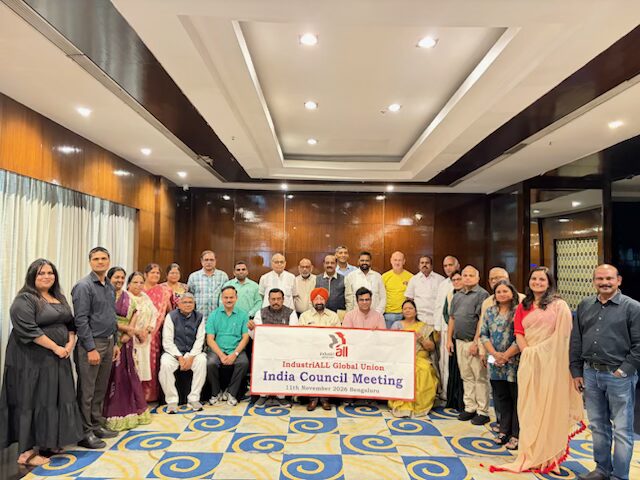


Labour reforms threaten workers’ rights
Unions warned that the new labour codes threaten freedom of association and risk making strikes illegal. OSH inspections have been weakened as the government shifts from enforcement to facilitation. Most workers remain outside the codes, despite claims they cover everyone.
Atle Høie, IndustriALL general secretary said:
“I congratulate our Indian affiliates and the wider trade union movement on the unity they have built in response to the introduction of the labour codes. IndustriALL stands in solidarity with Indian workers in their struggle to protect their rights and ensure that workers and their unions have a say in the laws that affect them.”
Contract work replaces permanent jobs
Affiliates reported that production is growing, but the share of permanent workers is falling as companies replace those who retire with contract workers.
Contract work can be deadly. At Western Coalfields Limited, a contract worker died on his first day, sent into the coalfield without training or a health check. The union secured around ₹2.5 million (about US$26,800) in compensation for his family.
Organizing contract workers is slow, but it is happening. At an Adani thermal plant, organized workers backed 3,000 contract workers denied a bonus and a union. At Bharat Aluminium Company Limited, a collective agreement improved social protection, medical cover and rations for contract workers.
Women in informal work face steeper odds. IndustriALL affiliate SEWA found that women working from home earn half what men in factories earn for the same work.
Affiliates called for local mobilization to carry that unity to the shop floor.
Planning meeting maps the way forward
At the IndustriALL–Union to Union project planning meeting, affiliates reported that one in five participants this year were contract workers and more women took on leadership. New networks also brought results: after collective union pressure, JCB reinstated a fired union leader.
Affiliates want practical, in-person training shaped by local needs, with the same participants returning so learning builds over time.
As the permanent job disappears, the question for India’s unions is no longer whether to organize contract workers, but how fast.