
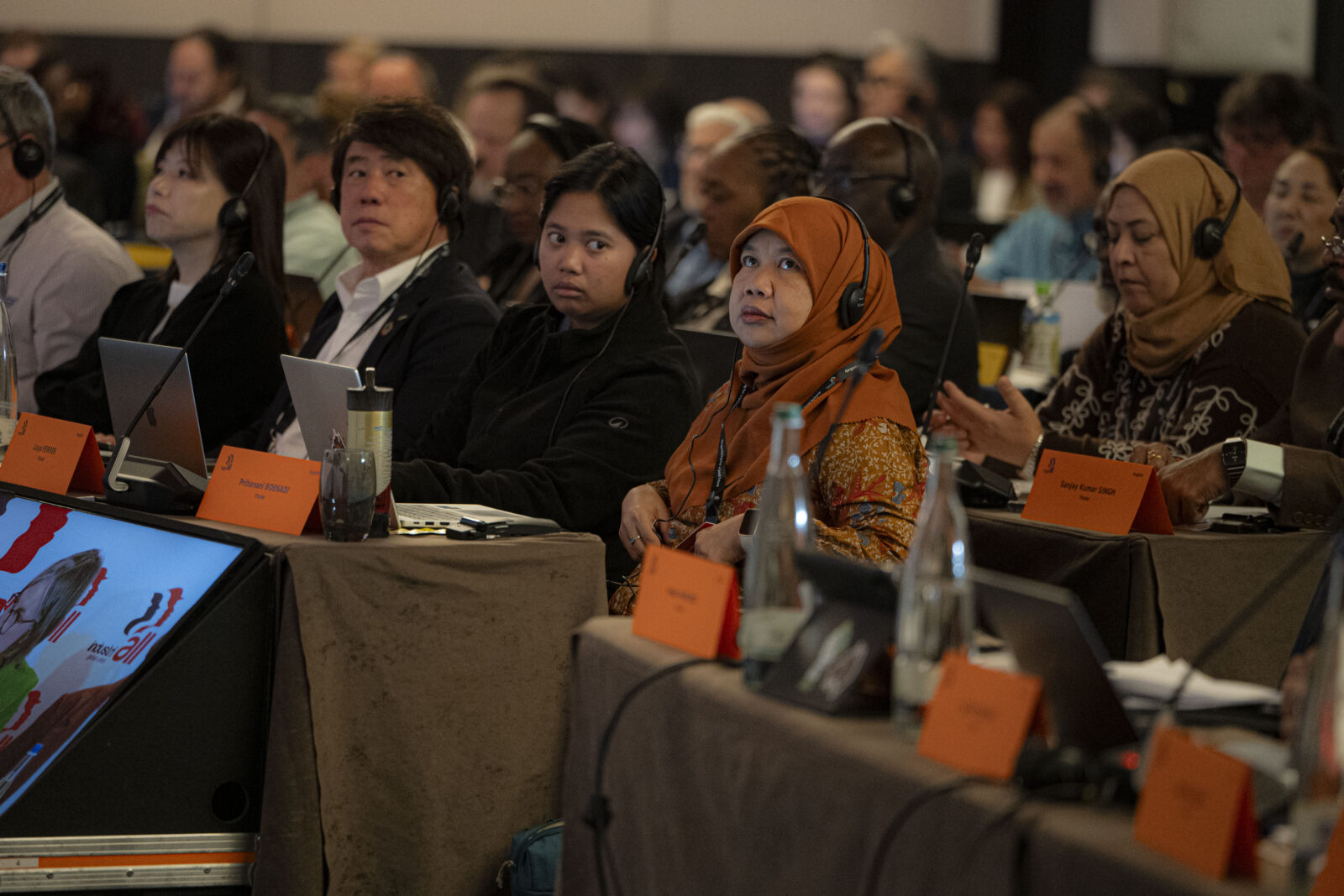


In Sweden, Tesla bought out IF Metall members one by one. Union busting against the United Auto Workers in Alabama cost Mercedes-Benz its global framework agreement.
“Organizing is not an additional task. Organizing is the most important strategic task of our movement. Without active members, there is no power,”
said Christiane Benner, president of IndustriALL and Germany’s IG Metall.
IF Metall ended its almost three-year Tesla strike. The company used strikebreaking banned in Sweden since the 1930s. The strike put collective agreements on everyone’s lips. King, Klarna and Ryanair signed them and IF Metall signed hundreds more during the conflict. Its president, Marie Nilsson, thanked unions worldwide: “Your solidarity has been absolutely invaluable.”
Organizing wins
In Bangladesh, an IndustriALL network helped 2,500 of 3,000 Crystal International garment workers unionize. Women hold 19 of 20 executive committee seats.
Brazil’s unions united to win elections and USA members canvassed voters.
“Unity is not a slogan, it is what wins,”
said general secretary Atle Høie.
Organizing means reaching young workers, overrepresented in precarious jobs and underrepresented in unions, said youth representatives Andrea Megazzini of FEMCA CISL, Italy, and Faye Daguman of PIGLAS, Philippines. The Executive Committee adopted IndustriALL’s first youth policy, ensuring young workers help lead today, not just tomorrow.
“Young workers have their rightful place in our organization,”
said assistant general secretary Christine Olivier.
The women’s committee report, finding precarious workers furthest from fair pay, calls for negotiator training, regular pay audits and gender-equal global framework agreements.
Organizing projects and campaigns are beginning to build sustainable unions that recruit and bargain.
“Our aim under these organizing projects is to develop an organizing culture among our affiliates that will remain as a lasting legacy,” said assistant general secretary Kan Matsuzaki.
The China challenge
Chinese capital increasingly dominates most IndustriALL sectors. Yet IndustriALL has no foothold in China, Atle Høie said. China has 41 per cent of world steel exports and its firms control around 87 per cent of critical minerals processing.
Opening the China debate, assistant general secretary Kemal Özkan warned against losing decent industrial jobs to competitors’ opaque subsidies.
Next steps:
- a global multinationals committee strategy on Chinese capital and
- dialogue with multinationals on Chinese labour practices.
Christiane Benner warned:
“In a world of increasingly powerful multinational corporations, we cannot afford to grow weaker.”