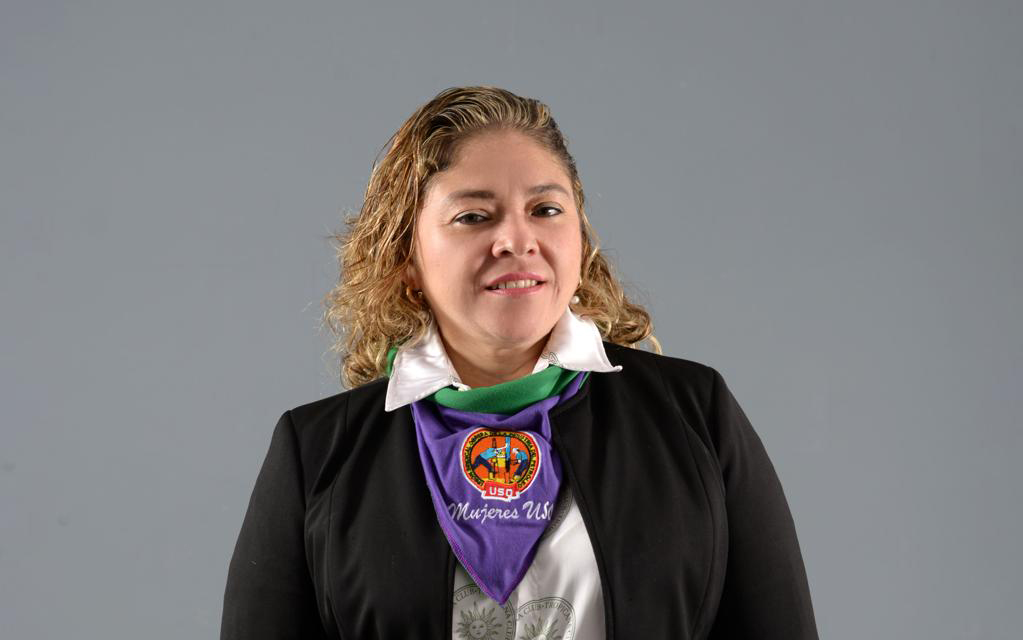


4 February, 2026On 15 January, Martha Orozco became the first woman elected to the national executive committee in the 100-year history of the Unión Sindical Obrera (USO), an IndustriALL Global Union affiliate in Colombia. Martha participated in IndustriALL’s regional gender project from 2017 to 2020 and became a mentor in the mentoring project implemented with LO-Norway. She spoke with IndustriALL about her trade union journey and her new leadership role within the union.
1) Becoming the first woman to join the USO’s national executive committee surely did not happen overnight. How did you prepare for this challenge, and what was the process leading up to your candidacy?
The process began well before 2022, when I was part of the team led by César Loza, who served as USO president until recently. Following his appointment to the board of directors of Colombia’s oil company, Ecopetrol, I assumed the position he vacated, as I had been democratically elected as his second in line.
Reaching a leadership position at this level required broad worker support and a formal vote. It involved 12 to 14 years of sustained training and organising work, including academic preparation, membership-building and the development of collective leadership. This was achieved through a democratic process of building knowledge and experience around trade union work.
2) What lessons, support or decisions were key along the way?
Training programmes provided by IndustriALL, the CUT and USO were essential, as was the openness of international actors such as the ILO and LO, which helped equip us with practical tools to strengthen our work. Equally important was the support of male allies who understood that women’s participation is a democratic necessity. Without that support, it is extremely difficult for women to reach leadership spaces.
One of the first to actively support this process was Edwin Palma, now Colombia’s Minister of Energy and a former USO president. He firmly believes that women’s participation in trade union leadership is a democratic imperative.
Without these allies, it is almost impossible to get there, since the system just seems designed to prevent women from participating. Women’s different paid and unpaid workloads make it very hard to engage and advance in the process; the help of other female colleagues and personal determination are definite assets.
3) From your perspective, what does women’s participation bring to national trade union decision-making spaces?
At USO, this work led to the negotiation of a collective agreement that included a gender chapter, something unprecedented at the time. This made it possible to establish a gender commission and encouraged other unions to consider similar provisions addressing issues such as gender-based violence and women’s participation within companies. There has also been progress in recruitment. Women’s participation in the industry increased from 21 per cent in 2021 to around 24–25 per cent in 2026. These gains were the result of sustained efforts to identify and open up spaces for greater women’s participation.
4) You have taken part in several IndustriALL training programmes on trade unionism, gender and leadership. How did these shape your work?
A crucial IndustriALL course I attended focused on trade union planning. Another important one addressed leadership recruitment and development. Without this knowledge, making progress as a woman trade unionist would have been far more difficult. Building leadership teams and supporting colleagues throughout the process is vital. Providing other women with the tools they need to advance is an essential part of sustainable trade union development.
5) You also became a mentor in IndustriALL’s mentoring project. What motivated that decision?
Mentoring creates a space to share experience, learn from the expectations of colleagues who are just beginning their journey, and contribute to building new organisational processes. It is a process of mutual learning, where both mentors and mentees exchange perspectives and strengthen collective capacity.
6) What message would you give to women who are active in unions but hesitant to take on leadership roles?
First, you need a genuine commitment to take on this responsibility. The obstacles are many and often significant. Second, it is essential to understand the industry, its data, its challenges and its dynamics. Analytical capacity is critical. Third, having the support of trusted colleagues and allies with experience makes a real difference. These three elements are fundamental.
7) What kinds of obstacles do women face in these spaces?
We live in a patriarchal society where women are often discouraged from entering academic, trade union and corporate leadership spaces. These are positions of power, and those who hold them frequently resist sharing it. Women who seek to enter these spaces often face resistance aimed at preserving existing power structures.
Care responsibilities also place an unequal burden on women, who must balance paid work, trade union responsibilities and unpaid domestic labour. In addition, Colombia has repeatedly been identified as one of the most dangerous countries in the world for trade unionists. This reality disproportionately affects women and discourages many from getting involved.
Taking on union leadership can also limit professional progression within companies, as trade union activists often face retaliation or career stagnation.
8) Given these challenges, what motivates you to continue as a trade union leader?
It requires deep personal conviction and commitment. The sacrifices are real, but so are the rewards. Trade unionism is a vocation rooted in service, solidarity and collective defence.
Successfully defending a worker in a disciplinary process and preventing an unjust dismissal brings a strong sense of purpose. Knowing that this work protects livelihoods and families provides lasting personal and professional satisfaction. That conviction is what makes the challenges worth facing.