








Read this article in:
English
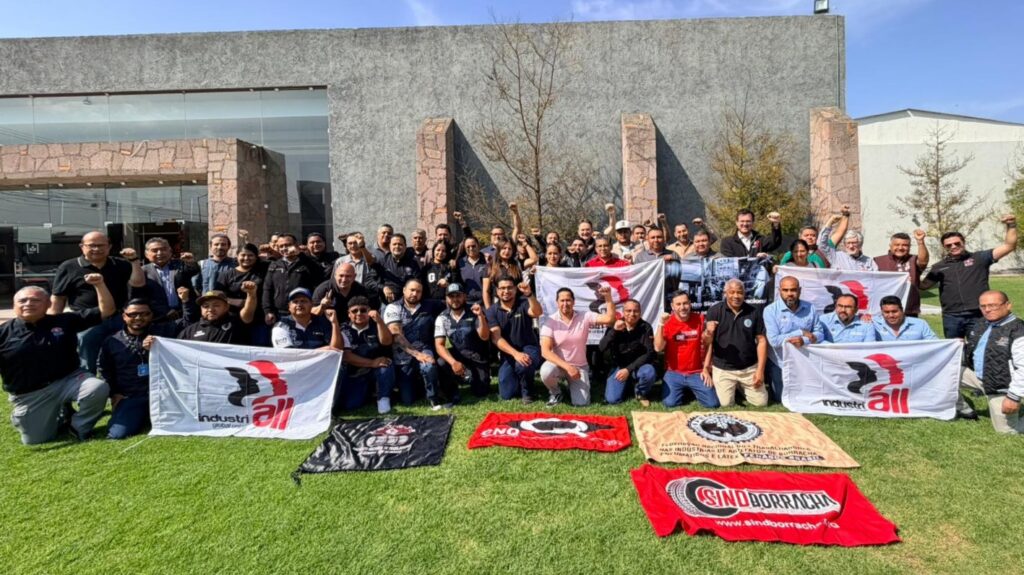
3 December, 2025Trade unions from Latin America, the United States, Canada and Mexico are working on a joint strategy in response to local, regional and global challenges. From 24 to 26 November, the International Trade Union Conference to defend the gains in the rubber and tyre sector was held in San Luis de Potosi, Mexico, providing a crucial opportunity to discuss the changes in the sector and strengthen coordination between the unions in the region.
The opening was attended by Victor Martinez Hernandez, general secretary of the SNTGTM – National Union of General Tire Workers of Mexico; Marino Vani, IndustriALL regional secretary for Latin America and the Caribbean and Tom Grinter, IndustriALL director for the rubber sector. The event was also attended by representatives of IndustriALL affiliates in Brazil (CNQ CUT and Sintrabor), the United States and Canada (United Steelworkers) and guest organizations from the sector in Mexico.
The first day examined the situation of the sector in Mexico, focusing on the historic contract law for the rubber industry, which is still in force but has not been renewed since 2017 and which the federal government intends to replace with a contract law for the tyre industry. Specialists and trade unions warned that, although this new proposal could incorporate some tyre companies currently outside the agreement, it would exclude hundreds of companies producing other rubber products, which could presently be included under the current contract.
They also expressed concern that the proposal does not guarantee labour and wage improvements for tyre workers and could be detrimental to the rest of the rubber sector. Following the discussions, a call emerged to reject the new contract, review the current one and, based on that review, negotiate addenda or additional chapters to the existing contract law.
Trade union representatives from Continental, Bridgestone, Goodyear, Pirelli and other companies then gave presentations on the current situation in each company, highlighting achievements, production challenges and trade union priorities in Mexico and the region.
The second day focused on the global challenges. Tom Grinter, presented an overview of the global and regional rubber and tyre industry and explained how IndustriALL is working to help affiliates coordinate policies and actions to address the issues in the sector. Marino Vani, highlighted the importance of building networks of workers from the same company or corporate group and of signing global framework agreements to strengthen collective action.
He also stressed the importance of the workers in the sector coordinating not only at national and regional level, but also with those in the mobility industry:
“Only in this way will they be able to build union power and influence economic, production and industrial policies, which are largely determined by the big companies in the mobility sector, together with governments, and determine the future and quality of employment in the rubber sector.”
The unions from Brazil and the United States presented a detailed report on the situation in the sector in their countries and the work being done by their organizations. They were joined by a number of Mexican colleagues and the discussions also covered issues such as health and safety at work, working methods and standards, mental health, the labour market, etc.
Cristian Alejandro Valerio –head of the sector for IndustriALL in Latin America – assessed the event very positively:
“We were able to bring together several unions from the sector in Mexico, to discuss and draw valuable conclusions on a crucial issue for workers: the future of collective bargaining, the contract law in Mexico, and a strategic agenda. The aim is to organise across unions in Mexico and Latin America, to build greater union power and solidarity among the workers in the sector and the mobility industry in the Americas over the next four years.”