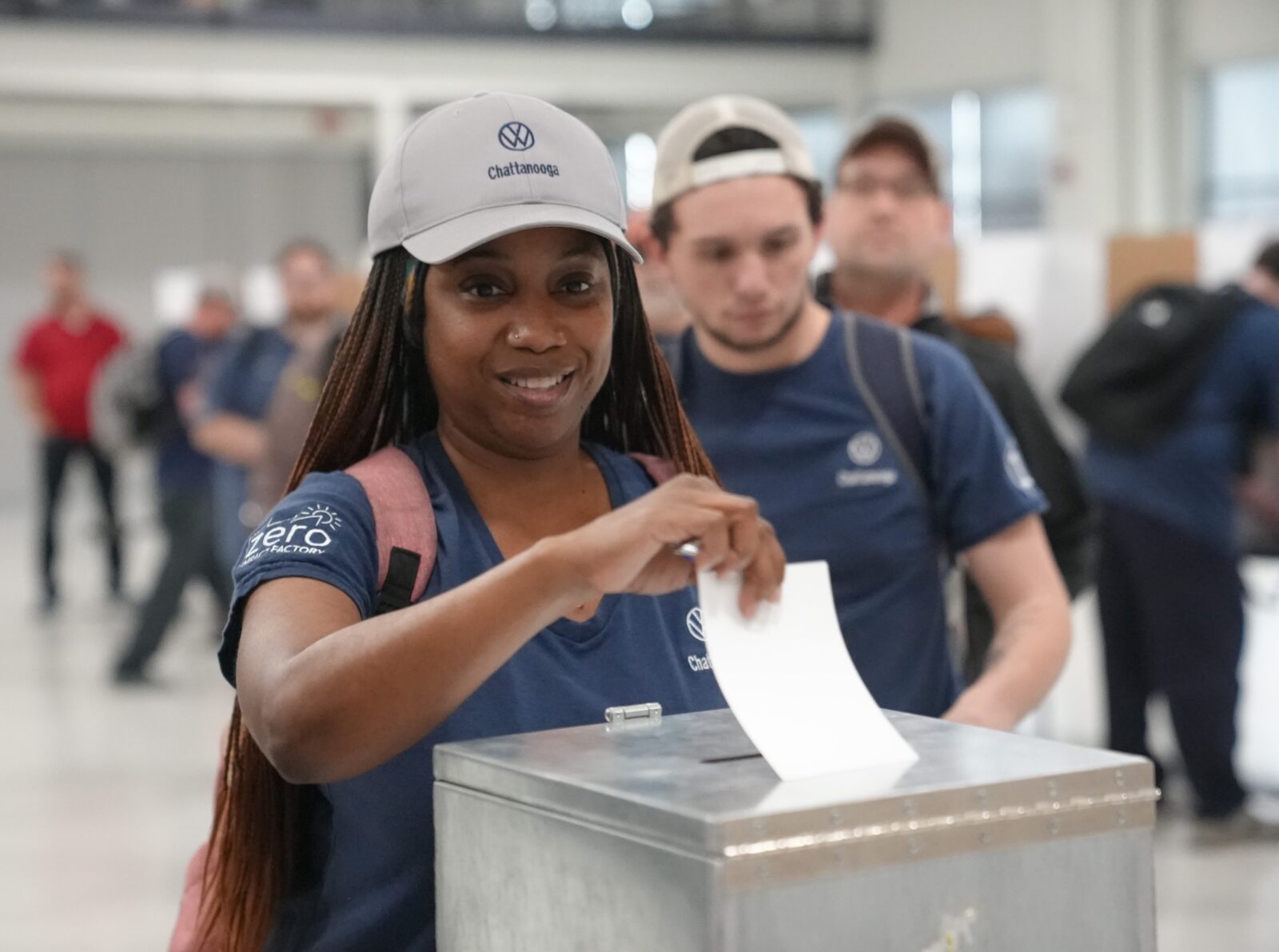
25 March, 2026When workers at the Volkswagen plant in Chattanooga voted by 97 per cent to ratify their first union contract, it was more than a historic number. It was a declaration of dignity.
For Steve Cochran, bargaining co-chair of United Auto Workers (UAW), an IndustriALL affiliate in Tennessee, the victory was years in the making.
“97 per cent shows the workers here have the utmost respect and trust in their bargaining team. It sends a clear message: the people in this plant stand behind this agreement. They stand behind their union,”
says Steve Cochran.
Years of broken promises
The road to victory was long. Workers first tried to organize more than a decade ago, in 2014. They narrowly lost that vote after an intense anti-union campaign, with company leaders and outside political figures warning that unionization would threaten jobs and future investment.
Another hard-fought effort in 2019 also fell short. Workers then stepped back to reflect on what had and had not changed. Despite repeated assurances from management that concerns about wages, healthcare costs, schedules and advancement would be addressed without union representation, little improved. Workers saw promises made and promises broken.
Frustrations deepened. Pay scales remained uneven and healthcare costs continued to climb. Inflation tightened household budgets, especially for younger workers and families trying to buy homes or raise children. Conversations on the shop floor, in break rooms and online grew more urgent as workers compared their conditions with gains won elsewhere in the auto industry.
“People don’t just work to work,”
Steve Cochran says.
“They work to support their families, to spend time with them, to live with dignity.”
The 2024 organizing victory made Chattanooga the first Southern auto assembly plant outside the Big Three to unionize and one of the few unionized auto plants in the southern United States.
What changed between the earlier defeats and the 97 per cent ratification vote was not just strategy but confidence. Workers who had once hesitated began to speak openly. Employees listened to veterans who had lived through both failed campaigns. The sense of isolation management once relied on began to dissolve. Many workers were no longer asking whether they needed a union but how to win one.
Then came the company’s union busting. Steve Cochran describes captive-audience meetings, warnings about future products and suggestions that outside forces would take control of the plant. Chuck Browning, the UAW’s chief negotiator, says the company’s approach during the most recent organizing drive appeared less aggressive than in earlier campaigns, partly because momentum among workers had already shifted toward unionization.
The shift was also a result of work behind the scenes, IG Metall and the VW World Works Council worked hard to convince VW management to stay neutral. That meant no outside parties would be let into the plant in the lead up to the vote, a common occurrence during union campaigns is that companies pay high-priced union busters to scare workers into voting against their interest with misinformation and threats. No third parties meant no union busters, politicians, or persuasive religious leaders could intervene in then union election, common tactics companies use to manipulate union elections. This was a game changer for those workers.
“This election was different because the workers were determined and an agreement negotiated by the VW Works Council and IG Metall with the company kept outside pressure out of the plant. When they told me they had this agreement, I couldn’t believe it—but they stuck to it, even when local politicians called Germany to gain access. Without politicians, union busters, or others trying to influence them, workers were able to vote out of choice, not fear, and that made all the difference. Who are we? UAW!”
said UAW Region 8 director Tim Smith, who oversees UAW business in Tennessee and other southern US states.
While the company still communicated its position and raised concerns about the union, Chuck Browning says the atmosphere differed from previous drives when opposition had been stronger.
Fear and uncertainty were part of the strategy. But by then, workers were already talking to each other and were ready to answer with facts.
Facing fear with facts
The union responded with education and unity.
“We answered with facts. We answered with the law,” Steve Cochran explains. “It’s illegal to threaten jobs or benefits. Once workers saw the company wasn’t being truthful, the propaganda stopped working.”
Instead of retreating, workers used each meeting as fuel. They debriefed afterwards, compared notes and corrected misinformation through WhatsApp and Facebook group chats and face-to-face conversations.
Chuck Browning says the union anticipated the company would communicate directly with workers and try to shape perceptions of the negotiations. In response, the union adopted a transparent approach.
“We were constantly communicating with the members as well as the public,”
he says.
“If the company offered something good, we would elaborate on that. If they were misrepresenting something, we would communicate that and show them the contract language.”
Even an 11 per cent pay raise from the company, announced as union support was growing, could not derail the organizing drive. Workers saw it as an attempt to stall momentum and show improvements were possible without a union.
The breakthrough came when management presented what it called its “last, best and final offer”, one that failed to protect jobs or secure the standards workers wanted. The bargaining team did not immediately put that offer to a vote. Instead, it asked workers for a strike authorization vote.
Workers delivered.
“As soon as we got that strike vote, the company came back to the table,” says Steve Cochran. “That’s the power of solidarity.”
Chuck Browning says the strike vote was used deliberately, at that moment it could create real leverage. Rather than holding it early as a formality, the union waited until workers could show clearly that the company’s offer did not have their support. The move shifted the pressure and brought Volkswagen back into serious negotiations.
Inspiration from collective action
The breakthrough in Chattanooga did not happen in isolation. It was fuelled by national momentum.
In 2023, UAW halted strikes at Ford, Stellantis and General Motors(The Big Three) after reaching tentative agreements on record contracts in a historic national dispute that began on 15 September. The gains won at the Big Three automakers reverberated far beyond those plants.
“The Big Three negotiations in 2023 helped us a lot,” Steve Cochran explains. “Workers saw what collective action and solidarity could achieve. They saw people standing together and actually winning.”
For Chattanooga workers, those victories were proof
“We just applied that to us too,” he says. “We can get those same things if we stick together and move forward. It became clear that if we didn’t act together, we would continue falling behind.”
Seeing autoworkers at the Big Three secure record contracts strengthened confidence in Tennessee and replaced doubt with determination.
“Respect and dignity are priceless,” Steve Cochran says. “If the company won’t give it to you, you have to stand together and take it back.”
When the 97 per cent result was announced, Steve Cochran says the reaction was immediate.
“It was overwhelming. People had never seen anything like it. You celebrate for a few hours. Then the next day, you go back to work and keep building.”
A different atmosphere on the shop floor
Just days after the contract took effect, the change was visible.
“The morale boost was amazing,” Steve Cochran says. “For the first time, I saw people brighten up and be happy to be at work. You don’t have to be miserable at work. Now we have work rules. We have rights. We have respect.”
The agreement covers 3,250 workers and sets a new standard in the U.S. South, where anti-union pressure remains strong.
Chuck Browning says the contract addressed the issues workers cared about most: healthcare, job security, inflation protection and respect on the shop floor. Job security was the top priority. The agreement includes product commitment, protections if the plant were sold, limits on outsourcing and protections against plant closure. Workers also won the right to strike over health and safety issues.
He says workers had long experienced unfair treatment, from job assignments and shifts to how complaints were handled. A heavy-handed random drug testing policy was also addressed in the agreement.
Automakers across the region have ramped up anti-union messaging. But for Steve Cochran, that only confirms one thing:
“They’re scared and that shows we have strength and momentum.”
No complacency. Only momentum
Far from slowing down, the victory has sparked calls from workers across the country asking how it was achieved.
The answer is simple, Steve Cochran says: know your goal, plan and never give up.
“All the companies use the same tactics. We already know what they’re going to say. We just get in front of it and talk to workers like auto workers. You connect. You build trust.”
The next challenge is ensuring management understands that the rules have changed.
“They’ve always had all the power. Now they don’t. The sooner they accept that, the better our relationship will be.”
For Chuck Browning, Chattanooga’s victory also sends a message beyond Volkswagen. It shows workers at non-union plants that organizing and winning a contract is possible and that it can improve both their economic lives and their day-to-day experiences at work.
A message to workers everywhere
For workers who believe a union victory is out of reach, Steve Cochran offers clear advice:
“Look around. Ask yourself why you’re even talking about organizing. The company has the chance to fix things. If they won’t, you must make them. And the way you make them is by standing together.”
He pauses, then adds:
“You never fail unless you give up. If you don’t give up, you’ll reach your goal.”
Chuck Browning puts it this way:
“Every union contract that we have ever achieved, at some point people said it was impossible. It’s impossible until you do it.”
In Chattanooga, workers proved that solidarity could transform fear into courage and a workplace into a place of dignity.