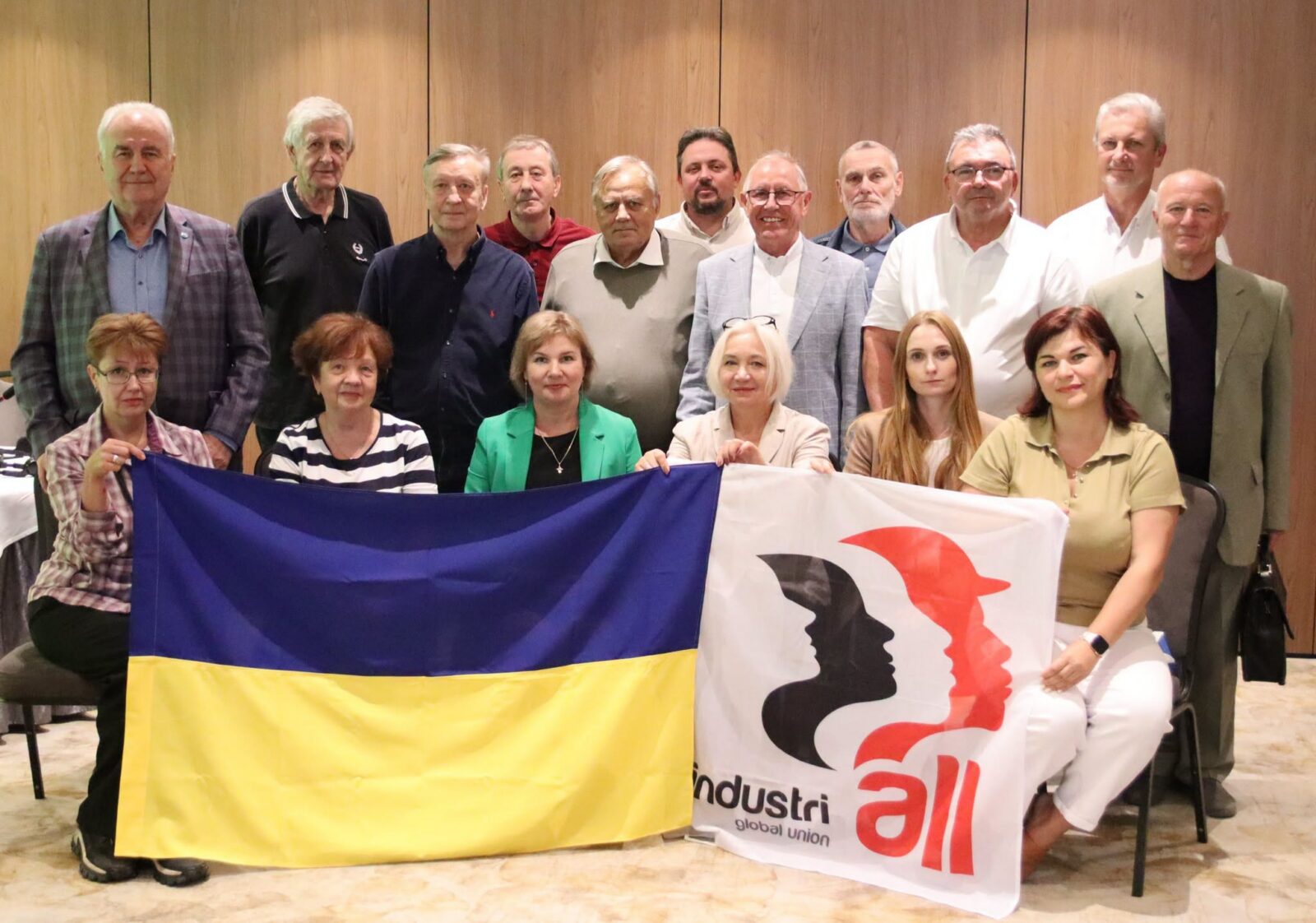

9 September, 2026Reconstruction must be built on social dialogue, not decided over workers' heads. That was the message from a hybrid meeting in Kyiv on 3 September 2026, held as part of a Union to Union-funded project. Ukrainian unionists in the room were joined online by speakers from the ILO, the ETUI, industriAll Europe, IG Metall and IF Metall.
The meeting went ahead under an overnight strike on a pharmaceutical warehouse and repeated air raid alarms.
Fourteen IndustriALL affiliates met to shape the rebuilding of a country where over half the energy generation, a million homes, 250,000 kilometres of roads, 1,200 hospitals and 3,600 schools have been destroyed. Reconstruction is expected to cost over US$600 billion. This figure is three times Ukraine’s pre-war GDP.
“We have no greater wish than that the war ends and that reconstruction can begin. We know how difficult it is to think about reconstruction when you are in the fight for your lives, your members’ lives and your families’ lives,”
said IndustriALL general secretary Atle Høie, opening remotely after travel and insurance to Kyiv proved impossible.
International perspectives
The ILO’s Verena Schmidt opened with global trends. Formal dialogue institutions don’t always mean real influence, she said. Trade union density is declining globally, while collective bargaining coverage is estimated at 33.4 per cent. This number is across countries for which data are available.
industriAll Europe’s Bruno Demaître outlined the EU’s legal framework for social dialogue, including 2025’s stronger European Works Councils rights. IF Metall’s Simon Petersson described Sweden’s Nordic model, where 90 per cent of workers are covered by collective agreements. These agreements are built on trust, not law.
The ILO’s Magnus Berge confirmed Ukraine has ratified the ILO’s core labour conventions and emphasized that attacks on collective bargaining were driven by politics rather than by a lack of union training. ETUI’s Torsten Müller explained the EU’s minimum wage directive. This directive requires action plans in countries with less than 80 per cent bargaining coverage. In addition, IG Metall’s Claudia Sowa-Frank presented Germany’s system of board-level co-determination, itself born from post-war reconstruction.
Locked out of the process
Ukraine’s national tripartite social and economic council hasn’t met since 2017. A new draft labour code is being written without proper union consultation.
“We expected the government to consult with us before this draft was published. We haven’t seen it. Once again, this shows that there is no real social dialogue in Ukraine,” said Mykhailo Volynets of NPGU/KVPU, the Independent Trade Union of Miners of Ukraine.
The pattern repeats. Employers withhold information and ignore signed agreements. Some industries have no employer body left to negotiate with.
In mining and metallurgy, Russian strikes on major plants have combined with a new EU carbon border tax and steel-import quotas. Only a handful of enterprises are still operating near capacity, said Bogdan Overkovskyi of PMGU.
The human cost keeps mounting
In the first half of 2026, six workers were killed and 36 injured on the job by shelling.
“We have to reorganize our cooperation with employers to create safer conditions during missile and drone attacks,” said Volodymyr Dmytryshyn of Naftogazprofspilka.
Wage arrears have passed UAH 80 million (around US$1.8 million) across several enterprises, including Odesa’s oil refinery. New agreements are often impossible to negotiate under martial law, so unions are extending existing ones. Furthermore, they are fighting to keep decisions – like the Mykolaiv shipyard bankruptcy, from being made without them.
“Collective agreements mean something when enterprises are making a profit and are able to fulfil them,” said Mykola Mytsko of CTU, pointing to the gap between what agreements promise on paper and what struggling enterprises can actually pay.
What unions are fighting for
“Engagement of the trade unions is extremely important. It really benefits the development of our enterprises. Only together can we save the industry and save trade unions,” said Valerii Matov of ATOMPROFSPILKA.
“Social dialogue should be part of the rebuilding of Ukraine,” said Yarema Zhuhaievych of TUAMBWU.
“We want to see Ukraine after the war not just economically rebuilt, but a country where workers have a voice. Where the union is an equal partner in social dialogue and collective bargaining is an effective mechanism for labour rights protection,” said Oksana Potapko of TUSWU.
Next steps
For 2027, affiliates want the national tripartite council revived, with sectoral equivalents alongside it. They want meetings kept in-person where security allows and a sharper focus on the practical content of sectoral agreements. They want gender equality on the bargaining agenda, as more women move into heavy industry, backed by continued capacity-building for union activists. Affiliates also called for greater understanding of human rights due diligence, particularly in dealing with international companies operating in Ukraine.
“Social dialogue is not just a tool for the labour market. It is also an important component of democratic and good governance,”
said IndustriALL assistant general secretary Kemal Özkan.