

Read this article in:
English
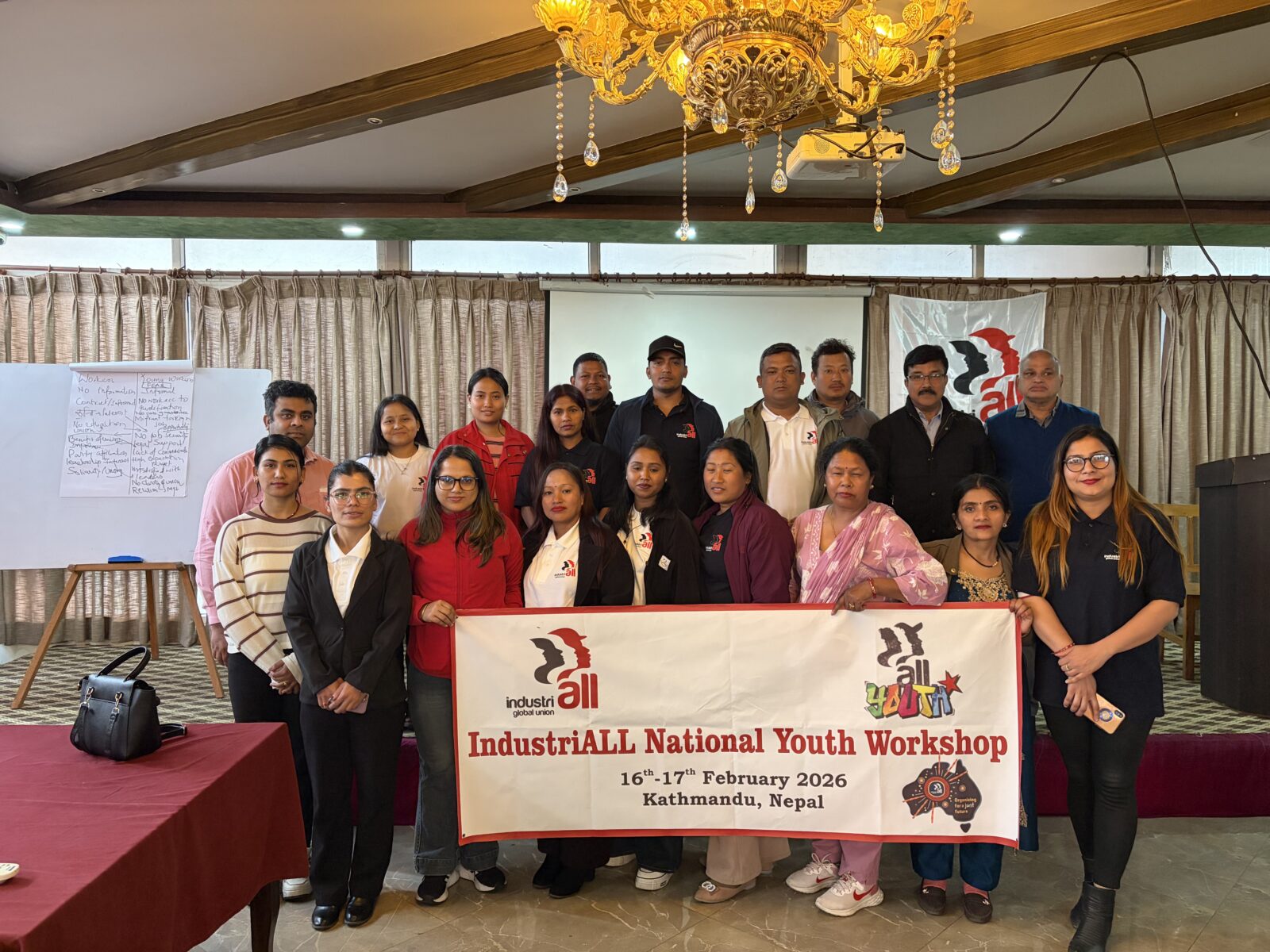
27 February, 2026Against a backdrop of political instability, shrinking democratic space and worsening conditions for workers, Nepalese trade unions met on 15–16 February 2026 for an IndustriALL Global Union-organized National Council Meeting, followed by a youth workshop, to consolidate priorities on jobs, wages, labour rights and youth organizing as the country moves toward national elections.
The discussions focused on strengthening union unity, aligning national strategies with IndustriALL’s 2026–2029 Strategic Plan and Congress outcomes, and transforming workers’ demands into a coherent political agenda capable of addressing precarious work, weak enforcement of labour laws and the growing disconnect between workers’ needs and national policy debates.
Participants raised concerns over limited political engagement on labour rights, weak enforcement of labour laws and persistent gaps between national frameworks and international labour standards. Low union density, particularly among young and precarious workers, was identified as a critical challenge, alongside the need for leadership renewal and a stronger evidence base for organizing.
Discussions also examined lessons from recent Gen Z-led protests and social movements in Nepal. Participants noted that declining worker morale, rising living costs, food insecurity and erosion of rights have fuelled widespread discontent, particularly among young people. The need for trade unions to connect with younger workers’ concerns was underlined, while offering durable pathways beyond episodic protest.
Group discussions mapped workers’ concerns across employment and job security, wages and social protection, precarious work and occupational safety and health, Just Transition and industrial policy and gender equality. Rising inflation, unsafe workplaces and the rapid expansion of precarious work were highlighted as urgent priorities.
Participants also raised concerns about energy and industrial transitions proceeding without adequate consultation, retraining, or employment guarantees. Women workers’ demands for equal pay, social protection and structural inclusion within unions featured prominently. These discussions were consolidated into a draft workers’ manifesto to be shared with political parties and union centres.
As a key outcome, affiliates agreed to establish a national youth committee, each nominating two activists under 32 (with at least one woman) to support inclusive unions, gender equality and leadership development within the Nepal Council.
IndustriALL South Asia regional secretary, Ashutosh Bhattacharya, said:
“Young workers are already protesting insecurity, rising prices, and the erosion of rights. Trade unions now have a responsibility to turn that anger into organized power and binding political demands.”