
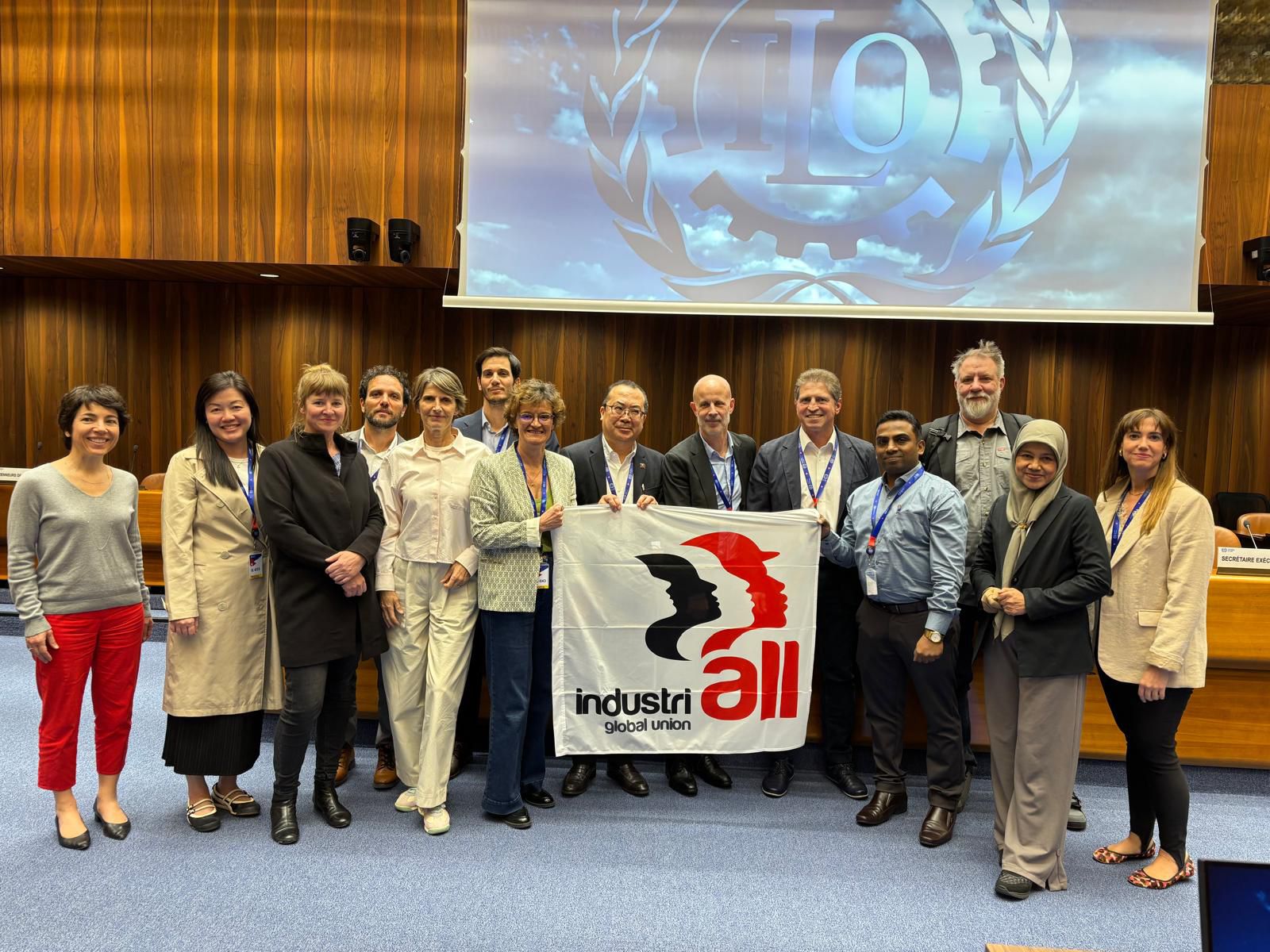


23 April, 2026From 13 to 17 April 2026, the ILO technical meeting on the challenges and opportunities for promoting decent work, productivity and a just transition arising from artificial intelligence in the manufacturing industry , took place in Geneva.
This meeting was initiated by IndustriALL with a clear objective: to open an international tripartite space on an issue that is already transforming production, employment and working conditions.
To this end, the workers’ group brought together affiliates and trade union experts from Argentina, France, Germany, India, Indonesia, Singapore, Sweden and the USA, all representing different sectors of the manufacturing industries, together with the participation of industriAll Europe as advisers, bringing concrete experience of how AI is already entering workplaces.
Throughout the week, the workers’ group defended one central idea: AI cannot be addressed only as a matter of innovation or competitiveness. It is also a question of rights, health and safety, work organization, social protection, equality, privacy, collective bargaining and the distribution of the benefits of technological progress. This perspective is reflected in the conclusions that were ultimately adopted. The text recognizes that AI is already transforming manufacturing at different speeds and in uneven ways across countries, industries, enterprises and workers and that its effects on employment, work organization, wages, work intensity, privacy and data protection must be addressed through policy action and social dialogue.
One of the most important outcomes is that the conclusions place the discussion within the ILO’s human-centred approach. The text states that AI must contribute to decent work, productivity and a just transition and must not develop outside those objectives. It also reaffirms that the fundamental principles and rights at work remain fully applicable in the age of artificial intelligence, including freedom of association, collective bargaining, non-discrimination and occupational safety and health.
The conclusions also consolidate the central role of social dialogue. They recognize that freedom of association and collective bargaining are essential to shaping the AI, digitalization and employment policies that will define the future of manufacturing. They also establish that workers must be informed, involved and consulted in a timely manner when AI systems likely to affect them are introduced.
In the area of training and reskilling, the adopted text strengthens the idea that skills development is a shared and continuous responsibility of governments, employers and workers. It includes references to technical and vocational education and training, lifelong learning, digital literacy and the link between education and access to quality jobs. This provides a useful basis for continuing to defend training as a right rather than an individual burden.
Another relevant advance is social protection. The conclusions refer to rights-based social protection systems and to universal access to adequate, comprehensive and sustainable protection for workers in all types of employment. They also recognize the need to strengthen labour administration and labour inspection, which is fundamental to ensuring the practical implementation of standards.
The final text also includes important references to privacy and data protection, to new OHS risks and to the need for the benefits of technological progress to be broadly shared. In other words, productivity is not presented as an end in itself, but as linked to wages, working conditions and employment.
The conclusions also reaffirm the existing international normative framework, including the ILO declaration on fundamental principles and rights at work, the centenary declaration, the tripartite declaration of principles concerning multinational enterprises, the guidelines for a Just Transition and the ILO code of practice on the protection of workers’ personal data. This explicit reference to the existing body of norms is important because it places the discussion on AI within a broader architecture of rights and corporate responsibility, including across the supply chain.
This meeting now leaves a concrete basis for further developing this agenda in coming years. The adopted conclusions task the ILO Office with strengthening data collection, action-oriented research and the dissemination of good practices and case studies, including collective agreements, on the impact of artificial intelligence in the manufacturing industry. They also foresee greater exchange of experience across countries and sectors, as well as stronger capacity building and technical assistance for constituents.
For IndustriALL, this is an important step. We have succeeded in securing an ILO text that recognizes that artificial intelligence in manufacturing must be addressed through decent work, labour rights, social dialogue, training, social protection and a broad sharing of the benefits of technological progress. At a time when the transformation is moving very quickly, these conclusions open up a future work agenda that will allow trade unions to continue advancing AI governance that places workers at the center.
Kan Matsuzaki IndustriALL assistant general secretary said:
“These conclusions are a very important step because they allow us to move towards governance frameworks for artificial intelligence where, in many countries, regulation remains insufficient or non-existent. Technological transformation must not be allowed to outpace regulation, workers’ protection or social dialogue; it must be governed in a way that guarantees decent work and secures a just transition.
The adopted conclusions and recommendations will be submitted to the 358th session of the ILO Governing Body in November 2026, where they will be formally considered.