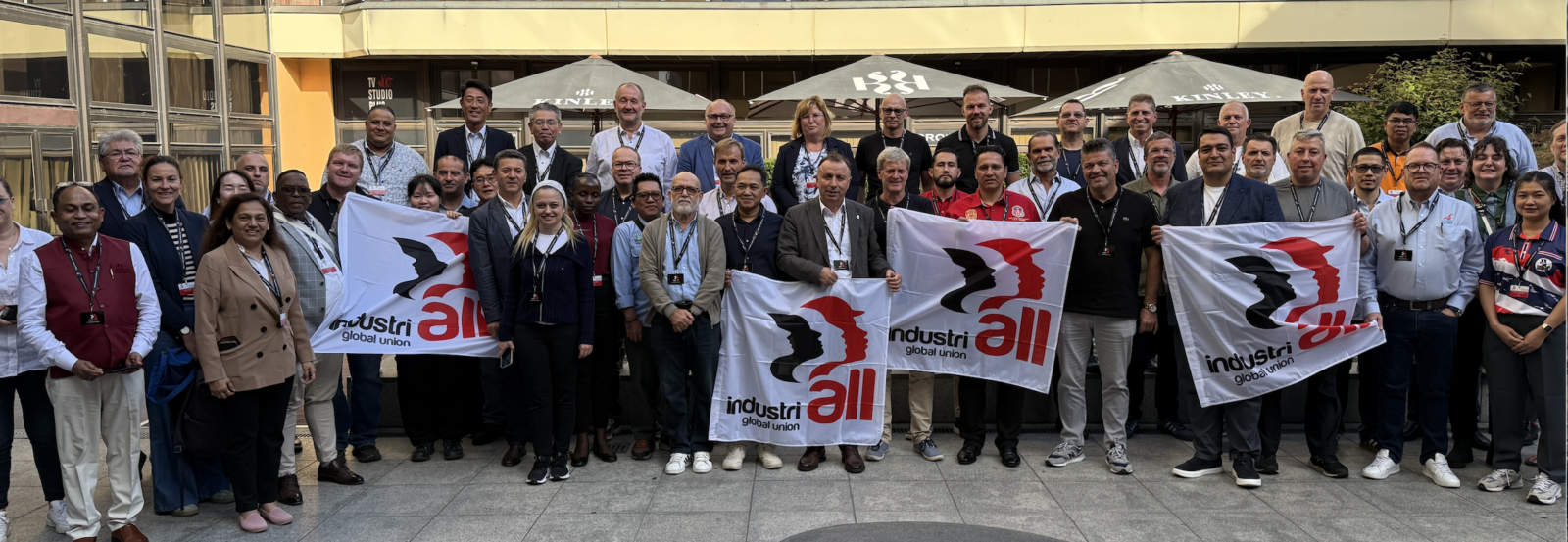


1 October, 2026Trade unions from the steel, aluminium, copper, nickel and related metals industries adopted the Prague Declaration on 30 September 2026, insisting that workers must not pay the price of the green transition.
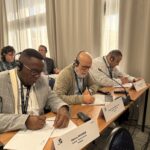
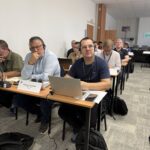
IndustriALL Global Union’s base metals sector conference met in Prague, Czech Republic, on 29-30 September. Delegates also adopted a Prague declaration and a base metals sector action plan 2027-2029.
Politics is reshaping metals
Political decisions now shape the metals industry as much as markets do, IndustriALL general secretary Atle Høie told delegates. He said he doubts protectionism is the answer, but where governments use it, unions must demand employment guarantees and training.
“We must never forget that our strength lies in organizing,”
he said.
Co-chair Emil Ramírez from United Steelworkers (USW) said copper is the most strategic metal of the moment, driven by power grids and data centres. However, he said US tariffs are leading to job cuts among North American producers. Co-chair Sanjyot Vadhavkar from the Steel, Metal and Engineering Workers’ Federation of India (SMEFI) said workers are too often asked to accept restructuring in the name of competitiveness.
“Every worker has a right to return home safely after every shift,”
she said.
Getting a seat at the table
In Sweden, Aleksandar Zuza from IF Metall said the union signed a collective agreement with a new green steel plant while it was still mostly on paper. In addition, the agreement capped subcontracting at two layers. At steelmaker SSAB, where blast furnaces are being replaced, the union sits on the board. Moreover, it aims to move all its blue-collar members into new jobs.
Conditions are harder elsewhere. Roman Durčo of OS KOVO said Czech steelmaking depends on state subsidies to build its electric arc furnace and is still waiting for a government scheme. In Türkiye, OZCELIK-IS said it used academic evidence and community pressure in the 1990s to stop an iron and steel plant closing.
Safety on the shop floor
Several delegates spoke from their own workplaces. Flavio Paiva of Brazil’s CNM-CUT, a mechanic for almost 20 years, said fear of missing production targets makes workers hesitate to stop dangerous processes.
Jackline Waswa of the Amalgamated Union of Kenya Metal Workers (AUKM), who sits on a safety committee at her workplace, said companies often treat prevention as paperwork. “A Just Transition must also be a safe transition,” she said.
Kyung-won La from the Korean Metal Workers’ Union (KMWU) said fatal accidents are concentrated among subcontracted workers. He added that safety is not a privilege granted by companies but a collective right.
Making companies accountable
Delegates said accountability must reach all the way down the supply chain and that unions have to make it happen. Raúl Cueto of Spain’s FICA-UGT said new EU due diligence rules move companies from will to law. However, he said this happens only if unions use them. Ali Gündüz of Birleşik Metal-İş said there can be no genuine due diligence without worker participation. Mesut Erdem of Türk Metal Sendikası said responsible business conduct begins with seeing the union not as a cost, but as the greatest guarantee of sustainable production.
What delegates agreed
The Prague declaration calls for:
- public support for industry to be tied to quality jobs, union rights and skills training
- a Just Transition that involves workers and unions in every decision
- stronger health and safety
- accountability for multinationals across the metals value chain.
“Our struggles may be different, but our solidarity is the same,”
Sanjyot Vadhavkar told delegates.