
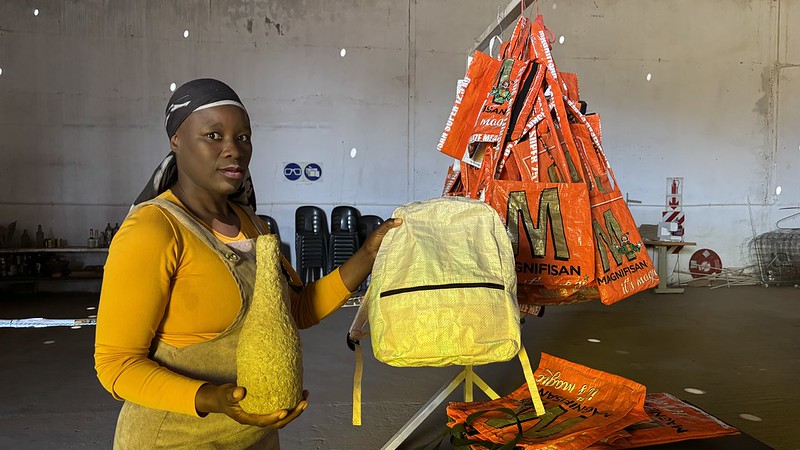
4 December, 2025Between 121 and 142 million people worldwide are employed in sectors that contribute to the circular economy, such as repair, recycling, second-hand trade and waste management. This represents roughly between 5 and 5.8 percent of total global employment (excluding agriculture), according to a new joint report by Circle Economy, the International Labour Organization (ILO) and the World Bank Group, in partnership with the UN Partnership for Action on Green Economy (UN-PAGE).
The study is the first global analysis of employment in the circular economy and shows that most circular economy activities are concentrated in the Global South. The Americas and Asia and the Pacific regions report the highest shares of circular employment, at 6.4 percent and 5.8 percent respectively.
More than half of all circular economy workers—over 74 million people—are employed in the informal economy, where jobs are not regulated and lack state protection. This is particularly prevalent in the Global South, leaving many of the workers driving sustainable development and caring for our planet among the most disadvantaged. They often face precarious working conditions, unstable incomes, and low wages.
“This report is a strategic tool for trade unions. It provides solid evidence to anticipate the impacts of the circular economy on employment and will empowers us to demand industrial and labour policies that ensure a real Just Transition. Now it is time for changes in production and consumption models, but those have to be built with and for workers,”
says Diana Junquera Curiel, IndustriALL director for Just Transition and member of the advisory board for the Circular Employment Global Baseline.
Titled Employment in the Circular Economy: Leveraging circularity to create decent work, the study aims to equip policymakers and decision-makers with data and practical tools to accelerate a just and job-rich transition to the circular economy.
“With this report, we are casting a new light on the businesses and workers that every day in every country and every sector of our economies provide essential services for our societies and planet,”
says Casper Edmonds, head of the extractives, energy & manufacturing Unit at the ILO.
“Some are at the forefront of innovation. But for many, circularity is not a choice, but a way of getting by. If we combine investments in circularity with measures to advance decent work, we accelerate a just and job-rich transition to the circular economy.”
A selection of sectors dominate circular economy employment. Repair and maintenance account for nearly half (46 per cent), followed by manufacturing (24.5 percent) and waste management (8 per cent). By contrast, industries that are crucial to advancing the circular transition—such as construction and mining—have a very low share of circular employment. The report stresses the need for targeted policies to ‘green’ jobs in these sectors and accelerate their transition toward a circular economy.
The findings call on policymakers to integrate workers’ rights and social protections into circular economy strategies. Too often, environmental legislation prioritises climate goals while neglecting the social dimension and the people driving the transition.
To ensure a just transition to the circular economy, the report recommends:
- Promoting circularity through public procurement and investment in high-potential sectors like manufacturing and construction
- Supporting sustainable enterprises through access to finance, business development services and capacity-building programmes
- Developing inclusive educational programmes with a focus on youth, informal workers and women
- Enforcing occupational safety and health standards, extending social protection to informal workers and upholding fundamental labour rights
- Strengthening data ecosystems at local, national, and international levels to monitor and assess circular economy activities and related employment trends
Photo credit: ILO, Limpopo Province, Waterberg District. Mokopane, South Africa.