28 January, 2026Social protection is an internationally recognized human right. It is enshrined in instruments like ILO Convention 102 on Social Security and ILO Convention 168 on Employment Promotion and Protection against Unemployment, and it encompasses elements such as unemployment and employment injury insurance, old-age and maternity benefits and sick pay.
Providing social protection is a state duty, but because it is an internationally recognized right, it is also part of the corporate responsibility to respect, according to the UN Guiding Principles on Business & Human Rights.
It is also in companies’ interests to ensure workers producing their goods and services have adequate social protection. This is because, as the ILO notes, social protection or social security is “defined as the set of policies and programmes designed to reduce and prevent poverty and vulnerability throughout the life cycle.” In other words, it is essential not only in human rights terms but also in terms of resilient societies and stable supply chains.
The Employment Insurance Scheme (EIS) pilot in Bangladesh is the first national employment injury insurance programme for the country’s four million ready-made garment (RMG) workers, providing payouts for life to injured workers and the families of deceased workers. The fund is administered by the government, but it receives voluntary top-up payments from over 90 global brands and retailers representing about 50 per cent of the total value of RMG export orders from the country. The EIS is a successful example of multistakeholder participation in a public programme.
On 27 January, IndustriALL co-hosted, along with the Committee on Workers’ Capital, the Interfaith Center on Corporate Responsibility and the Labour Rights Investor Network, with the technical assistance of the ILO, a virtual investor meeting on the EIS. The event was part of a series of webinars and meetings IndustriALL has organized since 2022 to increase investor awareness of the importance of social protection and investors’ role in strengthening initiatives such as the EIS.
The audience included pension funds, faith-based investors and large asset managers, and speakers included the ILO, global brands and a Swiss investor. Via video, a senior official of the Bangladesh Ministry of Labour and Employment spoke of the government’s commitment to putting in place a national scheme to institutionalise the EIS.
Representatives of H&M, Primark and PVH spoke about why they were signatories to the EIS, noting that the pilot has proven its value, with proper governance, a reliable claims process and a predictable financial flow. A lively exchange with the audience rounded out the meeting.
“Without the EIS, we’d be back to square one, with individual systems for each brand to address injuries one by one.”
H&M
“The EIS is a perfect example of what ‘good’ looks like.”
Primark
At a time when regulations meant to strengthen corporate human rights due diligence in supply chains are being attacked or weakened, investors are an increasingly important guardrail in holding companies to account for their impacts on human rights. Many large investors are “universal owners”, meaning they hold assets across the entire economy and are therefore affected by systemic risks.
Poor social protection not only affects individual workers; it creates societal risk that carries implications for productivity and supply chain stability. Making these connections clear to investors is one way to build support for crucial initiatives such as the EIS, which is showing the way towards responsible sourcing and effective social protection for workers.
Said Christina Hajagos-Clausen, IndustriALL textile and garment director:
"The EIS pilot successfully demonstrates shared responsibility – across the government, brands, employers, trade unions and investors. And it’s in investors’ interests for workers in their companies’ supply chains to receive fair remedy for injuries they incur while producing for those companies."
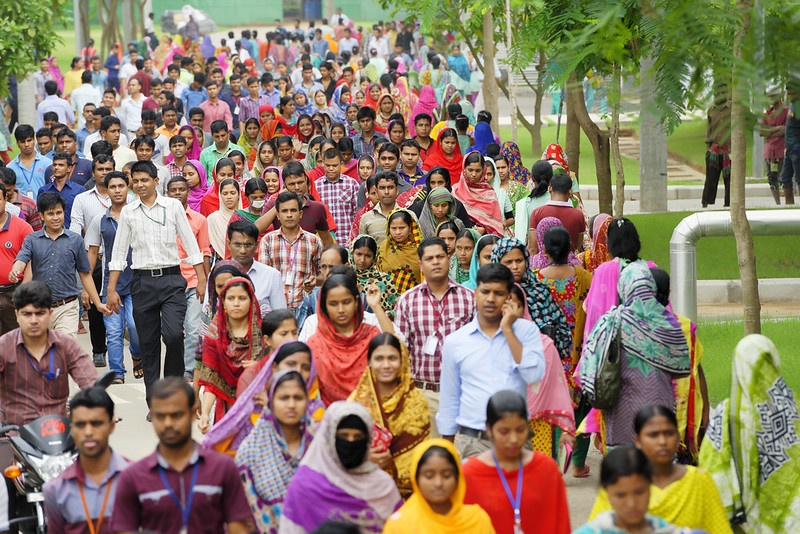
Photo: Bangladeshi garment employees leaving a clothing plant at the end of their working day. Credit: Crozet M. / ILO