
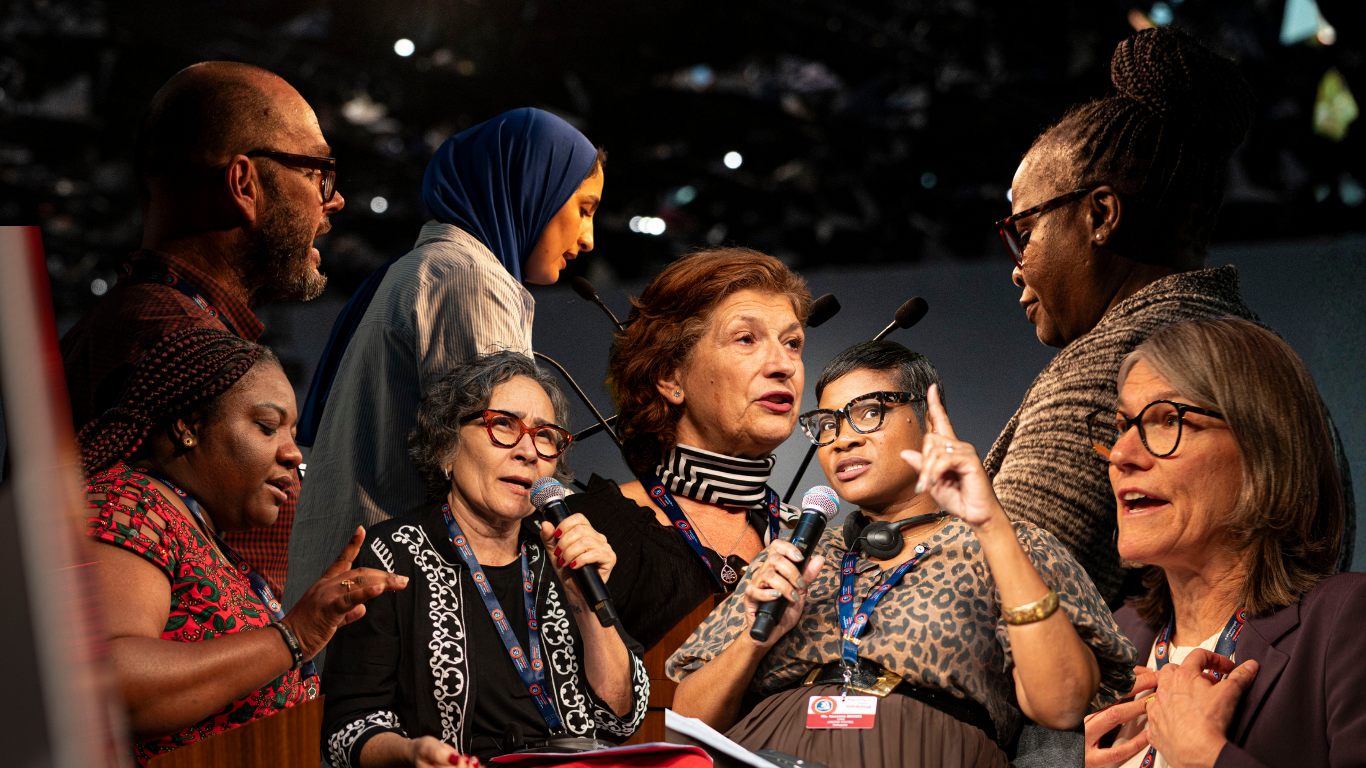
5 March, 2026In November 2025, as delegates gathered at IndustriALL’s fourth congress in Sydney, feminist trade unionism took centre stage. Vice president Rose Omamo set the political tone for what would become a defining moment for the organization.
“This resolution calls us to adopt feminism as a transformative political project. It is a tool to confront the root causes of oppression.”
Her intervention was not procedural. It was directional. As a long-time advocate for feminist trade unionism within IndustriALL, her words reflected years of organizing work from the women’s committee that shaped the resolution and built momentum toward this moment. Feminism, she made clear, is not an accessory theme. It is a political framework for power.
When the vote came, there were no votes against. No abstentions.
This was not a symbolic moment. It was a strategic turning point, a deliberate political decision by IndustriALL affiliates to place feminist trade unionism at the centre of the organization’s agenda.
What happened in Sydney marked a structural shift. Feminism was no longer positioned at the margins of union debate. It was recognized as central to organizing strategies, bargaining priorities and global direction.
The feminist resolution states that feminist trade unionism must be mainstreamed across all areas of IndustriALL’s work, from Just Transition to trade policy, from organizing to global framework agreements, from occupational health and safety to corporate accountability.
This is not an add-on. It defines how the organization moves forward.
Feminism as a transformative political project
If Rose Omamo set the political direction, the first intervention from the floor demonstrated that feminist trade unionism is a collective commitment, including from male leadership.
Etienne Vlok from SACTWU in South Africa, began by naming women leaders across his union structures, presidents, general secretaries and global representatives. It was not a rhetorical gesture. It was recognition of concrete shifts in power.
“I come from a union whose president is a woman. I come from a union whose general secretary is a woman… This makes me proud.”
This expressed pride with purpose. It acknowledged progress while refusing complacency.
“There are now more than 40 per cent women delegates in this congress. But 40 per cent is not equality. It is a foundation to build on.”
As the first speaker in the debate, and as a male trade unionist, his message was clear: feminist transformation is not a women’s issue. It is a union issue. Representation alone is not the goal. Structural equality is.
The resolution reflects this approach. It demands that feminist thinking inform organizing strategies, collective bargaining and union governance.
Women’s leadership must not only be visible but empowered, resourced and embedded in decision-making processes.
Challenging patriarchal union cultures
Several affiliates spoke candidly about internal union dynamics.
Leontine Mbolanomena from FESATI Madagascar was direct:
“We can give quotas. We can give titles to women. But we don’t trust the quotas. They don’t get real responsibilities and make decisions.”
Her words resonated because they addressed an uncomfortable truth. Formal inclusion does not automatically translate into power. Feminist trade unionism requires structural change in decision-making processes, accountability and leadership culture.
Maria Travasson Ramos from CNM CUT Brazil sharpened the political stakes:
“Feminism must be part of our everyday work. Not empty words but a real policy that fights for justice. There can be no strong trade unions without strong feminism.”
This logic runs through the resolution. Feminist principles must shape union structures, policies and campaigns. The aim is not visibility. It is transformation.
Grounded in workplace realities
The debate was rooted in lived experience from sectors where women workers face systemic discrimination and violence.
Rukmini VP from INTWF India explained:
“I have been a witness to routine harassment and discrimination of women employees at the workplace.”
Endang Wahyuningsih from FSP KEP Indonesia connected feminist organizing directly to occupational health and safety:
“Women should not only be in the women’s committee. They must be represented in all committees, especially OHS, where women workers need protection, including protection of their reproductive health and freedom from sexual harassment.”
The resolution expands OHS standards to explicitly include sexual and reproductive health and rights and calls for gender-transformative training across supply chains. It strengthens commitments to institutionalize prevention of gender-based violence and harassment in collective agreements and labour frameworks.
Sujana Purba from FSP2KI Indonesia put it plainly:
“There shouldn’t be any toleration for sexual harassment or discrimination.”
These demands align with the resolution’s call for transparent pay practices and structural mechanisms to eliminate gender-based wage and promotion disparities.
Feminist political economy
One of the most forward-looking aspects of the resolution is its embrace of feminist political economy.
The text links gender justice to global trade regimes, neoliberal restructuring and climate crisis. It calls for a coordinated feminist political economy strategy within IndustriALL to shape trade policies and solidarity responses.
Darius Guerrero from PTGWO in the Philippines articulated this connection clearly:
“We push for a wealth tax and for climate justice so that both are central to the Just Transition we are fighting for.”
The resolution demands a gender Just Transition that incorporates care work and women’s economic agency. It recognizes care work as foundational labour that must be formalized, protected and integrated into collective bargaining and economic policy. This shifts feminist trade unionism beyond representation and into economic restructuring.
Standing firm against backlash
The resolution also addresses the rise of right-wing authoritarianism and anti-feminist backlash. It commits unions to defend civic space and protect women organizers facing repression.
Lamia Safa from SNP-CDT in Morocco framed the broader stakes:
“Liberating women is the liberation of our society.”
In the current global climate, this is not a neutral position. It is a strategic one.
Leadership and institutional ownership
Reflecting after Congress, assistant general secretary Christina Olivier describes the resolution as a defining moment for the organization’s political direction.
“This resolution makes clear that feminism is not a side issue for IndustriALL. It is central to how we organize, how we bargain and how we fight. In the current global climate of inequality and backlash, taking this position is not optional. It is necessary.”
She emphasizes that the unanimous vote sent a strong signal internally and externally:
“Our affiliates have spoken with one voice. Feminist trade unionism is the direction of travel for our movement.”
For leadership, the significance of the resolution lies not only in its adoption, but in what it demands moving forward, concrete changes in organizing strategies, bargaining priorities and institutional culture.
From words to power
The resolution upholds a collective vision of feminist trade unionism that centres the leadership, experiences and rights of women workers in all their diversity.
In Sydney, affiliates did more than adopt a text. They claimed feminism as a central organizing framework for confronting corporate power, climate injustice and economic inequality.
- From representation to restructuring
- From recognition to redistribution of power
- From words to power
Feminist trade unionism has moved from commitment to strategy at the centre of IndustriALL’s agenda. In doing so, the organization has positioned itself as a forward-looking global union prepared to meet the political challenges of this moment with clarity and conviction.