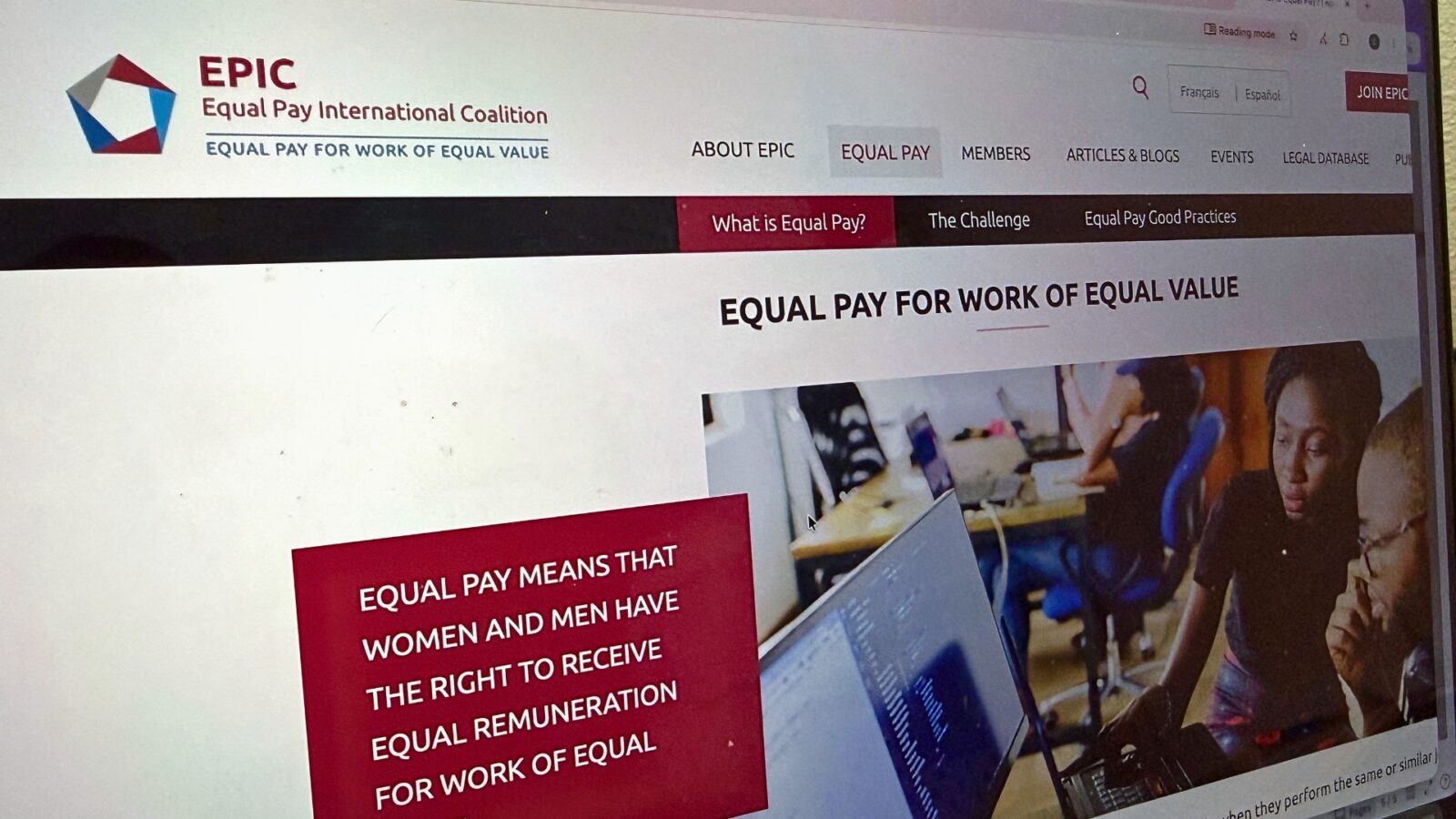
25 September, 2026Having recently joined the Equal Pay International Coalition (EPIC), IndustriALL Global Union took part in its technical meeting in Dublin, Ireland, on 17 September 2026 to mark Equal Pay Day, and immediately saw the value of being part of this unique global platform.
Access to leading experts, innovative methodologies and country experiences, combined with new opportunities for networking and collaboration, is creating valuable synergies. These can help strengthen and scale up IndustriALL’s pay equity work across sectors and regions.
Pay equity has become a key priority in IndustriALL’s gender-transformative agenda. The organization has developed a Pay Equity Toolkit, training modules and awareness-raising materials. It has already delivered programmes in Türkiye, Asia and Sub-Saharan Africa. Through global framework agreements (GFAs), IndustriALL is also working with multinational companies to address gender pay gaps and advance pay equity in practice.
“If we want to increase our impact and scale up our efforts, IndustriALL and its affiliates cannot work in silos at sectoral or company level with individual employers. To achieve greater impact, bring more stakeholders on board and strengthen capacities, these efforts need to be embedded in broader national and global negotiation and capacity-building strategies. Our experience has shown that many stakeholders who should play an active role in implementing and monitoring ILO Convention No. 100 still lack understanding of the principle of equal pay for work of equal value,”
said Armelle Séby, IndustriALL director for gender and white-collar workers.
What the data show
The latest evidence confirms both the urgency of action and the opportunities for change. Data from the Organisation for Economic Co-operation and Development (OECD) show that the average gender pay gap across OECD countries remains 10.1 per cent and that progress in closing it is far too slow. The actual gap is likely to be larger, as many indicators measure only full-time workers and fail to fully capture the impact of part-time work and care-related career interruptions.
The data also reveal the persistent undervaluation of women-dominated sectors. Around 87 per cent of long-term care workers are women, while demand for care workers is projected to increase by 22 per cent by 2033 due to population ageing.
At the same time, women remain underrepresented in future-oriented occupations, with only 12 per cent of employed women working in ICT-intensive jobs. Encouragingly, around two-thirds of OECD citizens support policies aimed at increasing the participation of women and other underrepresented groups in the labour market.
These findings highlight an important lesson for trade unions. Pay transparency can expose inequalities and give workers tools to challenge discrimination. On its own, however, it cannot address the structural causes of gender pay gaps: unequal care responsibilities, occupational segregation and the persistent undervaluation of women’s work. Lasting progress requires collective bargaining, gender-neutral job evaluation and strong enforcement mechanisms.
Lessons from Brazil and Canada
Important lessons are also emerging from countries that have introduced pay transparency and pay equity legislation.
In Brazil, the 2023 Equal Pay Law (Law No. 14,611) has generated valuable data and increased the visibility of gender pay inequalities. The findings show some encouraging developments. These include growing participation of women in the labour market and improvements in salary scales, career progression systems, childcare support and flexible working arrangements. However, these advances have not yet translated into equal pay outcomes. The data also revealed significant disparities affecting Black and Indigenous women, showing the importance of addressing the intersection between gender and race.
Canada’s Pay Equity Act provides another important example. It covers approximately 1.4 million employees and more than 5,000 federally regulated employers. The legislation shifted Canada from a complaint-based system to a proactive approach requiring employers to identify and correct pay inequities. In 2025 alone, 16,700 employees received pay adjustments, with an average wage increase of CAD 2.37 (approximately US$1.70) per hour. This demonstrates the concrete impact pay equity legislation can have when properly implemented.
Implementing pay transparency is also complex. Challenges include technical difficulties in collecting and analysing pay data, limited understanding of legal obligations, the resources needed to develop pay equity plans and the difficulty of capturing intersectional inequalities. Capacity building, proactive enforcement and social dialogue are key to overcoming them.
Slow progress in Europe
Employer resistance is a common challenge. In Europe, implementation of the EU Pay Transparency Directive remains slow, with only five member states having fully transposed it so far. Strong employer lobbying against the directive partly explains this.
Collective bargaining delivers
Examples from Australia show the importance of social dialogue. In the early childhood education sector, a multi-employer agreement negotiated by the United Workers Union delivered wage increases of around 15 per cent for 91,000 workers. In the aged care sector, a successful union campaign led to wage increases of up to 28 per cent after the Fair Work Commission recognized the historic undervaluation of care work.
These examples show that collective bargaining remains one of the most effective tools for turning pay transparency into concrete wage improvements.
A practical tool for unions
To support this work, the International Labour Organization (ILO) has developed a practical tool that can help unions and employers move from identifying pay gaps to correcting them. The Gender-Neutral Job Evaluation Tool for Equal Pay (GNJEEP) helps enterprises evaluate jobs using objective criteria such as education, effort, responsibility and working conditions, compare jobs of equal value, identify workers who may need pay adjustments, estimate pay gaps and generate automated diagnostic reports.
The GNJEEP is designed to support social dialogue and collective bargaining by providing objective evidence to address the undervaluation of women’s work and advance equal pay for work of equal value.
A detailed report of the EPIC technical meeting is available on request from aseby
About EPIC
EPIC is led by the ILO, UN Women and the OECD. Launched in 2017, it brings together governments, employers’ and workers’ organizations, companies, civil society and academia to achieve equal pay for women and men everywhere. It contributes to target 8.5 of the UN Sustainable Development Goals. Visit their website.