9 July, 2026Confédération démocratique du travail (CDT) continues to organize demonstrations in support of workers' social rights, urging the government to fulfil its commitments to workers.
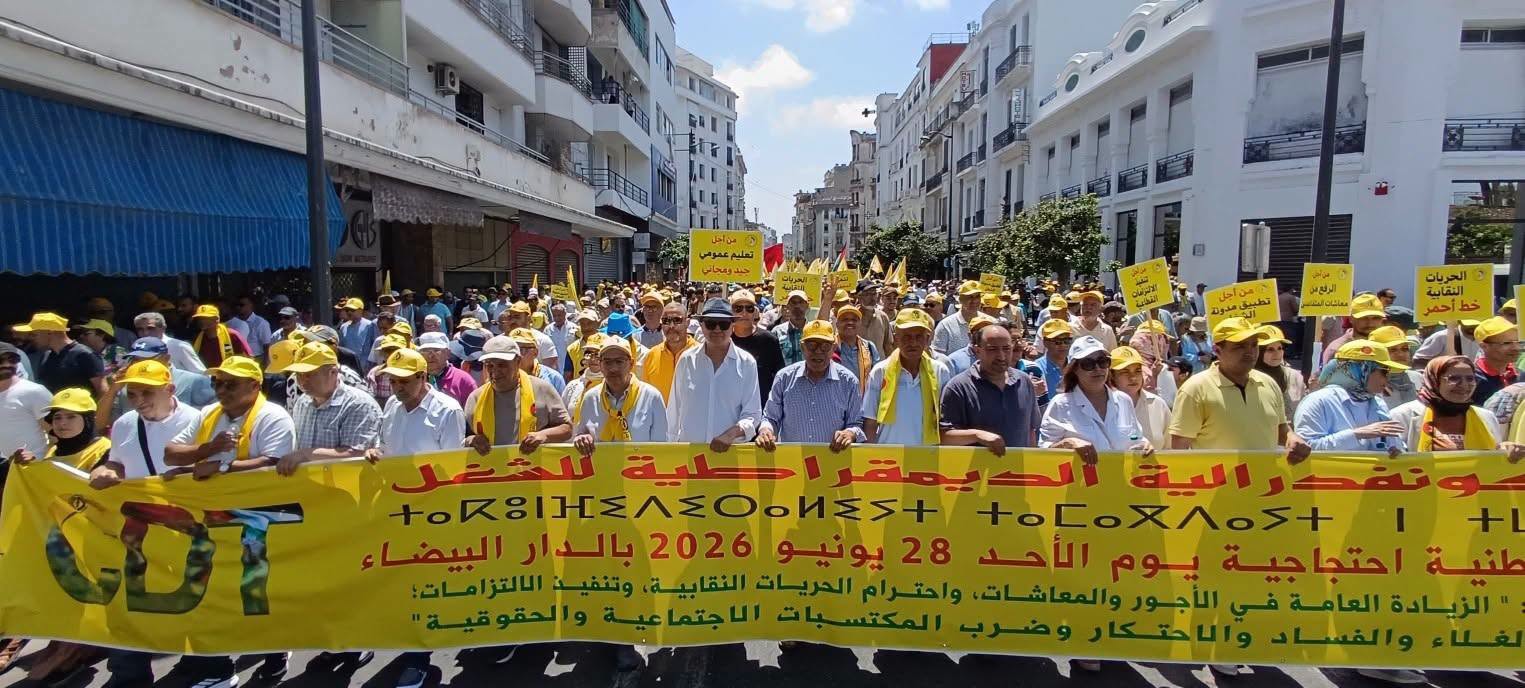
The Moroccan working class joined a large-scale national protest march in Casablanca on Sunday 28 June 2026. The march was organized by CDT.
Protesters denounced the government’s social policy and the persistent rise in prices. They also spoke out against the collapse in purchasing power, the refusal to increase wages and pensions and continued restrictions on trade union freedoms.
Regional marches organized by the CDT also took place across Morocco on Sunday 17 May 2026, demanding an immediate increase in wages and pensions, an end to the erosion of purchasing power, and fulfilment of social commitments. Participants accused employers of restricting trade union activity and the CDT rejected the purely formal nature of social dialogue, calling for concrete measures on wages, pensions, taxation, social protection and working conditions.
Khalid Houir Al-Alami, general secretary of CDT, said:
“The social conditions in Morocco are worrying and called for urgent intervention to address the impact of the economic crisis on the purchasing power of the working class and the general public. These protests are an expression of the working class’s rejection of public policies that have failed to meet their basic demands, foremost of which are a pay rise, a review of income tax and the fulfilment of social commitments.”
Khalid Houir Al-Alami added that Morocco is experiencing a social crisis that endangers social security, with high living costs, declining purchasing power and rising youth unemployment and that trade union rights are being violated by employers who reject union organizing.
New national march amid deepening cost-of-living crisis
Building on this momentum, the CDT has announced a further national protest march in Casablanca on Sunday 12 July 2026, in continued rejection of the deteriorating social situation and widening hardship affecting broad sections of Moroccan society.
The escalation comes against a backdrop of continued increases in the price of basic goods and services. The price of red meat has climbed to unprecedented levels and fuel prices remain another major concern given their direct impact on transport costs and the price of goods more broadly.
The CDT said the new march protests the failure of successive rounds of social dialogue to respond to workers’ core demands and the continued postponement of urgent issues, chief among them a general increase in wages and pensions, reform of income tax and fulfilment of previously agreed social commitments.
The union also criticized a recent vote by the House of Councillors, Morocco’s second parliamentary chamber, rejecting draft laws that would have capped petrol and diesel prices and reopened the Samir oil refinery, arguing this would have strengthened national energy security.
The CDT further denounced growing restrictions on trade union freedoms and the right to strike, condemning legal actions against trade unionists. For the CDT, the upcoming march is a renewed call for policies to protect purchasing power and strengthen social justice for Moroccan workers.
IndustriALL assistant general secretary, Kemal Özkan, said:
“What our Moroccan affiliates want is legitimate. Inequality is increasing in the world and also in Morocco. It cannot continue in this way, something has to change. IndustriALL is in full solidarity with our Moroccan sisters and brothers in struggle.”