
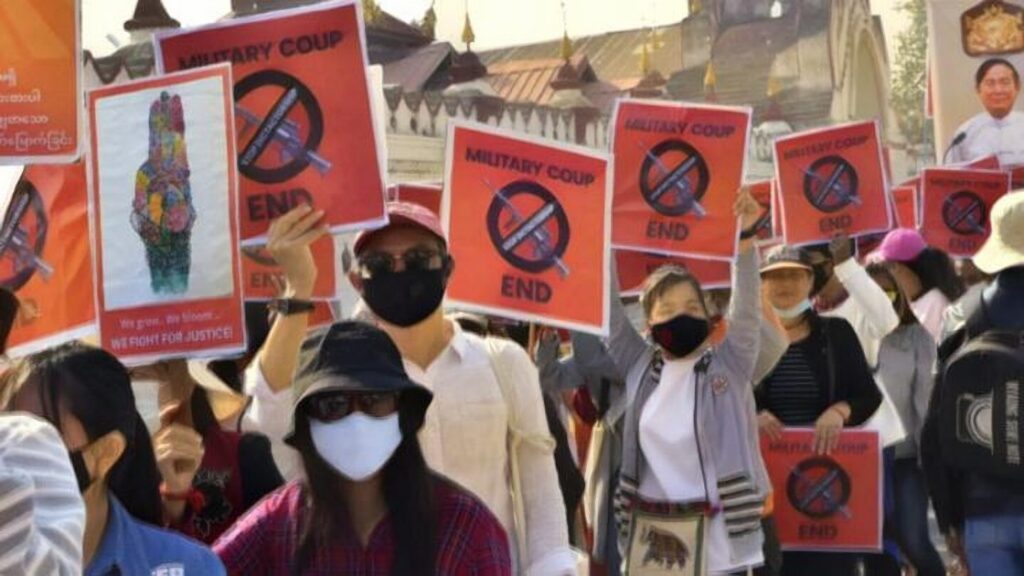
25 February, 2026Five years after the military coup, Myanmar is no longer a “high-risk sourcing destination.” It is a war economy. In this joint op-ed, Myanmar trade union leader in exile Khaing Zar and IndustriALL Global Union General Secretary Atle Høie set out why responsible exit is now the only responsible choice.
Five years after the military coup, Myanmar is no longer a “high-risk sourcing destination.” It is a war economy.
The garment sector remains one of the junta’s largest sources of hard currency. The World Bank reported US$5.5 billion in garment exports in 2022. Exports remained above US$5 billion in 2023 before falling to US$4.46 billion in 2024. In that same year, Europe alone imported approximately €2.8 billion worth of textile and clothing products from Myanmar, much of it entering duty-free under the EU’s Everything But Arms (EBA) scheme.
These are not neutral trade statistics. They represent large-scale foreign-exchange inflows into a financial system tightly controlled by the military authorities.
State media reports document repeated Central Bank of Myanmar (CBM) foreign-exchange allocations to priority imports such as fuel and edible oil. On 2 September 2024, the CBM instructed that up to 75 per cent of foreign currency earned from trade, CMP garment exports, and natural-resource sales could be directed toward fuel and palm-oil imports. As economist Sean Turnell has detailed in The Military, Money, and Myanmar: Breaking the Nexus, post-coup measures have centralized foreign-exchange control through forced currency conversions, multiple exchange rates, restrictions on outward payments and tight control over currency dealers. Export earnings, including those from garments, do not flow freely in such a system. They are captured and redirected.
They help sustain regime priorities.
Myanmar’s military continues aerial bombardments, forced recruitment, arbitrary detention and the systematic destruction of civilian communities. Oil and dual-use fuel imports are indispensable to these operations. When foreign currency is centrally controlled, it becomes part of the machinery that enables repression.
The international community has acknowledged this crisis.
The U.S. Treasury’s Office of Foreign Assets Control (OFAC) has imposed sanctions under Executive Order 14014 targeting military leaders and military-linked enterprises. The UK’s Office of Financial Sanctions Implementation (OFSI) and the European Union have adopted parallel restrictive measures. These sanctions prohibit making funds or economic resources available to designated actors. They are intended to prevent financial support from sustaining the junta.
Yet sanctions cannot achieve their purpose if broader commercial activity continues to generate foreign exchange that enters the same controlled system. When currency is captured and reallocated by the military authorities, continued sourcing risks undermining the objectives of sanctions policy.
In June 2025, the International Labour Organization invoked Article 33 of its Constitution, an extraordinary measure used only in cases of serious and persistent violations. The ILO called on member States to review their relations with Myanmar and ensure they do not contribute, directly or indirectly, to ongoing abuses.
That review must extend to trade preferences.
Myanmar continues to benefit from the EU’s EBA scheme, which grants duty-free market access on the condition of compliance with core human rights and labour conventions. Those conditions are plainly not met. Freedom of association has been dismantled. Independent unions have been outlawed. Trade union leaders face arrest and persecution. Continuing EBA under these circumstances sends a dangerous signal: that systematic violations do not carry meaningful economic consequences.
The EU should immediately initiate suspension of EBA preferences for Myanmar. This is not a measure against workers; it is a measure against a regime that captures trade revenues. Preferential access should not be allowed to strengthen a system that systematically crushes labour rights.
Some brands argue that enhanced human rights due diligence allows them to remain responsibly engaged. But due diligence requires workers to speak freely and organise independently. Those conditions do not exist. Monitoring mechanisms cannot substitute for freedom of association. In the absence of genuine mitigation possibilities, continued sourcing becomes increasingly indefensible.
Where mitigation is impossible, disengagement becomes necessary under the UN Guiding Principles on Business and Human Rights and the OECD Guidelines for Multinational Enterprises.
This does not mean abrupt withdrawal without safeguards. It means responsible exit.
Responsible exit requires advance notice, wage guarantees, severance payments and compensation funds. It requires consultation with legitimate worker representatives, including those in exile. It requires safeguards to prevent factories or contracts from being transferred to military-linked conglomerates.
Responsible exit is not abandonment. It is refusal to remain financially entangled in repression.
Myanmar’s workers have already paid a heavy price for resisting military rule. Many joined the Civil Disobedience Movement. Many have been dismissed, displaced or forced into hiding. They do not ask for cosmetic audits. They ask for international actors to align their economic decisions with their stated commitments to human rights.
In a war economy, neutrality is an illusion.
Trade, sourcing and sanctions policy must be brought into coherence with reality. Continuing business as usual while repression deepens is not a neutral choice. It is a choice that carries responsibility.
The credibility of global labour rights and human rights commitments now depends on whether governments and brands are prepared to act accordingly.