
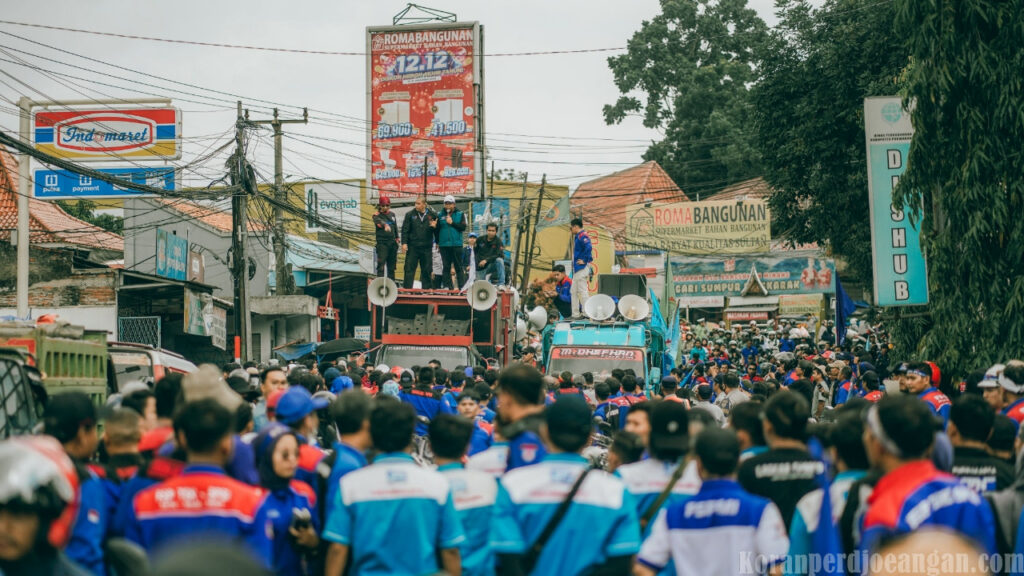



5 January, 2026Indonesian trade unions organized nationwide protests in the last two weeks of December 2025 against a newly introduced government regulation on wages, criticizing the lack of proper consultation with trade unions and the introduction of what unions describe as an unfair adjustment index.
Further protests took place in the first week of January in Jakarta, Bekasi, Karawang, West Java, Aceh and Riau. The president of the Indonesian Trade Union Confederation (KSPI) and the Labour Party, Said Iqbal, announced that workers would organize another large demonstration at the Presidential Palace and the parliament building on 8 January.
Unions have rejected the regulation, saying it was adopted without proper consultation and warning that the adjustment index, set between 0.5 and 0.9, could suppress minimum wages, particularly at the provincial level.
The protests followed the approval of the regulation by Indonesian President Prabowo Subianto on 17 December. The President said the changes aim to maintain workers’ purchasing power for a decent living, stabilize the national economy and take into account the 2024 ruling of the Constitutional Court. That ruling stated that the government must revise its minimum wage policy, taking into consideration the need for a decent living, justice and humanity and reinstated the sectoral minimum wage.
In response, KSPI has put forward four demands: at least a 6.5 per cent minimum wage increase; a 6–7 per cent increase to protect workers’ purchasing power; a 6.5–6.8 per cent increase as a realistic compromise; and an adjustment index of 0.7–0.9 instead of 0.5–0.9.
Riden Hatam Aziz, president of IndustriALL Global Union affiliate FSPMI, said:
“Tens of thousands of workers from Jakarta, West Java and Banten have taken the minimum wage issue to the streets. The government must abolish the new regulation, which poses a serious threat to a living wage, as it may result in no wage increase in some regions despite rising living costs. The regulation also contradicts the ruling of the Constitutional Court.”
On 19 December, IndustriALL general secretary Atle Høie wrote to the Indonesian President, urging the government to review the regulation. Høie said constitutional requirements, international labour standards and the principles of social dialogue must be respected and warned that the regulation was adopted “without meaningful public participation and without adequate consultation with trade unions, despite their constitutionally and internationally recognized role as social partners in wage determination”.
“The conclusions of the ILO Experts’ Meeting on Wage Policies, including living wages, reaffirm that wage-setting frameworks should be grounded in evidence-based methodologies, aimed at ensuring decent living standards and developed through genuine tripartite consultation,”
Høie said.