
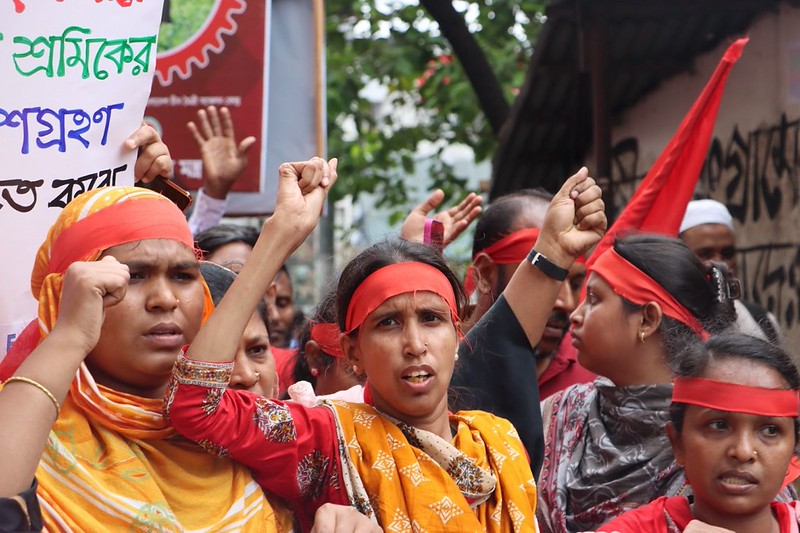


12 May, 2026Across South Asia, unions report diluted labour protections and weakened collective structures. What is presented as reform is in reality a restructuring of power away from workers.
Trade union leaders from Bangladesh, India, Pakistan, Nepal and Sri Lanka came together for a webinar on labour laws reforms, organized by IndustriALL on 4 May. Discussions highlighted how this shift is being operationalized. Wages remain stagnant, fixed-term employment is normalized and contracting expanded, reducing employer accountability.
Labour law reforms undermine rights
Governments are using legal reforms to narrow definitions of workers, making it harder to claim rights and protections. Union registration is becoming more restrictive, while surveillance and data exposure deter organizing. Joining a union is increasingly becoming a risk, weakening collective power and discouraging resistance.
Increased participation of women and young workers is often presented as progress. However, speakers warned about the dangers of this expansion taking place through precarious and low-paid work, without corresponding protections, job security or safeguards against exploitation.
Speakers highlighted a striking pattern of weak implementation of labour laws. Widespread labour law violations, ineffective inspection systems and increased barriers around organizing consistently undermine enforcement, even where formal protections exist.
This raised a critical question: when non-implementation is this widespread, does it cease to be a gap and become a strategy?
Building a collective response
Systematic documentation of violations and use of international mechanisms were identified as key tools. India’s inclusion in the preliminary list for ILO Committee on the Application of Standards (CAS) under Convention 081 offers a opportunity to push accountability, but sustained collective resistance will be essential to defend worker rights.
Unions stressed that growing informalization, labour deregulation and exclusion of workers from policy-making reflect a systemic shift across South Asia. These developments cannot be addressed in isolation. Unions must build stronger regional solidarity to develop common strategies, increase pressure and confront cross-border drivers of deregulation.
Kemal Özkan, assistant general secretary of IndustriALL says:
“Across global governance spaces, labour protections are treated as obstacles, collective rights as rigidity and precarity is repackaged as opportunity. What we are witnessing is not just economic change, but a deliberate weakening of democratic institutions and worker power.”
Ashutosh Bhattacharya, regional secretary of IndustriALL South Asia adds:
“In the name of consolidation and deregulation, hard-won rights are being systematically rolled back. This is why strengthening international solidarity and collective action is no longer optional, it is essential.”