
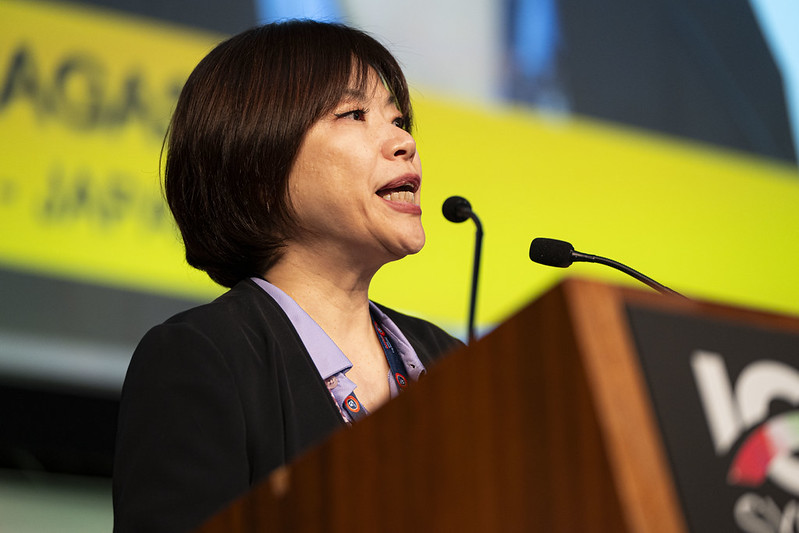
13 January, 2026Representing more than 1.9 million workers across diverse sectors, UA Zensen faces the same pressures confronting the rest of Japan’s labour movement, including declining union density and the rise of non-regular employment. The union has responded by concentrating on organizing workers often left outside traditional structures and by strengthening its involvement in supply-chain human rights issues. Elected president of UA Zensen last year, Tomoko Nagashima discusses how the union is preparing for the years ahead.
As president of UA Zensen, what are your top strategic priorities for the next three to five years?
“Our top priority is organizing, which is important for IndustriALL overall and of course for us as well.
“Japan’s unionization rate continues to fall, but UA Zensen is committed to increasing membership and exceeding our annual organizing targets. As unions in Japan are enterprise-based, we must reach companies that remain unorganised. We have already made progress in organizing part-time workers, who were traditionally not included, and we want to keep widening the scope of union membership. Our long-term goal is to build unions in every company and to strengthen bargaining power, particularly in small and medium-sized enterprises.
“UA Zensen has a long-standing focus on identifying and fostering leaders, which is something I am proud of. Since the 1960s, we have helped develop leaders both domestically and internationally, strengthening today’s labour movement. We are also working to develop the next generation of leaders and to promote more balanced leadership, particularly by supporting women.”
Your own background spans twenty-five years in the movement. How has your experience shaped your leadership today?
“I started in retail and became a full-time union officer in 2000. The company I worked for went bankrupt and we were struggling through a restructuring plan, supporting our members throughout. After a merger, I became general secretary of AEON Retail Workers’ Union. From there I continued to advance within UA Zensen, becoming chair of the commerce sector, vice president, and then last year president of UA Zensen. I also serve as deputy president of RENGO and as a steering committee member of IndustriALL’s textile and garment sector.
“The tasks are more difficult now. Twenty-five years ago I could focus on a narrower set of issues. Today the challenges are broader and more diverse, and the responsibilities have grown.”
How do you see UA Zensen’s role within Japan’s wider labour movement, given declining unionization rates?
“As I mentioned, we have to organize unorganised companies and accelerate our organizing efforts if we are to counter the decline in union density. Many unions are struggling with the same challenge. We should work more closely with RENGO, the Japanese trade union confederation, to help stop this trend. RENGO is trying to organize individual workers, and it may be necessary for us to consider other forms of organizing as well.”
How would you describe general attitudes toward unions in Japan?
“Japan has long had harmonious industrial relations and a history linked to the three guiding principles of productivity. With this approach, companies and unions cooperate in production, and after companies make a profit we negotiate over the distribution of that profit. In general this creates good relationships. However, some global multinational companies see unions as enemies, and in those cases the situation is more difficult.”
Can you please let us know more about UA Zensen’s focus on human rights due diligence?
“UA Zensen works to promote human rights due diligence in supply chains, and here global framework agreements are an important tool, implemented through social dialogue. In Japan, only three GFAs have been signed – one with IndustriALL and Mizuno, and two with Uni Global Union and AEON and Takashimaya. Japanese brands can be proud of this, but more work is needed and GFAs should be expanded to other companies. Increasing society’s awareness of human rights due diligence is important, and GFAs provide a meaningful way to help achieve that.”
What does global solidarity mean to UA Zensen in practice?
“Global solidarity is important and beneficial for two reasons. First, being globally connected allows us to obtain information that is valuable for unions and also for companies, because we can detect problems early and try to solve them.
“Second, we can learn from other countries. Workers in Japan and elsewhere face similar challenges, and some countries have solutions or initiatives that we can learn from. When Japanese companies operate overseas, there may be labour disputes or union-busting. Local unions sometimes reach out to us, and because we can obtain information and extend support, this becomes beneficial for the workers and also for the companies involved.”
FACT BOX
UA Zensen is Japan’s largest industrial union, representing more than 1.9 million members across a wide range of industries that shape daily life. Its coverage spans everything from textiles, chemical, pharmaceuticals and energy, to building materials, commerce and restaurants, including temporary agency work and contract work. The union is affiliated to the Japanese Trade Union Confederation, RENGO.
Cover photo: Tomoko Nagashima at IndustriALL Congress in Sydney, Australia, November 2025.