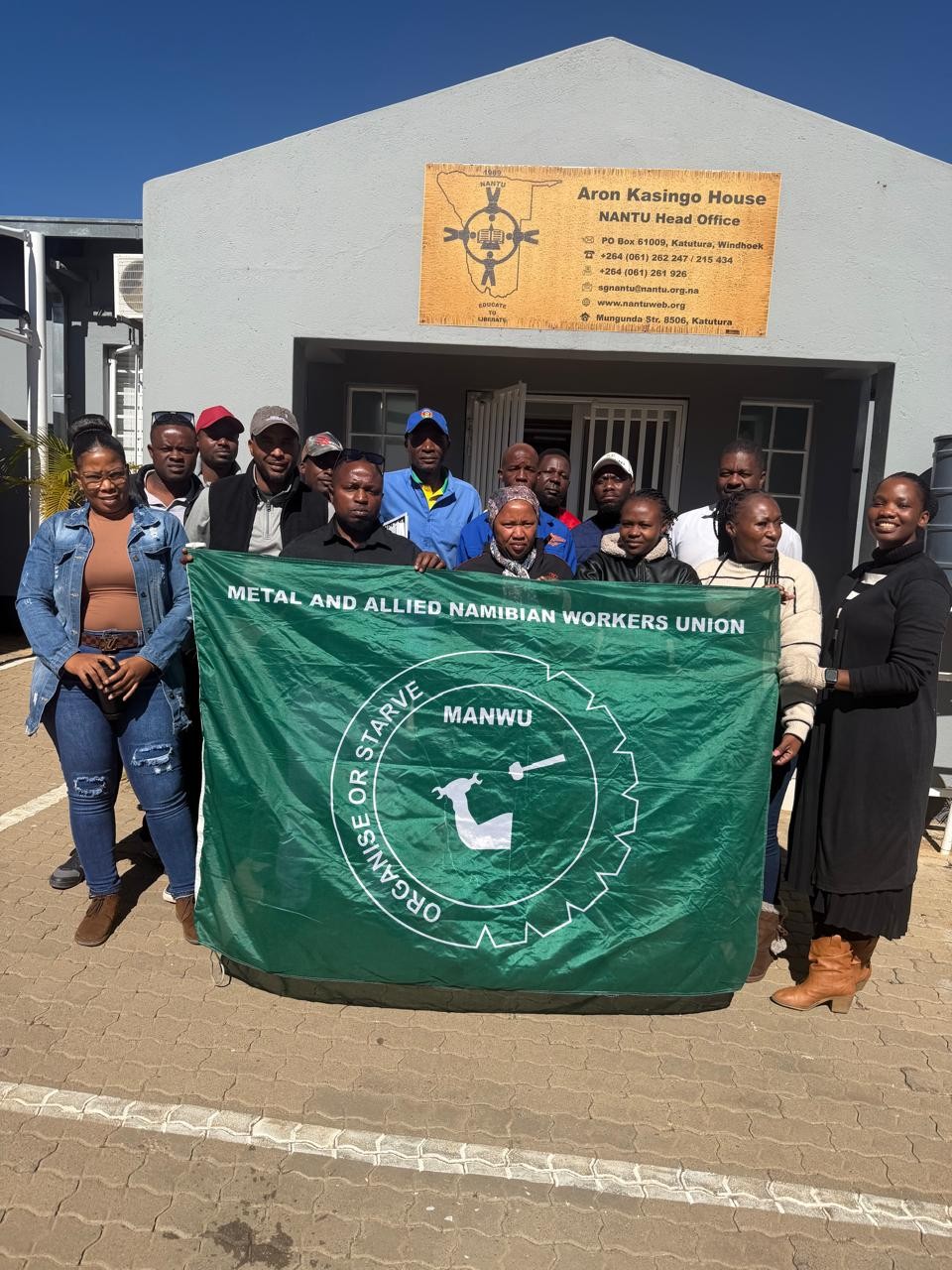
11 June, 2026Fourteen shop stewards from the Metal and Allied Namibian Workers' Union (MANWU) attended a capacity-building workshop in Windhoek on 4-5 June. The training focused on organizing the automotive industries, which employ about 40,000 workers.
MANWU, an IndustriALL affiliate, wants to boost its membership in the sector.
Namibia’s automotive sector is growing. The government has backed original equipment manufacturers (OEMs), most notably Peugeot, as anchors for a domestic industry. But the Peugeot project has stalled. The carmaker has struggled to sustain sales in the local market and has not broken into exports. Fewer jobs have been created as a result.
New entrants, among them Chinese manufacturers, are expected to make in-roads into Namibia’s still-modest market. Meanwhile, the government is laying groundwork for an electric vehicle (EV) industry. This is in line with a Just Transition policy that seeks to ensure the shift to clean transport does not happen at workers’ expense.
Learning the basics
The workshop, supported by IndustriALL Sub-Saharan Africa regional office, covered occupational health and safety (OHS), workplace case handling, organizing strategies and the Just Transition.
OHS committees were described as a centrepiece of the training. Workers learnt how to establish and run such committees. When they function properly, the committees are among the most effective mechanisms available. They reduce injuries, enforce legal protections and give workers a formal voice over working conditions. In a sector where safety risks are common and enforcement uneven, health and safety are key.
“We came to learn how to handle cases at the workplace, to know our rights and what the union can do for us,”
said Stephanie Kapuka who works at Gobabis Toyota.
Case handling including navigating disciplinary procedures, grievances and disputes were discussed. For workers without specialist legal training, workplace conflicts can feel unwinnable. The workshop aimed to change that, building confidence alongside competence.
Participants were honest about the organizing challenge. Collective bargaining improves only when membership grows. Workers must trust that the union can deliver. And the union must have the numbers to sit at the negotiating table.
Just Transition
In Namibia, where mining and manufacturing are central to livelihoods and under pressure from decarbonization, the meaning of the Just Transition is contested. For MANWU’s members, just transition means the automotive sector will be transformed. The global push for EVs is reshaping the industry, even if uptake in Namibia remains low. If workers are not at the table, the costs will fall on the most vulnerable. That was the clear message from the shop stewards. MANWU is participating in national Just Transition discussions and wants to ensure that shop stewards can translate the policy language back to the shop floor.
“I want to understand what Just Transition means for our jobs, not just to hear the phrase but know what it actually means for workers like us,”
said Andreas Hochobes from Drydock and Ship Repair.
“With the transition going through the automotive industries as a result of e-mobility, unions should continue their recruitment drives and engage in collective bargaining. Social dialogue with key partners remains essential in order to protect workers’ working conditions,”
said Paule-France Ndessomin, IndustriALL regional secretary for Sub-Saharan Africa.