17 February, 2026Global supply chains face constant disruption from pandemics and wars to trade tensions and climate shocks. Yet when crises hit, workers are too often forced to absorb the costs.
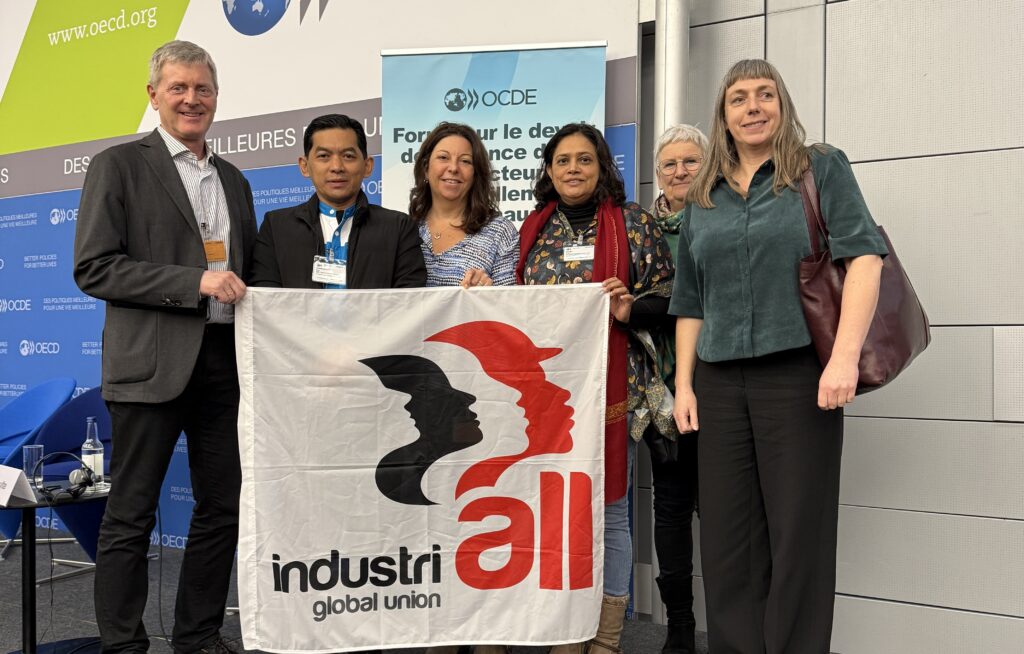
At the 12th OECD Forum on responsible business conduct in Paris, marking 50 years of the OECD guidelines for multinational enterprises, IndustriALL delivered a clear message: resilience must be built on binding agreements, responsible purchasing practices and collective bargaining, not voluntary pledges.
In the opening panel on supply chain shocks, IndustriALL garment and textile director Christina Hajagos-Clausen challenged the structural imbalance in global production, warning that supply chain “agility” frequently shifts commercial risk downward.
“When crises hit, brands adjust their purchasing practices overnight. Workers do not have that flexibility. Without collective bargaining and binding agreements, they are left to absorb the shock.”
OECD data presented at the forum showed that while most companies now publish sustainability information, only a small proportion meaningfully report on human rights due diligence. For unions, this reflects a persistent implementation transparency gap which without enforceability does not protect workers.
Christina Hajagos-Clausen stressed that collaboration only works when it includes enforceable commitments on purchasing practices, wages and industrial relations. Binding models such as the Bangladesh Accord and the ACT Cambodia framework demonstrate how negotiated agreements can embed worker representation into supply chain governance and create greater predictability in times of crisis.
An ACT-organized session focused on Cambodia’s brand-supported collective bargaining agreements, a practical effort to connect purchasing commitments with higher wages.
Athit Kong, president of Cambodian union CCADWU, emphasized the importance of bringing brands directly into bargaining structures:
“This is the element of bringing the brand in. I don’t see another model than these three coming together that would be more beneficial to workers. We want to make decent wages, but we also want to make this sustainable for the industry, the skills foundation is necessary.”
His intervention highlighted that wage increases must rest on strong industrial relations systems that deliver fairness for workers and stability for the sector.
Speakers acknowledged that many corporate initiatives have failed to deliver real improvements. The emerging consensus was clear: wage growth cannot be separated from purchasing commitments. Responsible purchasing must reinforce, not undermine, collective bargaining.
Cambodia’s garment sector, employing predominantly women and supporting millions of livelihoods, has become a testing ground for this approach. While described as a “leap of faith,” binding agreements on purchasing are beginning to show measurable results, built on trust between brands, unions and employers and aligned with national industrial priorities and skills development.
IndustriALL general secretary, Atle Høie, underscored the impact:
“It is crucial to connect collective bargaining with brands’ purchasing practices to implement a living wage. In Cambodia, this is becoming a reality. We now have eight signed collective agreements lifting the wages of tens of thousands of workers. This is a sensational agreement and it shows that binding commitments can deliver real results for workers.”
The conclusion from Paris was unmistakable: resilience without workers’ rights is an illusion. Enforceable standards, sectoral bargaining and shared responsibility are the foundation of stable and just supply chains.
For IndustriALL, the direction is clear: move from voluntary commitments to binding agreements, align purchasing with wage-setting and ensure workers and their unions are embedded in supply chain governance.
Binding agreements deliver and when unions are at the table, supply chains become more stable, predictable and fair.