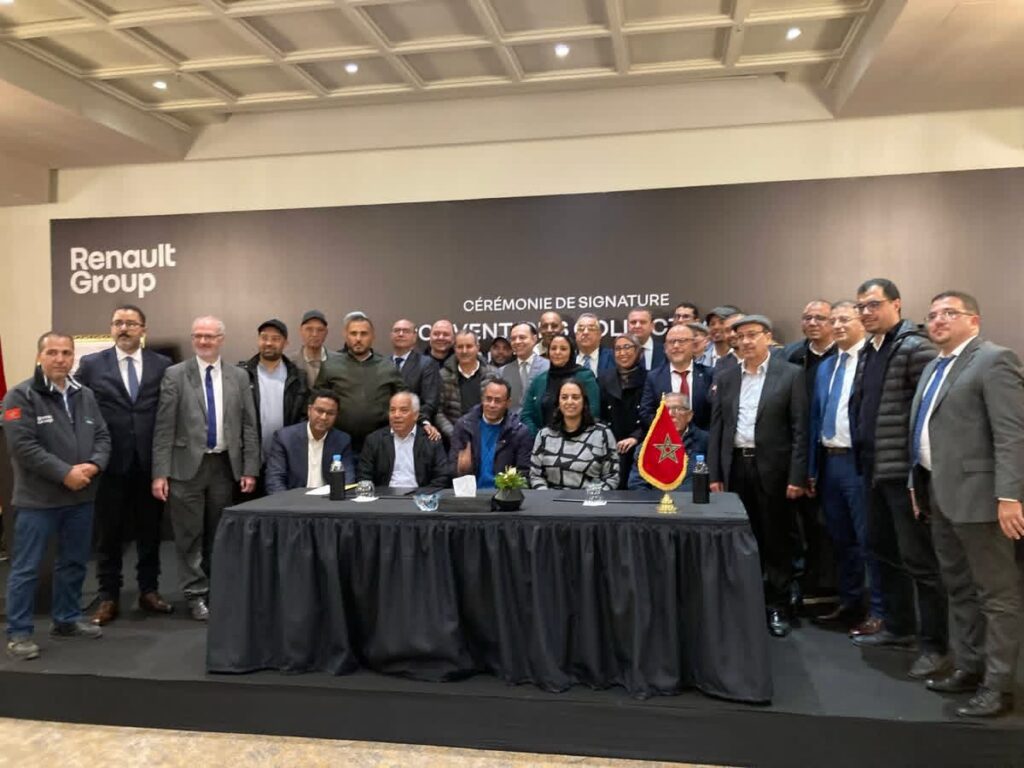
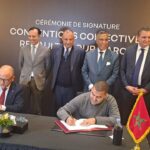
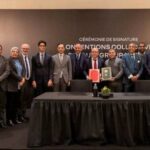
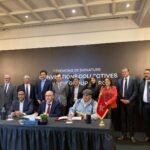
16 December, 2025Last week, Renault Morocco signed three collective agreements in Casablanca and Tangier with the unions affiliated to IndustriALL -Syndicat Nationale des Industries de la Métallurgie et Electromécanique - SNIME-CDT La Confédération démocratique du travail (CDT) and Fédération Nationale de la Métallurgie et des Industries Synthétiques Métallurgiques et Electroniques - FNMISME - UMT Union marocaine du travail (UMT).
The signing ceremony was presided over by Younes Sekkouri, minister of economic integration, small business, employment and skills and Riadh Mezour, minister of industry and trade. It was attended by Mohamed Bachiri, managing director of Renault Morocco. It was also attended by a trade union delegation from UMT led by secretary general, Miloudi Moukharik, and a delegation from CDT, led by secretary general Khalid Alami Houir.
The agreement will improve workers’ benefits and working conditions. It also emphasizes the importance of ongoing dialogue in promoting the gains of the approximately 10,000 workers and ensuring the development of the company. The agreement also includes new provisions relating to Just Transition particularly on job security through continuous training and skills acquisition to adapt to modern technology and automation.
The agreement concerns workers at the Somaca factory in Casablanca, affiliated to the CDT, and the Renault factory in Tangier, affiliated to the UMT, which are renewing the agreement for the third consecutive time. The agreement also concerns Renault Commerce Morocco workers affiliated to CDT through the signing of their first collective agreement.
IndustriALL has a global framework agreement with Renault. Through this agreement, Renault commits to working with its suppliers to ensure they comply with fundamental workers’ and trade union rights. This issue was the subject of several meetings between Moroccan unions and Renault management in 2024 and 2025 and the IndustriALL Renault MENA Union Council. IndustriALL is also currently conducting a project on Just Transition in a Renault operation in Morocco, in collaboration with the company and union.
Minister of employment, Younes Sekkouri said: “The agreement reflects Morocco's approach to balancing workers’ rights and the needs of the company. We value ongoing social dialogue within the company because of its impact on human capital, which is essential to the company's success.”
Minister of industry and trade, Riadh Mezour, said: “These agreements aim to establish a solid and clear social framework that guarantees the rights and benefits of employees and contributes to improving working conditions within the group. This strategic move by Renault Morocco reflects its firm commitment to strengthening its social model and its renewed confidence in the sustainability and effectiveness of the Moroccan industrial system.”
Miloudi Moukharik, secretary general, UMT said: “The collective agreement has been a constant demand of UMT since the factory was established, given its importance in supporting workers’ rights. Labour laws represent the minimum social standards and therefore a collective agreement is needed to improve the situation of workers. We are proud of this exemplary collective agreement, which will reorganize the relationship between workers, their representatives and management. In response to this important agreement, the union office and human resources will need to motivate workers to increase productivity and ensure the quality of cars manufactured in Morocco.”
Secretary general of CDT, Khalid El Alami Houir, said: “The collective agreement signed represents a qualitative shift in the structure of relations between the company and its employees. The agreement guarantees greater protection of workers’ rights while taking into account the rights of employees and, at the same time, the needs of the company and its competitiveness requirements at the national and international levels. Permanent and responsible social dialogue is an important factor in reaching such a collective agreement.”
Mohamed Bouchmal, secretary general of the Renault Tangier Union – UMT and board emmebr of Fédération Nationale de la Métallurgie et des Industries Synthétiques Métallurgiques et Electroniques – FNMISME – UMT said: “This agreement sets an example that should be followed and we call on other companies to conclude similar agreements, because collective agreements make it possible to compensate for the shortcomings of labour law and enable workers to gain new social benefits. The framework agreement between IndustriALL and Renault formed an important basis for the current collective agreement, which provides for sustainable social dialogue.”
Mohamed Moufid, secretary general of Renault Casablanca SOMACA Union -CDT and general secretary Syndicat Nationale des Industries de la Métallurgie et Electromécanique – SNIME-CDT said: “The agreement represents a milestone in the history of social dialogue and reflects the strength of social dialogue within the company and the spirit of responsible partnership.”
IndustriALL general secretary, Atle Høie, said:
“The global automotive industry is undergoing a major transformation that is affecting jobs and working conditions. We congratulate the workers, unions and all other parties involved on this important achievement, which addresses such transformation and is being managed wisely through genuine social dialogue, leading to agreements that maintain social and economic balance.”