
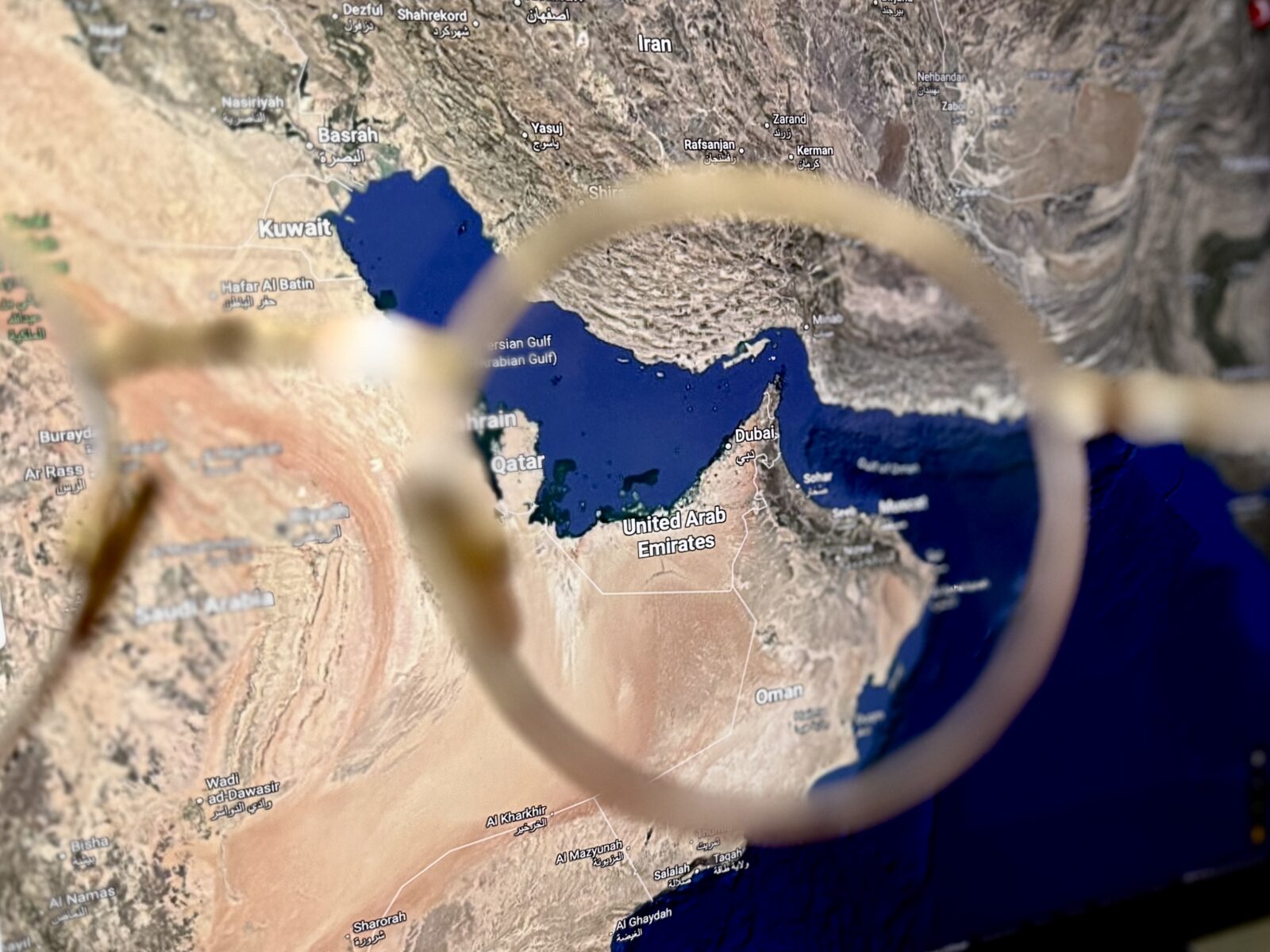
13 May, 2026The military attacks carried out by the United States and Israel against Iran, and the closure of the Strait of Hormuz that followed, have sent energy prices surging and triggered fuel shortages, rationing and inflationary pressure across the global economy. Governments are now making some of the most consequential energy decisions in decades, fast and without workers.
The European Commission has already fast-tracked its AccelerateEU package, bringing forward electrification targets and grid investment plans. Across Asia, governments are rushing to expand solar, wind and battery capacity. These are not transition plans developed through social dialogue. They are emergency responses to a supply shock, and the workers who will build and operate the new system are not at the table.
That is not a new problem. It is an old one, moving faster.
The IEA’s April Oil Market Report sets out the scale of what has already happened. Global oil supply fell by 10.1 million barrels per day in March, the largest disruption in the history of the global oil market. Petrochemical plants across Asia have cut operating rates by between 10 and 30 per cent, threatening supply chains in manufacturing, textiles, construction and packaging. Governments across four continents, from Argentina to Ethiopia, from Pakistan to the Philippines, have introduced emergency measures to reduce fuel consumption. And the IEA is unambiguous about what restoring the energy system requires. The IEA’s own April Oil Market Report lists “the mobilisation of skilled labour and contractors” as a precondition for supply recovery, alongside political stability and the reopening of the strait itself.
Workers already knew the energy system was fragile. They knew the transition was coming and that too little was being done to shape it around their needs. What the Hormuz crisis has changed is the speed. Decisions that were supposed to take years are being made in weeks.
What IndustriALL president said and why it matters now
When IndustriALL president, Christiane Benner visited IndustriALL’s Geneva headquarters in March, she was direct about what Just Transition actually requires.
“To find common ground, our union needs one thing above all else: clarity on what decarbonization actually means for individual workplaces.” That means jointly analyzing which locations will be significantly affected, what skills will be needed and where jobs are at risk or new ones will be created. “Such a shared framework of facts lays the groundwork so that employees do not feel steamrolled.”
The Hormuz crisis has not changed that argument. It has made the consequences of ignoring it visible to everyone. Industry observers have warned that the world is going to get the energy transition forced on it in a very painful way, very quickly. That is precisely what IndustriALL and many other global unions have spent years trying to prevent.
The question is no longer whether the transition happens. It is whether workers help shape what replaces the system that just failed, or have that decision made for them by governments and employers responding to a crisis with no plan for labour.
The scale of the skills gap
The IEA’s World Energy Employment 2025 report put numbers to what workers on the ground already know. The energy sector now employs 76 million people worldwide, up more than 5 million since 2019 and has accounted for 2.4 per cent of all net new jobs created globally over the past five years. Energy employment grew at 2.2 per cent in 2024, nearly double the economy-wide rate.
But inside that growth story is a crisis in the making. Out of 700 energy-related companies, unions and training institutions participating in the IEA’s Energy Employment Survey, more than half reported critical hiring bottlenecks already threatening energy infrastructure delivery. To prevent that gap widening further by 2030, the number of qualified new entrants into the energy sector would need to rise by 40 per cent, requiring an additional US$2.6 billion per year in training investment globally. That is less than 0.1 per cent of world education spending.
The Hormuz crisis has not created that gap. It has exposed it. Rebuilding energy supply chains, in whatever direction governments now choose, will require the workers, the skills and the training institutions that barely exist. Knowing where they are, and where they are not, is the starting point.
Why unions cannot sit out the IEA survey
That is what makes the IEA Employment and Skills Survey, closing 15 May, more urgent than it has ever been.
Diana Junquera Curiel, IndustriALL’s director for Just Transition and industrial policy, is direct about what is at stake:
“the Hormuz crisis has done in weeks what we have been arguing for years: it has made the connection between energy security and workers impossible to ignore. The data from this survey is how we turn that moment into leverage, in every negotiation, every policy discussion, every conversation with governments and employers about what rebuilding actually requires. Without union voices in it, those arguments are weaker. It is that simple.”
Christiane Benner has been clear on what makes a Just Transition work in practice. It is not grand policy commitments. It is concrete tools: collectively bargained training programmes, transformation funds that workers help design and binding employment prospects that give people a reason to trust the process.
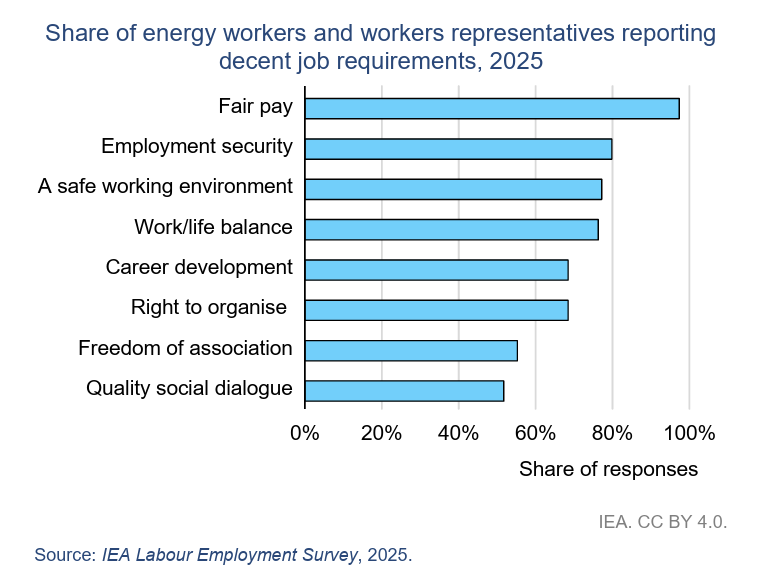
Those demands only carry weight when they are backed by credible, internationally recognized data. The IEA Labour Employment Survey , gathering responses from workers and their representatives across 65 countries, asked what makes a job decent. The answers were unambiguous: fair pay (90 per cent), employment security (73 per cent) and a safe working environment (71 per cent). These are the fundamentals that collective bargaining delivers. Yet the same survey found that only 35 per cent of workers classified clean energy jobs as quality jobs with both good conditions and good pay. That gap, between what workers say a decent job requires and what the energy transition is currently offering, is precisely what unions exist to close. Those priorities, recorded in a report read by governments and employers worldwide, put workers’ demands on the table in rooms where unions are not always present.
The 2026 survey can do the same. But only if affiliates show up.
Fill in the survey before 15 May
The IEA Employment and Skills Survey 2026 closes on 15 May 2026. It covers employment trends, skills needs and training capacity across the energy sector.
Every response from a union, a worker representative or a training institution makes the final report harder to ignore. It makes the skills gap harder to dismiss. It makes the case for collectively bargained training easier to win.
The energy shock has arrived. The question now is whether workers’ experience is counted in what comes next, or whether governments and employers rebuild the system without them, again.
You will find the link to all of the surveys here