
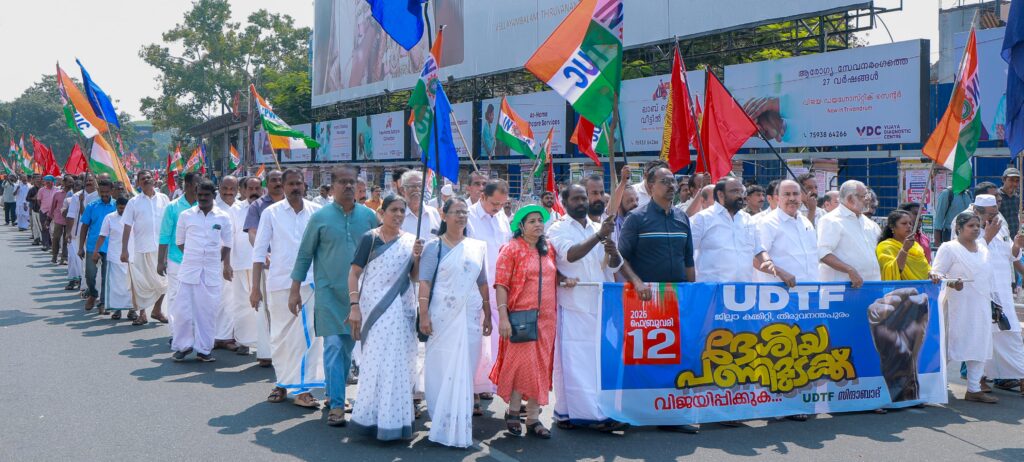



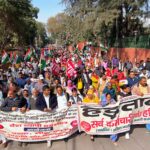

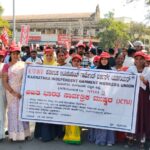

16 February, 2026Trade unions across India delivered a powerful display of collective strength on 12 February 2026, as a nationwide general strike brought vast sections of the country to a standstill. Called by the Joint Platform of Central Trade Unions, the strike was a clear rejection of anti-worker policies and the Indian government’s continued refusal to engage in social dialogue.
According to preliminary union assessments, over 300 million workers, farmers and other sections of the people took part in strike actions and mass mobilisations across more than 600 districts. From coal mines to public offices, workers across formal and informal sectors stopped work in solidarity. Markets closed in many regions, public transport was at a standstill and industrial areas witnessed large union-led processions. Notably, women workers from various unorganized sectors were seen at the forefront, while students and youth joined protests demanding jobs and public education.
This massive action is the latest escalation in a long-running struggle against the four labour codes, pushed through Parliament without consultation, without convening the Indian Labour Conference and in open disregard of international labour standards. Trade unions have now organized six nationwide general strikes since the codes were introduced, because of the government repeatedly ignoring workers’ demands. Unions warn that the codes weaken collective bargaining, restrict the right to strike, push nearly 70 per cent of factories outside labour law coverage, and strip millions of workers of occupational safety, social security, and wage protections.
Frustrations with the legal developments have further intensified since the release of the Draft Labour Policy Shram Shakti Niti 2025, which unions say openly seeks to centralize power, and recast the state as a facilitator for employers rather than a guarantor of workers’ rights.
Affiliated unions of IndustriALL played an active role in the mobilization, with workers from manufacturing, mining, energy, textiles and related sectors joining the nationwide action. Although each union brought forward sector-specific concerns, there was clear convergence around demands for job security, fair wages, social protection and in defence of collective bargaining rights.
Sanjay Vadhavkar, general secretary of Steel, Metal & Engineering Workers’ Federation of India and IndustriALL executive committee member said:
“The government cannot continue to ignore the collective voice of the working population. We are demanding dignity, job security and the recognition of health, safety and social protection as fundamental rights. Any development model that sidelines workers’ welfare is neither sustainable nor just. We will continue to struggle until our demands are met, including the immediate withdrawal of anti-worker labour reforms and the establishment of meaningful dialogue with trade unions and workers.”
Sanjay Singh, general secretary of Indian National Electricity Workers Federation and IndustriALL executive committee member stated:
“The message from workers is clear: stop dismantling labour protections. Job security, safe workplaces and social protection are workers’ rights, not concessions to be granted at the government’s convenience. We will continue to fight for the repeal of the four Labour Codes, the restoration of MGNREGA, the revival of the Old Pension Scheme and the full implementation of our genuine demands.”
Kemal Özkan, Secrétaire général adjoint d’IndustriALL, a déclaré :
« La force de cette grève réside dans l’unité et la détermination de la classe ouvrière indienne. IndustriALL est pleinement solidaire des syndicats et des travailleurs indiens. Leurs revendications reflètent les normes internationales fondamentales du travail, notamment la liberté syndicale, la négociation collective, la protection sociale et la sécurité des conditions de travail, autant de droits qui doivent être respectés et défendus par le gouvernement. »