
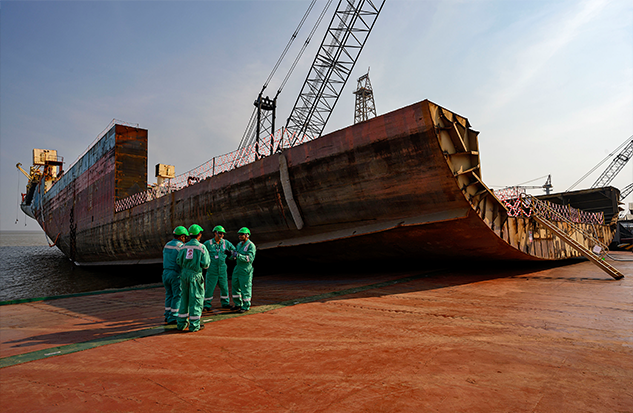
17 September, 2026Two Indian yards are set to be included in the 16th list of EU-approved ship recycling facilities – a first for the South Asian region which constitutes around 80 per cent of global ship recycling capacity.
IndustriALL supports this inclusion following years of investment and effort by federal and local government and industry, and a growing commitment to social dialogue. The two yards, Shree Ram Vessel Scrap and YSI Recyclers, operate in Alang, Gujarat and have been substantially evaluated by the EU. The inspection reports are publicly available, and show that these yards have met the standards of EU and OECD countries.
We believe that this inclusion is consistent and fair, as the EU has approved ten Turkish yards, which operate in similar circumstances. Yards in India and Turkey face more scrutiny than yards in Europe, which are governed by the local authority and not audited by the EU.
The inclusion of Indian yards is a new development which will be watched closely for compliance. This scrutiny provides an incentive to the industry to improve. Approving two yards out of the 110 Hong Kong Convention (HKC) compliant yards in Alang is a measured approach that sends a positive signal that improvements will be rewarded.
The Indian government has a well-developed green industrial strategy for integrating ship recycling into the circular economy, and sees compliance with global standards as a priority. This includes improving yard infrastructure and the quality of steel capture, improving living and working conditions in Alang, gaining access to markets for green steel, and providing shipbreaking credit notes that companies can use for new build ships.
Inclusion in the EU list is fair recognition for the progress made by the industry, especially since the entry into force of the HKC a year ago.
The European Ship Recycling Regulations (EU SRR) and the HKC are broadly similar. However, the EU SRR only applies to EU-flagged ships. There are well-documented evasion patterns where EU-owned ships are reflagged prior to recycling, for commercial reasons as well as due to a lack of capacity to recycle ships in Europe.
Despite this, the EU SRR is considered by many in the industry to be more stringent legislation than the HKC because it only allows recycling in yards which have been inspected and added to an approved list, whereas the HKC devolves this authority to national governments. This can lead to compliance gaps, such as those currently experienced in Bangladesh, where substandard yards are being allowed by the government to operate.
In addition, the EU SRR controls 15 hazards compared to the HKC’s 13, and pays more attention to downstream waste, requiring a chain of custody to hazardous waste treatment, storage and disposal facilities (TSDF) that meets international standards. The EU SRR also requires access to suitable health facilities.
In practice, being added to the EU list sends a signal that a yard has invested in occupational safety and environmental standards, allowing that yard to attract higher value ships and differentiate itself from competitors.
The ship recycling union in Alang, the Alang Sosiya Ship Recycling and General Workers Association (ASSRGWA), welcomes the inclusion of Indian yards in the list.
General secretary Vidyadhar Rane says:
“Inclusion in the EU list shows that the industry is improving. The EU list is seen as taking care of downstream, and this helps us to organize the downstream industry. Previously, yard owners thought their responsibility ended at the yard gate, but as they try to get on the EU list, they are taking a much wider interest in the whole ecosystem.
“We have spent many years building constructive social dialogue in the industry, and the EU list is a positive incentive that encourages the industry to improve.”
IndustriALL assistant general secretary Kan Matsuzaki says:
“IndustriALL places great value the way in which government, employers and the trade unions have worked together to develop social dialogue and bring the Indian yards up to international standards. This is a powerful demonstration of the importance of international solidarity, and clear recognition that workers and their union are legitimate partners in building a safer, more sustainable ship recycling industry.”