
19 May, 2026On 12 May, the Mauritian parliament voted to demolish the remaining asbestos social houses, a long-overdue recognition of the dangers posed to working-class families and communities. For the Confederation Des Travailleurs des Secteurs Publique et Prive (CTSP), an IndustriALL affiliate, as well as the Construction, Metal, Wooden and Related Industries Workers Union (CMWEU) , the vote is a moment of vindication. These two unions have campaigned for demolition for decades.
However union leaders are cautious. A parliamentary declaration is not a demolition order. The struggle over Mauritius asbestos houses, they say, is not over yet.
According to historical records, when cyclones Carol and Alix tore through Mauritius in 1962, they left devastation on a scale the island had rarely seen with eight people dead, over a hundred injured and 100 000 people left homeless. Nearly all the workers’ settlements in their path were flattened. The government’s response was swift: 3,113 social houses were immediately built to resettle the displaced.
However, the material chosen was a mixture of cement and asbestos which was cheap, durable and widely used across the British colonies then. Sixty years later, the people living in those houses are still paying for that decision with their lungs. In Mauritius, where residents of the social estates have lived alongside deteriorating asbestos panels for six decades, the full toll of the 1962 construction programme may not yet be visible in the mortality data.
Although Mauritius has banned asbestos imports through the Consumer Protection Act, the Dangerous Chemicals Control Act and the Constitution the restrictions have since been waived by law amendments, a move that unions have condemned. Further, Mauritius has not ratified International Labour Organization (ILO) Asbestos Convention 162 which calls for the substitution and elimination of asbestos, medical surveillance and compensation for workers exposed to asbestos, the right of workers to information about asbestos hazards, safe removal and disposal procedures and the responsibility of employers and states to prevent exposure at source.
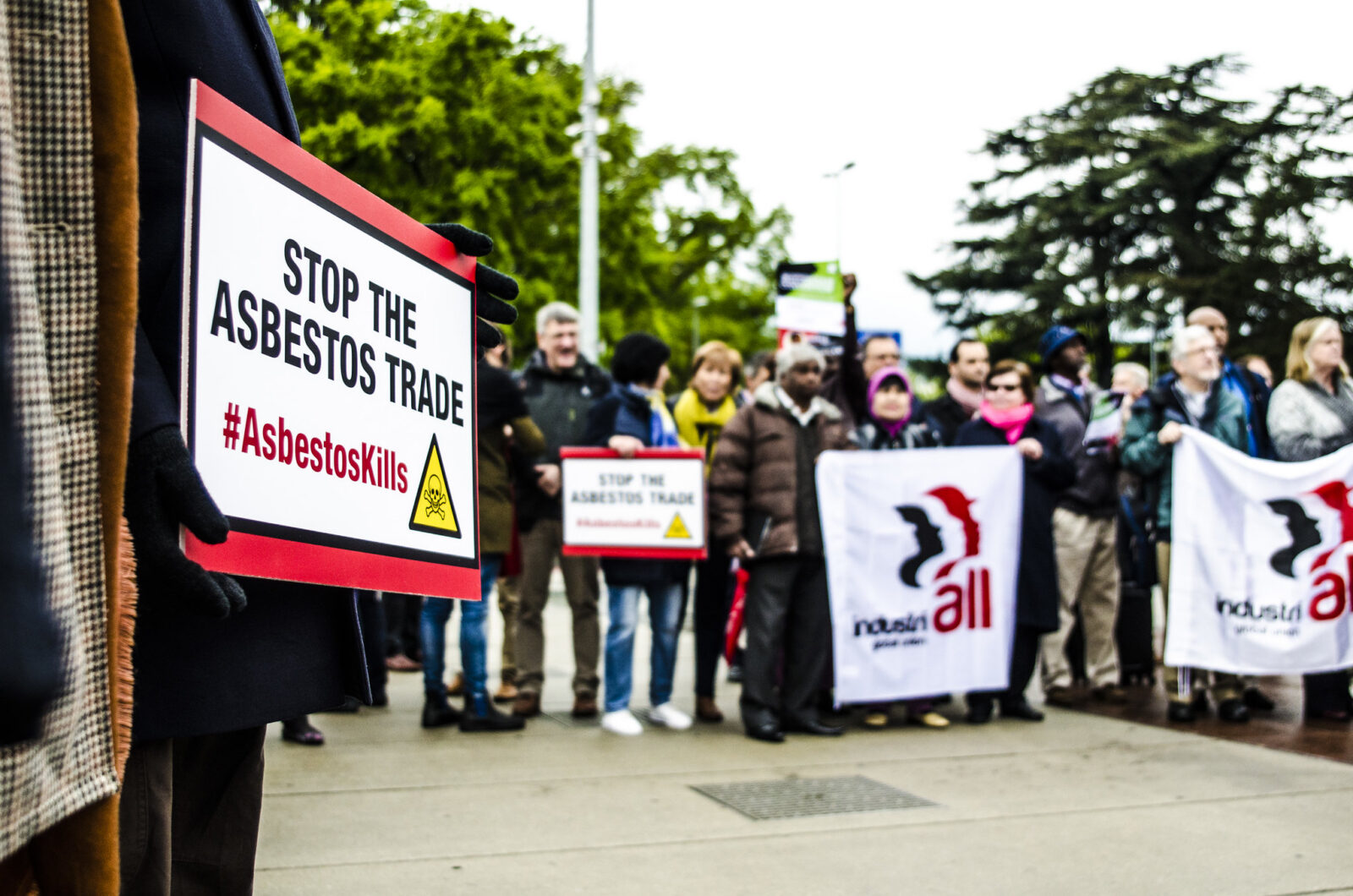
The IndustriALL executive committee supported the call, by 12 African countries, to amend the Rotterdam Convention to include chrysotile asbestos on the list of hazardous industrial chemicals and has demonstrated against the asbestos trade.
A death that changed everything
The unions’ campaign origins lie in a case that exposed the scale of what the authorities had ignored. Claude Marguerite, a union member and resident of one of the asbestos estates, died of mesothelioma, in 1999, an aggressive cancer of the lining of the lungs and chest wall caused by asbestos exposure. After his death, the CMWEU went to the Supreme Court of Mauritius to obtain permission to exhume his body. It was a legally and emotionally tense decision, but the union’s leadership judged that without hard scientific evidence, the authorities would continue to look away.
Working with the University of Manchester, researchers conducted an asbestos fibre count on 10 grams of Marguerite’s lung tissue. The results were stark: 86,000 asbestos particles were identified. The findings gave the union the evidence it needed and ignited a mass public awareness campaign that would force the government to act.
A disease that does not forgive
According to the World Health Organization and International Agency for Research on Cancer guidance, asbestos is not a single hazard but a cluster of them. Prolonged exposure to its microscopic fibres, which lodge permanently in lung tissue and cannot be expelled, causes a range of serious and fatal conditions. Mesothelioma is the most feared: it typically presents decades after exposure, responds poorly to treatment and carries an average survival rate of about a year from diagnosis. Asbestosis, a chronic scarring of the lung tissue, causes progressive breathlessness and has no cure. Lung cancer risk is significantly higher in those exposed to asbestos.
Two decades of silence
In 2001 the government persuaded in part by the union campaign agreed to commission a national investigation into the adverse impact of asbestos. A Commonwealth asbestos expert, John Addison, was brought in to lead it. He had previously worked alongside Reeaz Chuttoo, then CMWEU’s technical adviser, on the decommissioning and asbestos removal at a sugar factory in Beau Plan in the Northern district of Pamplemousse.
The report has never been made public. No government, in 24 years, has dared to table it in parliament. The reason, union officials say, is that the report’s findings would expose the state to substantial civil damages claims from the asbestos houses’ residents, as well as from the thousands of workers who spent careers in sugar factories, hospitals, schools and other public and private sites where asbestos was usually used. The liability calculation, rather than the public health imperative, has driven successive governments’ approach to making the Addison report public.
“This is a declaration of good intentions by the government of Mauritius. We will be watching every step of the implementation. A vote is not a bulldozer. We will be in the streets, in the courts and in parliament until the last asbestos panel comes down and the families and communities are compensated,”
said Chuttoo, now CTSP president.
Paule-France Ndessomin, IndustriALL regional secretary for Sub-Saharan Africa emphasized:
“Convention 162 on asbestos is clear that states must protect workers from exposure, compensate those harmed and eliminate the hazard at source. Mauritius has an obligation, not a choice, to demolish these houses and be accountable to the affected families and communities and release the Addison report.”