
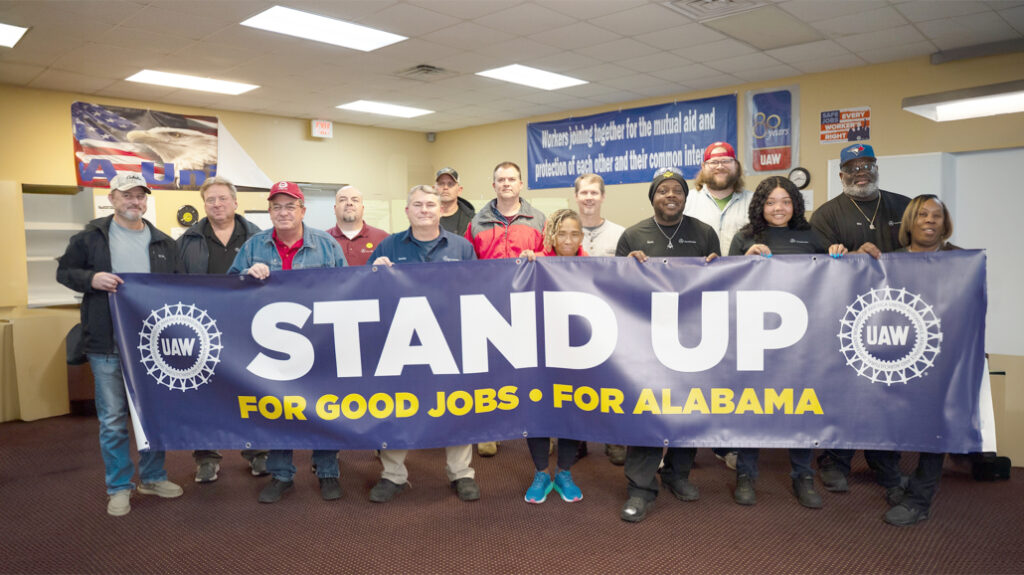
15 September, 2026IndustriALL and the United Auto Workers have filed a formal complaint with Germany's OECD National Contact Point, demanding that the German government facilitate dialogue between Mercedes-Benz and the unions over workers' treatment in Alabama. The complaint alleges Mercedes-Benz has created an unacceptable divide between the labour standards it promotes globally and how it treats workers in its US operations.
The complaint escalates pressure on Mercedes-Benz to apply labour standards consistently worldwide. It comes after repeated attempts to engage Mercedes-Benz directly over workers’ rights have been rebuffed.
“Workers at Mercedes plants in the US should not have to navigate a maze of legal proceedings, consultants and corporate structures simply to join a union and have a voice,” said UAW president Shawn Fain. “We’ve tried over and over to sit down with Mercedes-Benz and work this out directly. They’ve chosen lawyers and litigation instead. We’re taking this to the OECD to finally get the company to the table and have a real conversation about workers’ rights.”
Double standards on labour rights
The complaint alleges an unacceptable divide between the company’s global labour standards and its treatment of workers in Alabama. Mercedes-Benz’s own Principles of Social Responsibility and Human Rights explicitly state that the company respects internationally recognized labour standards. Yet its lawyers argue the principles do not apply in the US.
This contradiction became stark when the company’s executive leadership told shareholders just two months earlier that all Mercedes employees, including those at subsidiaries, are covered by the Principles. During an NLRB election hearing, however, Mercedes-Benz’s lawyers dismissed the Principles as irrelevant. They argued it was merely “a document between something in Germany and some group of unions in Germany.”
Five core allegations
The OECD complaint centres on five main issues:
- Rejecting the application of its own labour principles in Alabama, despite global commitments to respect them.
- Undermining workers’ freedom of association by failing to respect the internationally recognized right of workers to organize and bargain collectively.
- Spending more than US$600,000 on union-avoidance consultants and lawyers to oppose workers’ organizing efforts. The unions argue this could have been invested in workers and operations
- Failing to engage in meaningful dialogue with global unions despite repeated attempts to seek constructive engagement.
- Creating a two-tier approach to labour rights that undermines the company’s credibility on international standards.
The unions say Mercedes-Benz’s inconsistent approach also creates unnecessary risks for investors. Applying different labour standards across borders risks recurring litigation, reputational damage and supply-chain instability.
“Mercedes-Benz has an opportunity to choose a different path,”
said IndustriALL general secretary Atle Høie.
“Instead of fighting workers who seek a voice on the job, Mercedes-Benz can invest in its workforce, maintain high standards and embrace genuine social partnership.
“Mercedes-Benz should respect the same fundamental principles for workers in the United States that it expects and promotes throughout its global operations.”