
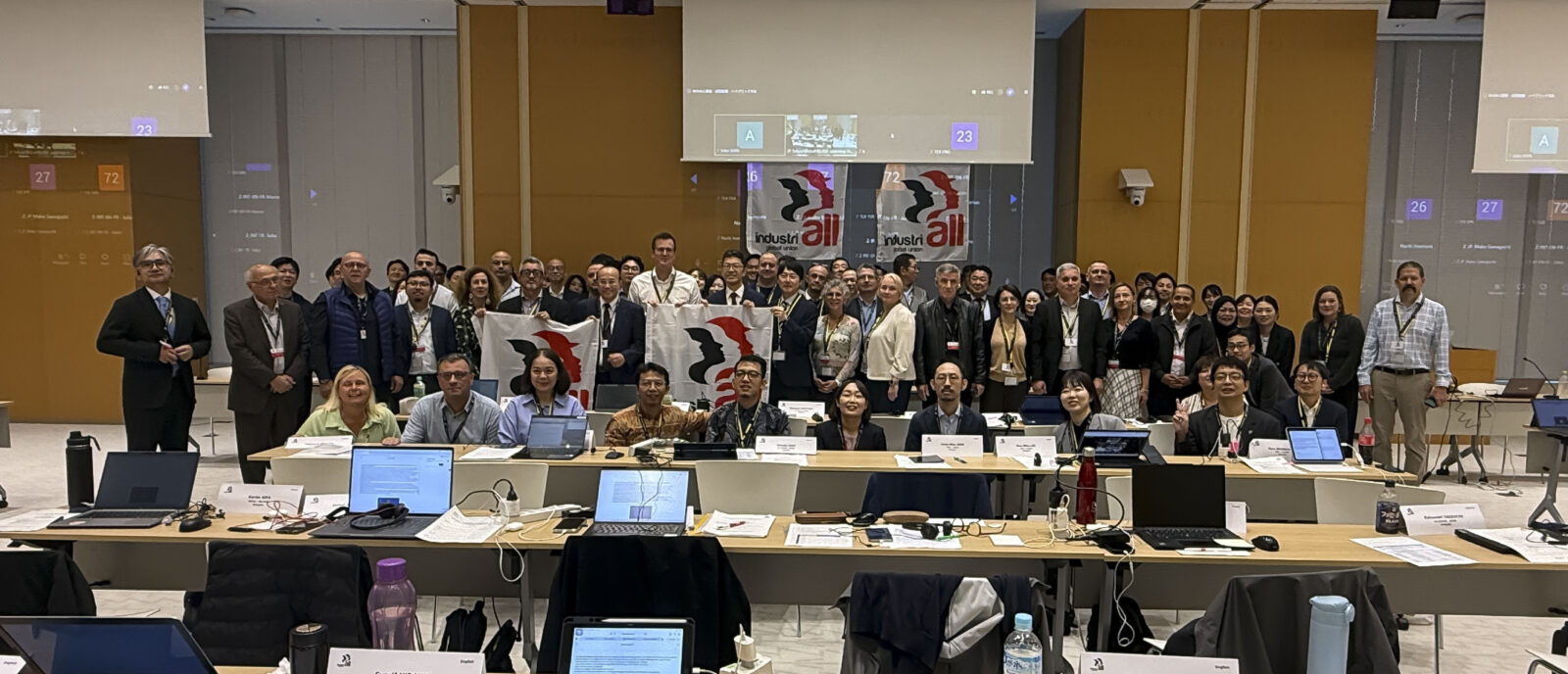
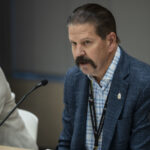
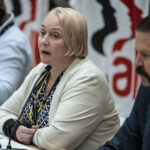
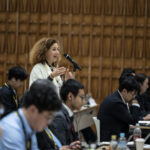
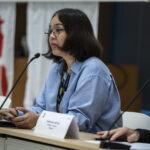
IndustriALL Global Union’s pharmaceutical union network met on 26 and 27 October, hosted by Japanese affiliates at Takeda’s global headquarters. Over two days, unions discussed equality, the state of the industry, human rights due diligence, health and safety, AI, robotics and skills.
The meeting also marked a change of leadership. After many years as chair, Masato Shinohara handed over to Hiroaki Aoki.
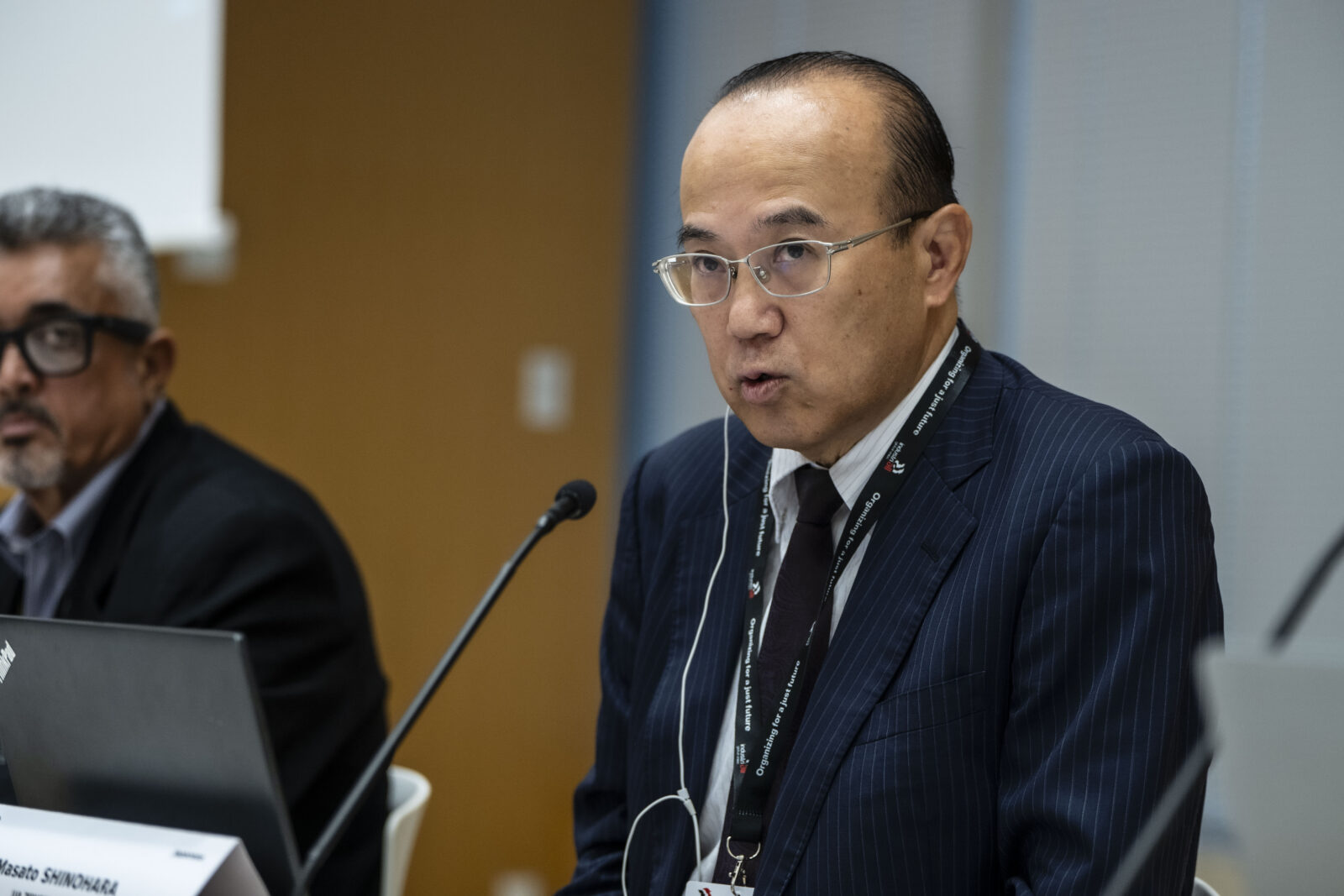
The meeting opened with words of welcome from Masato Shinohara, chair of the network; Takeshi Annaka of Japan’s Ministry of Health, Labour and Welfare; Go Takahashi, managing director of the Japan Pharmaceutical Manufacturers Association; Edson Bicalho, co-chair of IndustriALL’s chemical and pharmaceutical sector; and Tom Grinter, IndustriALL pharmaceuticals sector director.
Women, diversity and inclusion: progress is not guaranteed
IndustriALL introduced the session by pointing to the industry’s own history. In the United States, a 1977 guideline kept most women of childbearing age out of early-stage drug trials until 1993. IndustriALL also presented its gender-transformative roadmap, which follows the feminist resolution adopted at its 4th Congress in Sydney in November 2025.
Sindi De Vrieze (AC ABVV, Belgium) described how the glass ceiling has been cracked over 30 years, while equal pay remains a challenge. Koen De Kinder (ACV-CSC Industrie & Energie, Belgium) warned that diversity and inclusion programmes are being dismantled in some countries, so equality needs structural guarantees.
Kenji Yasuda of the Pharmaceuticals and Cosmetics Union (YAKUSHO Rengo, Japan) explained how the old ideal of the “good wife, wise mother” still shapes Japan’s tax, pension and workplace systems, which were built around a husband who earns and a wife who depends on him. Through the national centre RENGO, unions are pushing to close the gender pay gap, bring more women into management and help all genders combine work and childcare.
“Culture does not change easily. But it can be changed,”
said Kenji Yasuda, YAKUSHO Rengo.
Amber Miller of the United Steelworkers (USW) presented Women of Steel, the union’s education programme that builds women members’ voice in the union.
Through that voice, women raise issues that would otherwise be overlooked, even the most basic ones. Miller gave one example: on some sites, women spend most of a 15-minute break walking to a toilet and back.
Key takeways
- Demand pay transparency as the first step towards equal pay for work of equal value.
- Write equality into collective agreements and union structures so progress cannot be reversed.
- Bargain for the basics, act against harassment and put women in union leadership roles.
The global industry: decisions move, dialogue must follow
Tom Grinter set out the big picture. The global prescription medicine market was worth about US$1.67 trillion in 2025, according to the European Federation of Pharmaceutical Industries and Associations. Production is shifting between countries, patents are expiring and mergers are changing who owns the factories.
Shinohara (UA Zensen, Japan) described the tensions the industry faces: access to advanced medicines against cuts in social security spending, protecting intellectual property against universal health coverage and companies’ pursuit of profit against workers’ rights. As companies globalize, he said, unions must build international networks company by company.
Hiroaki Aoki, president of the Takeda Pharmaceutical Workers’ Union (UA Zensen, Japan), said innovation and access to medicines must go together. He pointed to “drug loss” in Japan: as of March 2023, 143 medicines approved in the US and Europe had not been approved in Japan and most had not even entered development there. Japanese unions lobby ministries and lawmakers, and JTUC-RENGO has a seat in drug pricing talks.
Aoki also raised a challenge for workers in every global company: decisions once taken in Japan are now made by global functions and union dialogue does not always reach the people who decide.
Aline Eysseric (FCE-CFDT, France), chair of the global Sanofi union network, described how the network grew from a first meeting in Singapore in 2014 to annual global meetings.
Natasha Ryndycz (Unite the Union), chair of the GSK UK national trade union group, spoke about the situation of GSK workers. On 14 October 2026, GSK announced plans to cut up to 1,217 jobs at its sites in Wavre, Rixensart and Gembloux in Belgium over the next two years.
The network discussed the announcement and committed to stand in solidarity with the Belgian unions. They are calling for solutions that protect workers’ rights and mental health.
Key takeaways
- Demand that companies inform and consult unions before deciding on technology or restructuring.
- Win company recognition for international bargaining at Sanofi, Takeda and GSK, and map the industry to set up new company networks.
- Push governments to put access to medicines for all on an equal footing with intellectual property protection, and influence how medicines are priced.
Due diligence: rights on the ground, not on paper
Human rights due diligence gives unions new leverage to hold companies to account across their supply chains. Laws alone are not enough: unions must combine them with global framework agreements and grievance mechanisms.
Süleyman Akyüz, president of Petrol-İş, said union density in Türkiye’s pharmaceutical industry is very low. According to Ministry of Labour figures presented by the union, only 1,667 of 45,135 pharmaceutical workers are organized: 3.7 per cent. Despite anti-union employers and legal barriers, the union signed a collective agreement at Provet at the end of 2024.
Petrol-İş has also used due diligence in practice. With IndustriALL and French unions, it has worked jointly on Sanofi, sharing information through the company’s works councils. But for this to work, Akyüz said, companies must play their part too.
From Brazil, participants heard about a three-year pilot with IG BCE and the German government that trains workers at three key companies to use due diligence tools. European colleagues explained how European Works Councils can raise problems from other countries in their own negotiations.
Key takeaways
- Use due diligence laws to demand consultation before restructuring, outsourcing, closures or sales.
- Hold companies accountable for rights across the supply chain, including outsourced production.
- Train union representatives and members to use due diligence tools, building on the Brazil pilot.
Health and safety: strong unions build safer workplaces
Myles Sullivan of the USW said that health and safety must be bargained, not left to management.
“In pharmaceutical workplaces, health, safety and environment are not merely a compliance issue, it is a mandatory subject of bargaining and a fundamental expression of union and worker power.”
He described the invisible hazards of exposure to hazardous drugs and the USW’s training for workers to spot risks and stop unsafe work. “Our members are the workers closest to the hazards,” he said.
Taru Reinikainen of Trade Union Pro (Ammattiliitto Pro, Finland) raised a gap in Finnish social security law that affects pharma workers. In Finland, a pregnant worker exposed to chemicals, radiation or infectious diseases can receive a special pregnancy allowance if safer work cannot be found. But after the baby is born, there is no equivalent protection for breastfeeding, even though some substances, such as certain solvents, can pass into breast milk.
Finnish parents share 320 working days of parental allowance, about 13 months, with 160 days for each parent. A parent can transfer up to 63 of their days to the other. When a workplace is unsafe for breastfeeding, families often have to transfer days from the other parent to the birthing parent. This prevents an equal split of leave and keeps women away from work for longer, especially in sectors such as pharmaceuticals. Pro is calling for a special parental allowance to close the gap.
“As long as the risk is borne solely by families and individual employers, equal sharing of parental leave remains impossible in high-risk sectors,”
said Taru Reinikainen.
Pro has also launched a campaign to highlight burnout. Its Burnout Day marks the point in the year when the strain of working life overtakes Finnish workers’ capacity to cope. According to calculations by the Finnish Institute of Occupational Health for Pro, one in four Finns shows symptoms of burnout at a concerning level. Mental health problems at work cost the Finnish economy around €4.7 billion (about US$5.4 billion) a year. Because burnout is not recognized as grounds for sickness allowance in Finland, Pro is proposing a change to the law.
Belgian colleagues described negotiated protections for pregnant workers and warned against pressure on sick workers to return too early.
Key takeaways
- Win health and safety committees with union representatives and the right to stop unsafe work.
- Tackle burnout, push for it to be recognized in law and negotiate the right to disconnect.
- Secure safe alternative work for pregnant and breastfeeding workers, lactation facilities and inclusive family leave.
AI, robotics and skills: negotiated, not imposed
More than 4.6 million industrial robots were working in factories worldwide at the end of 2024, according to the International Federation of Robotics. IndustriALL introduced the session with an overview of its AI policy paper and the ILO’s first-ever conclusions on AI in manufacturing, adopted in April 2026.
Ogawa Shintaro, general secretary of the Bristol Myers Squibb union (JEC Rengo, Japan), said a strong union in the age of AI develops people instead of trying to stop AI. He set out three steps: dialogue, development and leaving no one behind. Training, he argued, is the employer’s duty and cannot be left to workers alone.
“A strong union does not stop change. It supports and develops people through it.”
Alaaddin Sarı, president of Lastik-İş, Türkiye, called for training during working hours and for productivity gains to be shared through shorter hours or higher pay. At Viatris, his union agreed that any performance-monitoring tools must be supervised jointly with Lastik-İş.
“Technological progress must be achieved with workers’ knowledge, labour and participation, and the prosperity it brings must be reflected in workers’ lives.”
The discussion raised a new question: when workers use AI tools, they also teach them. So who owns that knowledge? The network set out proposed bargaining demands, including union agreement before workers’ know-how is used to train AI.
Key takeaways
- Apply IndustriALL’s AI policy and require union agreement before workers’ knowledge is used to train AI.
- Close the skills gap through dialogue, paid training during working hours and job guarantees, so no one is left behind.
- Bargain on AI: demand consultation before decisions, assess workloads and share productivity gains through shorter hours without loss of pay or higher wages.
A new chair
At the close of the meeting, Masato Shinohara stepped down as chair after many years of service and handed the chair to Hiroaki Aoki.
“For many years, Shinohara-san has given this network his time, his wisdom and his warmth. He built bridges between unions in Japan and colleagues around the world and he leaves a network that is stronger and more united. We thank him and we welcome Aoki-san, who takes on the chair with the full support of the network,”
said Tom Grinter IndustriALL pharmaceutical director.