



Read this article in:
English
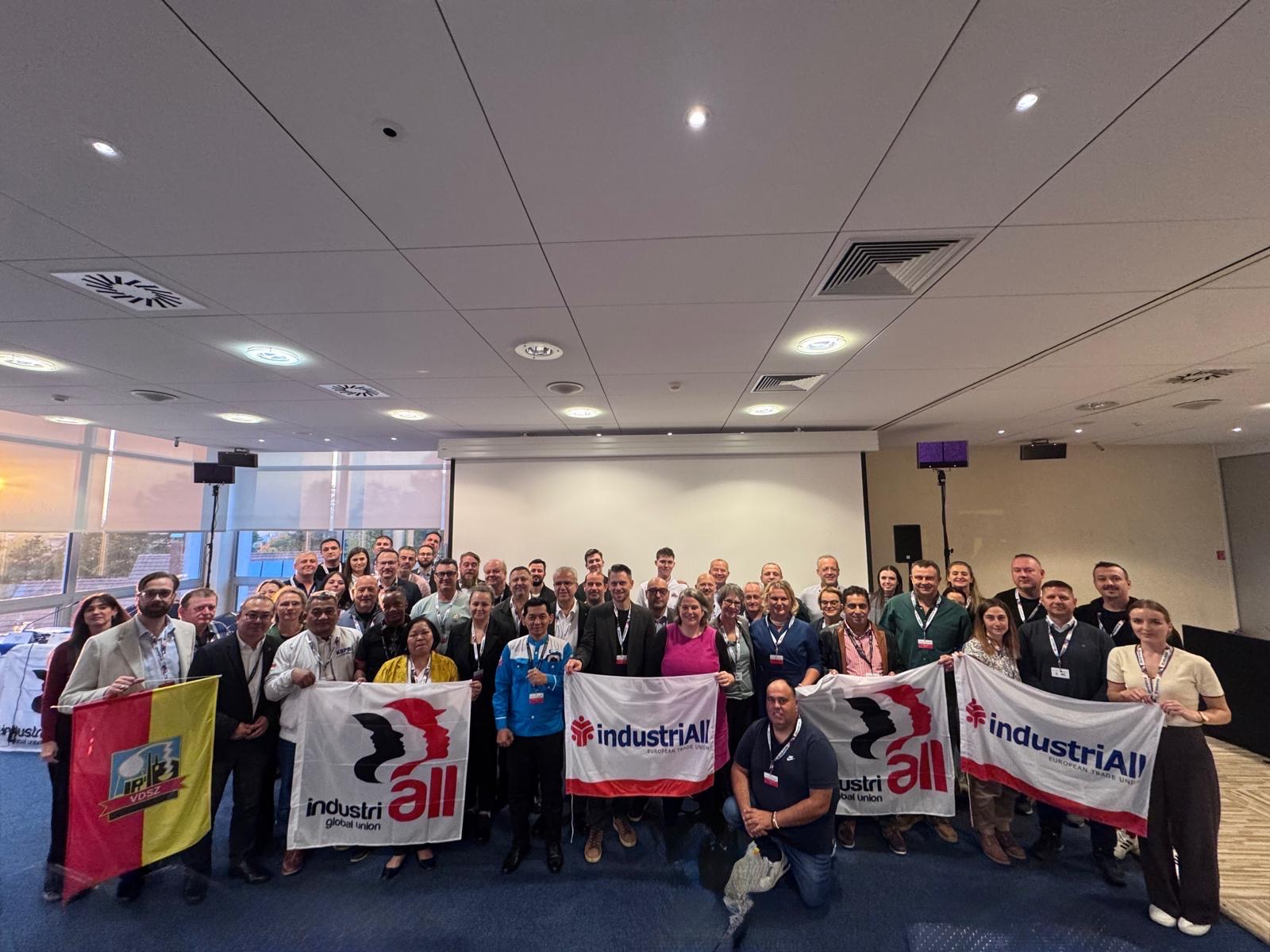
23 October, 2026Trade unionists from Europe, Asia and Africa met in Bratislava, Slovakia, on 20-21 October 2026 to strengthen union power across the global battery supply chain. The conference focused on organizing, workers’ rights and safe and decent work, including strong health, safety and environmental standards essential for a sustainable supply chain.
IndustriALL Global Union and industriAll Europe jointly organized the event, with support from Friedrich-Ebert-Stiftung and the European Union. It built on their successful first meeting in 2023, which participants regarded as positive and which highlighted the importance of international trade union cooperation.
Participants shared project outcomes and organizing experiences. They addressed freedom of association, collective bargaining, health and safety, environmental standards and gender equality.
They discussed global and European developments, human rights due diligence, social dialogue and priorities for coordinated long-term action.
Organizing early to build lasting power
A central lesson was that unions must act early. Representatives from Hungary, Poland, Slovakia, Serbia and Spain described building membership in new battery factories.
Mapping companies and supply chains and building relationships with workplace activists, proved essential.
Indonesian unions established themselves early in expanding nickel-producing areas. They used workplace coordinators and training for organizers, women and young workers, showing that organizing must span the supply chain.
In the Democratic Republic of Congo (DRC), unions confront unsafe mines, precarious employment and restrictions on freedom of association. Participants stressed organizing artisanal miners and ratifying ILO Conventions 176 on mine safety and 190 on violence and harassment.
Health and safety as a starting point
Health and safety can bring workers together. At Northvolt in Sweden, unions reached a multinational workforce, achieving 85 per cent union density and establishing 70 workplace safety representatives.
In Hungary, concerns about hazardous substances helped mobilize workers and challenge unsafe practices. Both cases showed that organizing starts by listening to workers, and that prevention needs strong regulation, enforcement and worker involvement.
Making the tools work
Unions have several tools: European Works Councils (EWCs), human rights due diligence, Global Framework Agreements (GFAs) and initiatives involving companies, governments and civil society.
These tools can help unions access company information, identify risks, anticipate restructuring and coordinate action across borders, but only when unions are well organized to use them. Audits matter only if they lead to corrective action that union representatives can monitor.
The revised EWC directive strengthens EWCs. Consultation must take place before decisions are final, more issues count as cross-border and penalties are linked to turnover. Strategic networks give GFAs and due diligence real force by monitoring implementation, training affiliates and linking local unions with headquarters and sister sites.
South African unions showed how hard this can be. Data protection laws restrict access to workers, legal processes are slow and women face barriers to reporting harassment. Persistence, mapping, legal rights, headquarters connections, public engagement and international solidarity can help unions organize unrepresented workplaces.
There is no magic tool: unions must combine workplace organizing, bargaining, supply-chain mapping, networks, due diligence and solidarity around concrete goals.
International solidarity across the supply chain
Battery supply chains link workers from mining to manufacturing, so unions need to know where minerals go and who decides.
Mapping nickel and cobalt supply chains can connect mine and refinery workers with unions at customer companies. Coordinated action can help unions respond to multinational company decisions.
Industrial policy must deliver for workers
Participants called for industrial policies that link public funding to quality jobs, strong labour standards and collective bargaining. Unions must be involved from the outset: a just transition needs social dialogue, bargaining and unions able to organize and represent workers.
Kan Matsuzaki, IndustriALL assistant general secretary, said:
“The battery industry is expanding rapidly and trade union organizing must keep pace. We must build union power across the entire supply chain. This includes critical minerals, battery production, recycling and electric vehicles. By doing so, we can give workers a strong collective voice to shape the industry’s future.
“We cannot achieve this country by country or sector by sector. We must organize and unite unions across borders and supply chains, strengthening international solidarity and collective bargaining power.”