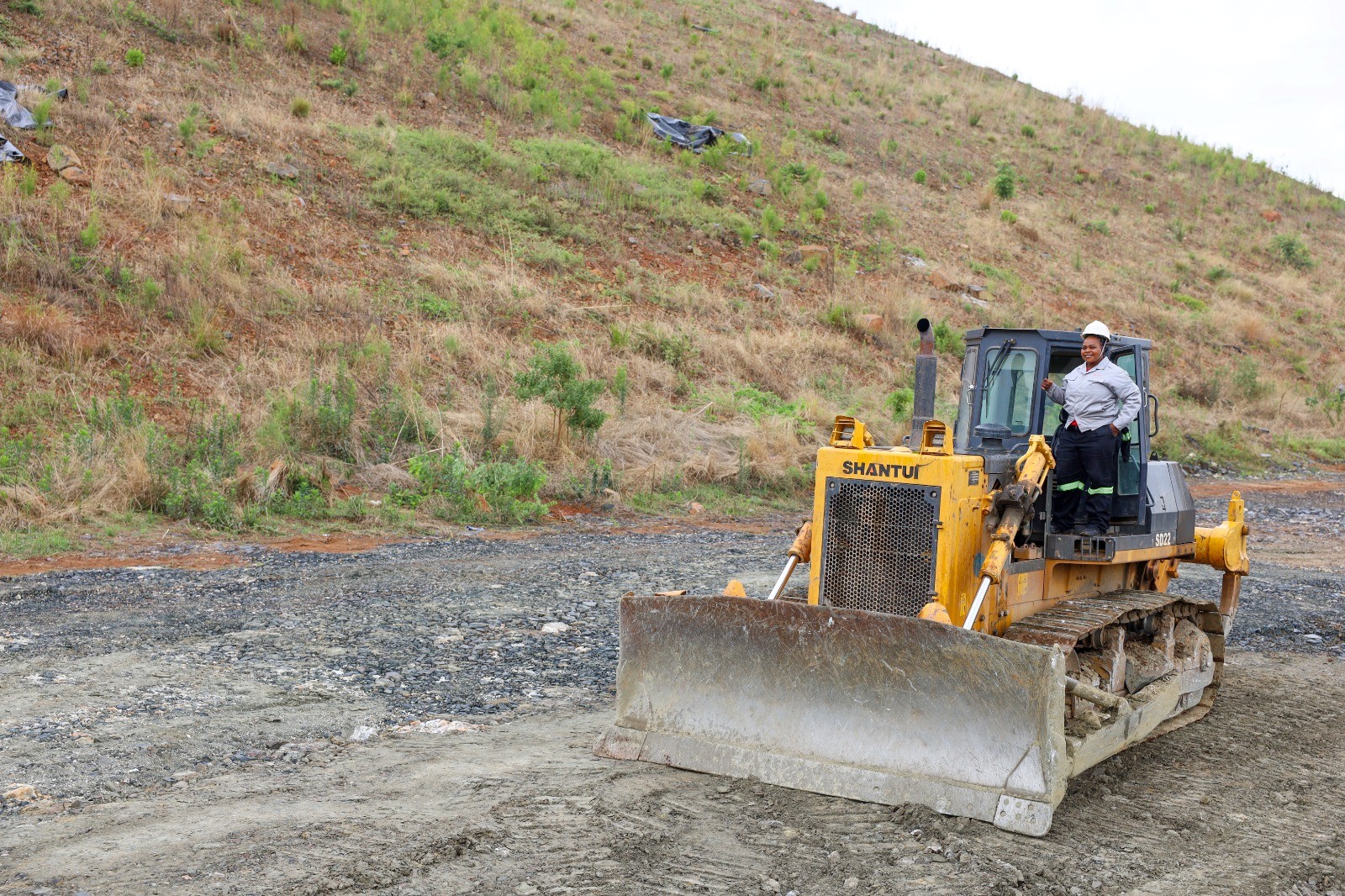
16 September, 2026At Prospect Lithium Zimbabwe's (PLZ) Arcadia mine Nelia Chipako is proving that women can operate heavy machinery in one of Zimbabwe's fastest-growing mining sectors. She is also pushing her union to challenge the bias and working conditions that still hold women back.
PLZ, which operates the mine near Harare, holds reserves estimated at 42.3 million tonnes of ore grading 1.19 per cent lithium oxide. These reserves are among the largest in the country. Nelia Chipako spends her shifts at the controls of a bulldozer and says the job is one women can do just as well as anyone. She believes proper training and experience are essential for that.
In an interview with IndustriALL Nelia Chipako described the double standards women still face in mining.
“Women face double jeopardy at work. we are doubted by employers and even once we get the job, we are underrated by our colleagues. But women should be given an equal opportunity to prove themselves. We can do better when we are given the chance,”
said Nelia Chipako.
The message has become central to her union work: women need the same chance to prove themselves in mining jobs. These jobs have long been treated as men’s work.
Balancing the job with family life adds another layer of pressure, Nelia Chipako explained.
“Being a parent in a difficult economy like Zimbabwe is not easy for women. We make sacrifices and carry our parental responsibilities, even under difficult conditions. The working conditions are demanding, there are no fixed off days and sometimes we work during the weekend,”
said Nelia Chipako.
Her experience reflects a wider struggle in Zimbabwe’s lithium sector. Women are entering jobs once treated as male-only. But many still face bias, insecure work and weak protection against harassment.
A seat at the table on human rights due diligence
Nelia Chipako was one of 41 delegates from South Africa, Zambia and Zimbabwe at an IndustriALL and Competence Centre for HRDD workshop in Harare on 18 August. Union representatives from the gold, copper, platinum and diamond sectors discussed using human rights due diligence (HRDD) as a bargaining tool. For them, it should not be a corporate box-ticking exercise. The Zimbabwe Diamond and Allied Minerals Workers Union (ZDAMWU) is piloting this at Bikita Minerals and PLZ. In particular, they are focusing on freedom of association, ending gender-based violence and harassment, and extending short-term contracts from three to twelve months.
“Labour safeguards must address the inequalities, gender discrimination, gender pay gaps and stereotypes that continue to exclude women,”
Nelia Chipako told participants at the workshop.
Nelia Chipako belongs to the Zimbabwe Diamond and Allied Minerals Workers Union (ZDAMWU), an IndustriALL affiliate. Zimbabwe, Zambia and South Africa are testing HRDD as an organizing tool in the critical transition minerals sector. They are applying it to gold, platinum, copper, diamonds, and lithium minerals. These minerals are in growing demand as the world shifts to low-carbon energy. Thousands of women, including Nelia Chipako, work in these mines.
“We now have a voice”
Nelia Chipako credits ZDAMWU’s arrival at Arcadia mine with changing the terms of the engagement with management.
“The union’s biggest achievement is that we now have a voice. In previous years, management made decisions without consulting workers. Now things have changed: we have suitable personal protective clothing, 12-hour shifts and adherence to health and safety standards,”
said Nelia Chipako.
“Mining can change lives, but only if it is done in an inclusive and sustainable way. If PLZ adopts HRDD in full, it could set an example for lithium mining across Zimbabwe,”
said Paule-France Ndessomin, IndustriALL Sub-Saharan Africa regional secretary.
PLZ is wholly owned by China’s Zhejiang Huayou Cobalt, a top lithium-ion battery materials producer. It took full control of Arcadia in a 2021–22 deal worth US$422 million. Zimbabwe holds some of Africa’s largest lithium deposits and is now the continent’s top producer. This growth is driven by EV and renewable-energy battery demand. Chinese firms dominate ownership, and the government, pushing for more local processing, banned raw ore and concentrate exports earlier this year. The goal is to capture more value through local beneficiation.