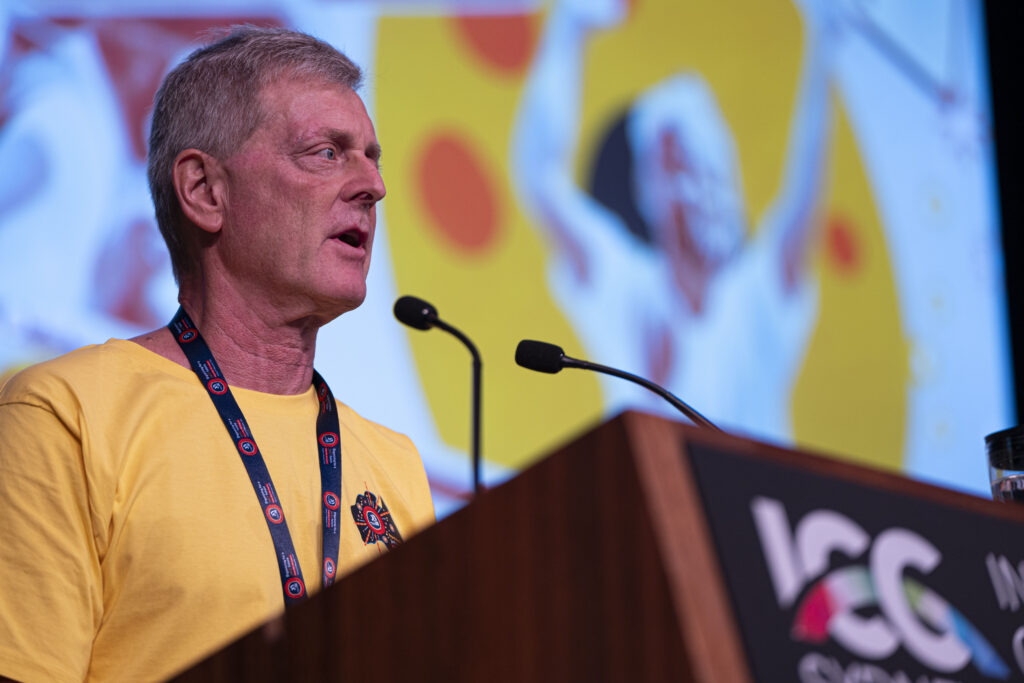


17 December, 2025As 2025 comes to an end, the discussions and decisions of IndustriALL’s fourth Congress in Sydney are still fresh. Congress is more than a meeting; it is where we take stock and set our collective direction. The days in Sydney were a success, but more importantly it is a mandate. A mandate from affiliates across every region and sector to act with clarity, courage and determination in a world that is becoming more unequal, more unstable and more hostile to working people.
By Atle Høie, IndustriALL general secretary
This past year has not been an easy one. War continues to define daily life for millions. Democratic space is shrinking in too many countries. Corporate power is increasingly concentrated in the hands of a few, while working people are told to accept insecurity, precarity and declining living standards as inevitable. Climate breakdown accelerates, and technological change, particularly artificial intelligence (AI) is introduced not as a tool for shared progress, but too often as a mechanism for control, surveillance and job destruction.
And yet, if there is one lesson from 2025, it is this: workers do not accept injustice quietly.
Trade unions do not retreat when the terrain becomes difficult. We organize. We negotiate. We fight, and we win.
During the year, our affiliates have shown incredible resilience and strength. In Kenya, a court ruling upheld trade union rights against intimidation and abuse, making it clear that the rule of law still matters when workers stand together.
In Italy, metalworkers secured a historic agreement after sustained mobilization, showing that collective bargaining remains one of the most powerful tools workers have to defend dignity and fair pay. In Türkiye, metalworkers also won significant gains amid record inflation, reinforcing that union strength matters across Europe and beyond.
In the United States, workers scored major victories in traditionally difficult organizing environments: after a 15-week strike, IAM union members ratified a new contract at Boeing; autoworkers achieved a historic union win at Volkswagen’s Chattanooga plant; and energy workers secured a groundbreaking victory with UWUA in the wind power sector, powerful reminders that collective action can overcome rooted resistance even in highly financialized and hostile contexts.
From South Africa, where NUMSA secured a wage deal while calling for industrial policy to protect the auto sector, to India, where courts ordered the regularization of contract workers and garment workers defied illegal closures, the message has been consistent: precarious work is not destiny. It is a choice, and one that can be challenged.
In Quebec, ArcelorMittal workers won a stronger collective agreement, proving that even global giants can be held accountable when unions are organized and persistent. While in Mexico more than 3,000 workers secured a hard-fought settlement after a prolonged strike at ArcelorMittal over profit-sharing and working conditions, including wage gains and the withdrawal of legal actions against workers and their union.
In Bangladesh, Pakistan, Korea, and Morocco workers won Collective Bargaining Agreements (CBAs), regularization and recognition through strikes and negotiation alike, often in contexts where the risks are high and the space for union activity is limited.
We also saw a powerful defence of fundamental rights in Indonesia, where unions successfully challenged the regressive omnibus law, demonstrating once again that determined collective action can push back against legislative attacks aimed at undermining labour protections and bargaining rights.
In Korea, unions welcomed the decision to uphold the impeachment of President Yoon, a powerful reminder that trade unions are not only economic actors but defenders of democracy itself.
And in sectors that define the future of the global economy, shipbreaking, semiconductors, energy and automobiles, union victories this year have shown that transformation does not have to come at the expense of workers’ rights. The entry into force of the Hong Kong Convention on ship recycling is a milestone, decades in the making, improving safety and shifting power in one of the world’s most dangerous industries.
In Cambodia, progress was also made on wages in global supply chains, as international brands signed an agreement with IndustriALL to support collectively bargained wages in the garment, textile, footwear and travel goods sector. These legally binding commitments require brands to back factory-level collective bargaining and responsible purchasing practices, marking an important step toward improving wages and working conditions for workers in a sector that is central to the country’s economy.
These are not isolated successes. They are part of a broader pattern. They show that even in an era marked by war, inflation, climate crisis and corporate greed, organized workers can still shape outcomes.
This matters, because the challenges ahead are immense.
Beyond national struggles, 2025 also brought important progress at global level. IndustriALL renewed and strengthened global agreements with multinational companies including ASOS and the H&M Group, reinforcing commitments on freedom of association, collective bargaining and workers’ rights across complex global supply chains. These agreements matter because they move responsibility up the chain, making clear that brands cannot outsource risk while retaining profit.
Artificial intelligence is advancing faster than regulation, and too often without workers at the table. Global value chains are being reorganized in response to geopolitical tensions, with workers paying the price through job losses, outsourcing and weakened protections. Oligarch power, economic and political, is tightening its grip in many parts of the world, undermining democracy and labour rights alike. And the climate crisis is no longer a future threat; it is a present reality, already reshaping industries, regions and livelihoods.
These are not separate issues. They are deeply connected. And they all raise the same fundamental question: who decides?
At Congress, our affiliates answered that question clearly. Workers must decide. Trade unions must be central actors in shaping the future of work, industry and society. That is why the Action Plan 2025–2029 adopted in Sydney is so important.
The Action Plan is a political commitment. It sets out how we will strengthen union power, expand collective bargaining, defend democratic space, advance Just Transition, and confront corporate power across global supply chains. It reflects the lived reality of our affiliates, and it gives direction to our collective work over the next four years.
But no action plan delivers itself.
What gives meaning to this mandate is the daily work of our affiliates: the shop stewards negotiating under pressure, the organizers facing intimidation, the workers who strike knowing the risks but acting anyway, the women and young workers pushing to be heard and to lead. It is also the work of our staff and partners, supporting struggles across borders, building capacity and keeping international solidarity alive when it is most needed.
Behind these achievements are real people. Workers dealing with repeated crises, organizers facing pressure and intimidation, and unions that keep going even when progress is slow and uncertain.
This is why solidarity is essential to our movement. No affiliate stands alone, and no struggle is isolated. Victories in one place strengthen workers everywhere, and attacks on rights concern us all.
As we move into 2026, we do so with pride in what has been achieved, and with urgency about what lies ahead. The world of work will continue to be contested terrain. Capital will continue to push its interests aggressively. Governments will continue, too often, to fall short of their responsibility to protect workers and communities.
IndustriALL and affiliates will continue to respond by organizing, by bargaining, by building alliances, and by insisting that dignity, democracy and justice are non-negotiable.
Congress has given us a clear mandate. The year behind us has shown what is possible. We enter that future together, confident in our collective strength, grounded in solidarity, and committed to defending the rights and dignity of working people everywhere.